Table of Contents
Picture this: it’s a chilly Monday morning, and three vehicles in your driveway need attention. The family SUV’s battery is sluggish after the weekend trip, the lawnmower refused to turn over for weekend prep, and your partner’s truck is completely dead – likely from that dome light left on. In households juggling multiple vehicles, recreational equipment, or seasonal machinery, dead batteries aren’t just an inconvenience; they’re a recurring logistical headache that throws the entire household routine into chaos. The frustration of scrambling for jumper cables, incompatible chargers, or expensive roadside assistance becomes all too familiar, eating into precious time and peace of mind.
This is where a single, versatile solution becomes indispensable. Modern multi-vehicle households demand more than just a basic trickle charger; they need intelligent, robust power management tools designed for diverse electrical systems. The right device transcends simple charging – it acts as a guardian against unexpected failures, streamlines maintenance across your entire fleet of vehicles and equipment, and provides reliable emergency power when you need it most. Investing in the correct battery support system isn’t merely about convenience; it’s a strategic move towards household resilience, saving significant time, money, and stress over the long haul. Let’s explore how to find the perfect all-in-one power partner for your dynamic household.
Top 10 Battery Chargers with Jump Start
Detailed Product Reviews
1. Schumacher Electric 6A Car Battery Charger and 100A Engine Starter, 5-in-1 Solution, Maintainer, 30A Boost, for 6V/12V Power Sport, Automotive, and Marine Batteries, SC1281

Overview:
The Schumacher SC1281 is a versatile 5-in-1 battery management system designed for automotive, marine, and power sport applications. It combines charging, engine starting, maintenance, testing, and reconditioning into a single unit, compatible with 6V/12V batteries including AGM, gel, and deep-cycle types.
What Makes It Stand Out:
Its standout feature is the comprehensive 5-in-1 functionality, especially the advanced desulfation mode for battery reconditioning—a rarity in mid-tier chargers. The 100A engine start capability and smart trickle charging ensure reliable performance across diverse battery types without overcharging risks.
Value for Money:
Priced competitively against single-purpose units, it delivers exceptional value by replacing multiple tools. While premium smart chargers exist, its robust 30A boost charge and wide compatibility justify the cost for owners of boats, RVs, or seasonal vehicles needing year-round battery care.
Strengths and Weaknesses:
Strengths: All-in-one versatility; effective desulfation; broad battery compatibility; maintenance mode for long-term storage. Weaknesses: Lower boost amperage (30A) than heavy-duty alternatives; no LCD screen for real-time diagnostics; manual mode selection may confuse beginners.
Bottom Line:
Ideal for DIYers managing multiple battery types, this charger excels as a reliable, multi-functional solution. Its reconditioning feature extends battery life, making it a smart investment despite minor interface limitations. Highly recommended for marine and seasonal vehicle owners.
2. TowerTop 2/10/25 Amp 12V Smart Car Battery Charger, Fully Automatic Battery Maintainer with Engine Start, Auto Desulfator, Battery Repair, Winter Mode, for AGM, STD, Gel, Deep Cycle Batteries

Overview:
The TowerTop 12V charger offers fully automatic, multi-stage charging with adjustable current settings (2A–25A) for AGM, gel, and standard batteries. It emphasizes speed, safety, and battery rehabilitation through advanced desulfation and repair modes.
What Makes It Stand Out:
True 8-stage intelligent charging (including desulfurization and pulse maintenance) and an HD LCD screen provide unmatched transparency. Its 85% efficiency rating and 25A max current enable rapid charging—fully replenishing a 100Ah battery in ~3.5 hours—while automatic operation ensures foolproof safety.
Value for Money:
Though pricier than basic chargers, its energy efficiency (1640% faster than 2A units) and battery-reviving capabilities offer long-term savings by extending battery life. The winter mode and repair functions add niche value for cold climates or neglected batteries.
Strengths and Weaknesses:
Strengths: Exceptional charging speed; intuitive LCD display; auto-restart after power loss; manual repair mode; wide compatibility. Weaknesses: No 6V support; repair mode ineffective on fully dead batteries; limited portability due to size.
Bottom Line:
A top-tier choice for tech-savvy users prioritizing speed and battery health. Its self-sufficient operation and diagnostic clarity justify the cost, especially for RV or boat owners. Avoid if you need 6V charging or ultra-portability.
3. Schumacher Electric Wheeled Manual 10A Car Battery Charger and 250A Engine Starter, 2-in-1 Solution, 50A Boost, for 6V/12V Power Sport, Automotive, and Marine Batteries, SC1445

Overview:
This rugged 2-in-1 unit focuses on high-amperage engine starting and charging, featuring a wheeled design for garage or workshop mobility. It targets users needing brute-force power for large diesel engines or deeply discharged batteries.
What Makes It Stand Out:
The 250A engine start capability and 50A boost charge outperform most consumer-grade units. Precision manual control via a 135-minute timer allows tailored charging cycles—ideal for reviving neglected batteries—while the wheeled base enhances usability in fixed locations.
Value for Money:
It’s cost-effective for professionals or heavy-duty users who prioritize raw power over automation. Cheaper than commercial-grade starters, though less versatile than smart chargers for maintenance tasks. Best for workshops where manual oversight is feasible.
Strengths and Weaknesses:
Strengths: Industry-leading 250A start power; robust 50A boost; durable wheeled design; broad 6V/12V compatibility. Weaknesses: No automatic maintenance mode; manual operation risks user error; bulky for portable use; lacks modern diagnostics.
Bottom Line:
A powerhouse for mechanics or fleet operators needing reliable jump-starts and aggressive charging. Not suited for set-and-forget maintenance, but invaluable where maximum cranking amps are non-negotiable.
4. Car Battery Charger Jump Starter with Air Compressor, 4500A Jumper Box for Car Battery Portable Booster Jump Pack, 12V Jumpstart Combo 150PSI Tire Inflator Air Pump(Up to 8.5L Gas/7.0L Diesel)

Overview:
This portable jump starter integrates emergency battery boosting, tire inflation, and power bank functions into a compact unit. Designed for roadside emergencies, it supports gas engines up to 8.5L and includes essential accessories like jumper cables and air nozzles.
What Makes It Stand Out:
The seamless combo of 4500A jump-starting power and a 150PSI cordless air compressor sets it apart. Ten safety features (e.g., reverse-polarity protection) and extreme-temperature resilience (-4°F to 140°F) make it a dependable all-in-one roadside companion.
Value for Money:
Saves cost versus buying separate jump starters and inflators. While not the most powerful booster, its balanced functionality suits most passenger vehicles. The included storage case and nozzles enhance practicality for frequent travelers.
Strengths and Weaknesses:
Strengths: True emergency versatility; reliable cold-weather performance; comprehensive safety suite; compact storage. Weaknesses: Limited to 8.5L gas engines; slower charging than competitors; basic inflator lacks preset memory.
Bottom Line:
Perfect for daily drivers seeking a single, affordable roadside solution. Its integrated tools cover common emergencies without overcomplicating the design. A pragmatic pick for casual users prioritizing simplicity.
5. Portable 10-in-1 Car Battery Jump Starter with Air Compressor 8000A 160PSI 45W Charger, Jump Starter Jump Box (All Gas 14L Diesel), Car Battery Jumper Starter Portable Jumper Cables, Gloves, Lights

Overview:
This premium jump starter redefines portability with 10 integrated functions, including 8000A starting power, a 160PSI smart inflator, PD45W charging, and emergency lighting. It targets adventurers needing extreme reliability for large engines (up to 14L diesel) in harsh conditions.
What Makes It Stand Out:
Unmatched 8000A peak current and FORCE START technology revive completely dead batteries even at -20°C. The inflator’s 3.3" smart display, ±1 PSI accuracy, and 3-minute tire fills outclass rivals, while 45W bi-directional charging powers laptops swiftly.
Value for Money:
Higher upfront cost is justified by professional-grade specs and multifunctionality. Outperforms budget combos with faster charging, superior lighting (800LM), and extended battery life (24-month standby). Ideal for off-roaders or commercial fleets where failure isn’t an option.
Strengths and Weaknesses:
Strengths: Elite starting power; intelligent inflator with memory; rapid PD45W charging; versatile emergency lights; durable insulated gloves included. Weaknesses: Premium price; bulkier than minimal jump starters; complex features may overwhelm novices.
Bottom Line:
The ultimate all-in-one emergency kit for serious adventurers. Its technical superiority and reliability make it worth every penny for those tackling extreme conditions or large vehicles. A non-negotiable investment for safety-conscious drivers.
6. YONHAN Battery Charger 10-Amp 12V and 24V Fully-Automatic Smart Car Battery Charger, Battery Maintainer Trickle Charger, and Battery Desulfator with Temperature Compensation

Overview:
This compact 10A smart charger handles 12V/24V lead-acid batteries (AGM, GEL, flooded) for cars, boats, and motorcycles. It functions as a charger, maintainer, trickle charger, and desulfator, with winter/summer modes for climate-adaptive charging. Safety features include reverse polarity and overcharge protection, targeting users needing reliable seasonal or long-term battery care.
What Makes It Stand Out:
Its integrated temperature compensation adjusts charging rates to prevent cold-weather drain, while the advanced repair mode uses pulse technology to revive sulfated batteries. The backlit LCD clearly displays voltage, current, and mode status, and it auto-resumes the last setting after power loss—ideal for garages or winter storage.
Value for Money:
Priced mid-range, it outperforms basic trickle chargers with its 4-in-1 versatility and desulfation capability. Though pricier than single-function units, the long-term battery lifespan extension justifies the cost for owners of multiple vehicles or those in harsh climates.
Strengths and Weaknesses:
Strengths: Intuitive LCD interface; robust safety suite; effective desulfation; works for 12V/24V systems. Weaknesses: Cannot revive dead/damaged batteries; requires >0.3V initial voltage; output cables are relatively short (65cm); not for lithium batteries.
Bottom Line:
A dependable, feature-rich solution for maintaining lead-acid batteries through winter or infrequent use. Recommended for car owners seeking hassle-free upkeep, though verify battery voltage compatibility first.
7. Schumacher Electric 6A Car Battery Charger and 50A Engine Starter, 4-in-1 Solution, Maintainer, 10A Boost, for 12V Power Sport, Automotive, and Marine Batteries, SC1361

Overview:
This 4-in-1 Schumacher unit combines a 6A charger, 50A engine starter, maintainer, and reconditioner for 12V batteries (standard/AGM). Designed for automotive, marine, and powersport use, it offers smart charging with desulfation mode to restore aging batteries, targeting drivers needing emergency starts and long-term maintenance.
What Makes It Stand Out:
The instant 50A engine start capability sets it apart from most smart chargers, while the 10A boost charge rapidly revives depleted batteries. Its automatic desulfation mode actively combats sulfation, extending battery life—a rarity in this price tier. The simple plug-and-play operation suits beginners.
Value for Money:
Competitively priced for a 4-in-1 tool, it replaces separate chargers and jump starters. The engine-start feature adds significant value over cheaper maintainers, though heavy commercial users might prefer higher-amp alternatives. Ideal for cost-conscious owners of 12V gas/diesel vehicles.
Strengths and Weaknesses:
Strengths: Emergency engine starting; effective desulfation; AGM-compatible; compact; user-friendly. Weaknesses: Limited to 12V systems; boost amperage (10A) lags behind rivals; no temperature compensation; shorter maintenance cycle than dedicated maintainers.
Bottom Line:
An excellent all-rounder for everyday drivers needing reliable starts and battery care. Highly recommended for home garages, though those with 24V systems or extreme discharge needs should look elsewhere.
8. Schumacher Electric Wheeled Manual 10A Car Battery Charger and 200A Engine Starter, 2-in-1 Solution, 40A Boost, for 6V/12V Power Sport, Automotive, and Marine Batteries, SC1446

Overview:
This heavy-duty 2-in-1 Schumacher charger delivers 200A engine starts and 10A charging for 6V/12V lead-acid batteries (including gel/deep-cycle). Featuring manual controls and a 135-minute timer, it targets mechanics or owners of large vehicles (trucks, boats) needing precise, high-power charging without automation.
What Makes It Stand Out:
The exceptional 200A engine start and 40A boost charge outperform most consumer units, while 6V compatibility broadens its use for classics or lawn equipment. Manual control via rotary dial gives experienced users granular oversight during critical charging stages, unlike fully automatic models.
Value for Money:
Priced higher than smart chargers, it justifies cost with industrial-grade starting power and 6V support. Cheaper than professional shop units, it’s a smart investment for frequent users of large batteries, though casual owners may find it overkill.
Strengths and Weaknesses:
Strengths: Unmatched 200A start capability; 6V/12V versatility; robust build; precise manual control. Weaknesses: Bulky and heavy; no automatic maintenance mode; no desulfation/repair features; requires user monitoring; lacks LCD diagnostics.
Bottom Line:
A powerhouse for demanding scenarios like jump-starting diesel trucks or charging deep-cycle marine batteries. Best for workshops or seasoned users prioritizing raw power over automation—skip if you want set-and-forget convenience.
9. YONHAN Battery Charger 20A 12V/24V LiFePO4 Lead Acid Fully Automatic Battery Maintainer, Car Battery Trickle Charger Automotive w/Repair, Winter Mode, for AGM, STD, Gel, Deep Cycle Batteries

Overview:
This 20A YONHAN charger rapidly charges 12V/24V lead-acid and LiFePO4 batteries (AGM, gel, deep-cycle) for cars, boats, and golf carts. With 7-stage charging, repair mode, and winter/summer settings, it focuses on speed and battery revival for users managing diverse fleets or seasonal storage.
What Makes It Stand Out:
The 20A speed (twice faster than 10A models) and LiFePO4 compatibility are rare in this category. The extra-large LCD offers sunlight-readable diagnostics, while dual-frequency pulse repair actively restores sulfated batteries—key for infrequently used equipment.
Value for Money:
Mid-to-high priced but delivers exceptional speed and versatility. The LiFePO4 support adds value for modern RV/marine users, and rapid charging saves significant time versus 6A–10A units. Justifiable for professionals or multi-vehicle households.
Strengths and Weaknesses:
Strengths: Very fast charging; LiFePO4 support; superior LCD visibility; effective repair mode; winter/summer optimization. Weaknesses: Not a jump starter; cannot revive dead batteries (<0.3V); shorter input/output cables; requires manual disconnection post-charge.
Bottom Line:
A top-tier choice for quick, versatile charging across lead-acid and lithium iron phosphate batteries. Highly recommended for time-sensitive users, though confirm battery voltage before use.
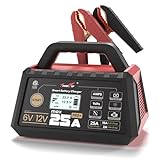
10. TowerTop 25A Pro+ Battery Charger, 6V/12V Car Battery Charger Fully Automatic Smart Battery Maintainer with Engine Start, Auto Desulfator, Battery Repair, for All Lead-Acid, AGM and LiFePO4 Batteries
Overview:
The TowerTop 25A Pro+ is a high-efficiency charger with 100A engine start capability for 6V/12V lead-acid and LiFePO4 batteries. Featuring 8-stage charging, adjustable current (up to 25A), and ETL certification, it targets users needing rapid, safe charging for cars, RVs, or marine applications.
What Makes It Stand Out:
Its 25A speed fully charges a 100Ah battery in 3.5 hours—1640% faster than 2A units—and the 100A engine start aids stubborn starts. The SMPS tech boosts efficiency to 85%, while six dedicated battery modes (including LiFePO4) and auto-desulfation offer precision unmatched by budget chargers.
Value for Money:
Priced premium but delivers exceptional speed, safety, and versatility. The engine start function eliminates separate jump starters, and energy efficiency reduces long-term costs. Worth the investment for frequent users of large batteries or mixed fleets.
Strengths and Weaknesses:
Strengths: Blazing 25A speed; engine start aid; LiFePO4 support; comprehensive safety; HD LCD; compact design. Weaknesses: Higher cost; manual mode needed for optimal control; repair mode limitations; not for permanent installation.
Bottom Line:
The ultimate all-in-one solution for speed, safety, and compatibility. Highly recommended for professionals or enthusiasts needing rapid, reliable charging across diverse battery types—just ensure temporary use only.
Understanding Your Multi-Vehicle Power Needs
Before diving into features, it’s crucial to accurately assess the specific demands of your household’s diverse power ecosystem. This foundational step ensures you select a solution that genuinely covers all your bases without overspending on unnecessary capabilities or, worse, falling short when critical.
Identifying Your Vehicle and Equipment Types
Start by cataloging every item requiring battery support. This includes not just daily drivers (cars, SUVs, trucks), but also seasonal vehicles (boats, RVs, motorcycles, ATVs), lawn and garden equipment (mowers, snowblowers), and even backup power sources like inverters or solar setups. Note the battery type for each – standard lead-acid (flooded, AGM, Gel) is most common, but newer electric vehicles (EVs) have specific 12V auxiliary battery needs, and lithium-ion is increasingly found in smaller equipment. Each type has distinct charging voltage and current requirements.
Calculating Required Power Output
Power output, measured in amps (A), is non-negotiable. A charger/jumper must deliver sufficient cranking amps (CA) or peak amps for jump-starting and appropriate charging amps for maintenance. Small cars might need 400-600 CA to start, while larger trucks or diesel engines can demand 1000+ CA. Charging speed depends on amp rating; a 2A charger is fine for maintenance but painfully slow for a dead battery, whereas 10A+ chargers revive batteries much faster. Crucially, ensure the unit supports the highest power demand in your household to avoid being stranded with an undersized tool.
Evaluating Battery Chemistry Compatibility
Modern batteries aren’t one-size-fits-all. AGM and Gel batteries, common in newer vehicles and premium equipment, require precise voltage control different from traditional flooded lead-acid. Lithium-ion batteries (increasingly in powersports and tools) have entirely different charging profiles and safety protocols. A truly versatile unit must explicitly support all the battery chemistries present in your garage or shed. Using an incompatible charger can severely damage batteries or create safety hazards, negating any perceived cost savings.
Essential Safety Features for Peace of Mind
Safety isn’t a luxury feature; it’s the bedrock of any device handling significant electrical power, especially when used by non-professionals in home settings. Prioritizing robust safety mechanisms protects your vehicles, your property, and most importantly, you and your family.
Spark-Proof and Reverse Polarity Protection
Accidental short circuits or reversed clamp connections are common mistakes, especially in a hurry. Look for units boasting “spark-proof” technology, which intelligently detects connections before allowing current flow, preventing dangerous sparks near the battery. Equally vital is reverse polarity protection – if you accidentally swap the positive and negative clamps, this feature instantly cuts power, preventing catastrophic damage to the charger, the vehicle’s electrical system, or even battery explosion. This is non-negotiable for household use.
Overcharge and Overheat Safeguards
Leaving a charger unattended, even for maintenance, requires trust. Overcharge protection automatically switches to a safe float/maintenance mode once the battery is full, preventing gassing, overheating, and shortened battery life. Overheat protection is equally critical; if the unit’s internal temperature rises dangerously (e.g., in a hot garage or during extended jump-start attempts), it will throttle power or shut down completely to prevent component failure or fire risk. These features are essential for reliable, set-and-forget operation.
Short Circuit and Fault Detection
Electrical faults happen. A quality unit continuously monitors the circuit. If it detects a short circuit (like clamps touching accidentally), it immediately interrupts power. Advanced models also feature fault detection that identifies potential battery issues (like internal shorts or sulfation) and alerts the user, often through error codes on a display, preventing futile charging attempts or highlighting a battery that needs replacement. This diagnostic capability adds significant value beyond basic function.
Performance and Usability Considerations
Beyond raw power and safety, the day-to-day experience of using your charger/jumper significantly impacts its value. Features affecting ease of use, speed, and integration into your routine make a substantial difference in whether the tool gets used correctly and consistently.
Charging Speed and Efficiency
Time is precious. While jump-start capability is the emergency hero, routine charging efficiency matters for maintenance. Higher amp ratings (e.g., 8A, 10A, 15A) recharge deeply discharged batteries much faster than 1A or 2A units. Look for units with multiple charging stages (bulk, absorption, float) that optimize the process for speed and battery health. Smart chargers adjust the current dynamically based on the battery’s state, maximizing efficiency without the risk of overcharging associated with older “dumb” chargers.
Portability and Storage Practicality
Consider where you’ll store it and where you’ll use it. Will it live in a crowded garage cabinet, the trunk of a car, or a utility closet? Weight and size vary significantly. While heavy-duty units for large trucks offer immense power, they might be cumbersome for quick tasks like jumping a lawnmower. Compact, lightweight designs with integrated handles or carrying cases enhance usability across diverse scenarios within your property. Also, consider cable length – longer cables (3-4+ feet) offer crucial flexibility when accessing batteries in tight engine compartments.
User Interface and Display Clarity
A confusing interface leads to errors or disuse. Prioritize units with clear, intuitive displays showing critical information: battery voltage, charging status (bulk/absorption/float), amp draw, and any error codes. Backlit displays are invaluable for working in dim garages or at night. Simple, well-labeled buttons or dials for mode selection (e.g., 6V/12V, battery type) prevent mistakes. Avoid overly complex menus unless the benefits (like advanced diagnostics) clearly outweigh the learning curve for your household.
Advanced Features for Modern Households
Technology has transformed battery management from a simple chore into a sophisticated aspect of vehicle ownership. Modern features offer enhanced control, diagnostics, and integration, providing tangible benefits for households managing multiple assets.
Smart Technology and App Connectivity
The rise of Bluetooth and companion smartphone apps adds a layer of convenience and insight. Track charging progress remotely, receive notifications when charging is complete or if an error occurs, access detailed battery health reports (voltage trends, estimated capacity), and sometimes even control settings from your phone. For households with multiple users or vehicles spread across locations (e.g., a boat at a marina), this remote monitoring capability is increasingly valuable for proactive maintenance.
Multi-Stage Charging Intelligence
Gone are the days of simple “on/off” chargers. True multi-stage charging (typically 4-8 stages) is essential for battery longevity. It starts with a high-current bulk phase, transitions to a controlled absorption phase to safely reach full capacity, and finally settles into a maintenance (float) mode. Advanced units add desulfation stages to gently recover mildly sulfated batteries and reconditioning cycles to extend overall battery life. This intelligence ensures optimal charging for health and performance, far surpassing basic trickle chargers.
Additional Power Ports and Versatility
Many modern units double as portable power stations. Built-in USB ports (A and C) for charging phones and tablets, 12V DC accessory ports for powering air compressors or coolers, and even AC inverters (turning DC battery power into standard household AC) add immense utility. This transforms the device from a single-purpose tool into a versatile power hub for the garage, workshop, or even emergency home backup, justifying its presence in a multi-vehicle household toolkit.
Durability and Long-Term Value
A charger/jumper is an investment meant to last through years of seasonal use and occasional emergencies. Assessing build quality and warranty terms is crucial for ensuring it delivers reliable service when you need it most, avoiding the cost and hassle of frequent replacements.
Build Quality and Environmental Resistance
Garages and sheds expose tools to harsh conditions – temperature extremes, dust, moisture, and occasional bumps. Look for robust housings made from high-impact plastics or metal alloys. Sealed components protect against dust and light moisture ingress (check IP ratings if available). Thick, abrasion-resistant cables with sturdy, corrosion-resistant clamps (preferably with insulated hooks) ensure reliable connections and longevity. A well-built unit withstands the rigors of home use far better than a flimsy alternative.
Warranty Coverage and Support
A strong warranty reflects the manufacturer’s confidence in their product. Look for warranties of 3 years or more; 5 years is increasingly common for reputable brands. Pay attention to what’s covered – does it include accidental damage protection, or is it strictly for manufacturing defects? Accessible customer support, clear documentation (including online resources), and readily available replacement parts (like fuses or specific cable connectors) significantly enhance the long-term value proposition and user confidence.
Total Cost of Ownership Perspective
While the initial purchase price is visible, consider the total cost over the unit’s lifespan. A slightly more expensive charger with superior safety features, multi-chemistry support, and robust build quality that lasts 8+ years offers far better value than a cheap unit that fails after two seasons or damages a $200 AGM battery due to incompatible charging. Factor in the potential savings from avoided roadside calls, extended battery life from proper charging, and the utility of extra features like USB ports. True value lies in reliable performance and problem prevention.
Integrating Charging into Your Household Routine
Owning the right tool is only half the battle; establishing simple maintenance habits ensures it effectively prevents the dead-battery emergencies that disrupt your life. Making battery care a seamless part of your schedule pays dividends in reliability.
Creating a Proactive Maintenance Schedule
Don’t wait for a failure. Establish a simple calendar for checking all vehicle and equipment batteries. For vehicles driven infrequently (weekend cars, RVs, boats), check monthly. For seasonal equipment (mowers, snowblowers), check before and after the season. Use your smart charger to perform regular maintenance charging sessions, especially during storage periods. Many units have dedicated storage modes that keep batteries optimally charged for months without overcharging. Consistency is key to preventing sulfation and capacity loss.
Safe Storage and Accessibility Practices
Store your charger/jumper in a dry, temperate location – extreme cold or heat degrades both the unit and its internal components over time. Keep cables neatly coiled (avoiding sharp bends) and clamps protected to prevent corrosion. Ensure it’s easily accessible when needed; burying it under boxes defeats its purpose in an emergency. Consider mounting it on a garage wall near a power outlet for quick connection, but ensure it’s out of reach of children and protected from direct impact.
Educating All Household Users
Ensure everyone in the household who might need to use the device understands the basic safety procedures and operation. A quick 5-minute demonstration on proper clamp connection sequence (positive first, negative to a grounded metal point away from the battery), recognizing basic status lights, and the importance of not forcing connections prevents accidents and misuse. Clear labeling near the storage spot with key safety reminders reinforces good habits.
Frequently Asked Questions
Frequently Asked Questions
Can one charger safely handle both my car’s AGM battery and my lawnmower’s standard lead-acid battery? Yes, but only if the charger explicitly lists compatibility with both AGM and standard flooded lead-acid (SLA) chemistries. AGM requires slightly higher voltage settings, so a “smart” charger that automatically detects or allows manual selection of battery type is essential for safe and effective charging of both.
How long does it typically take to fully charge a completely dead car battery? Charging time depends heavily on the battery’s capacity (measured in Amp-hours, Ah) and the charger’s output amperage. As a rough estimate, a standard 50Ah car battery completely drained might take 8-12 hours on a 5A charger, but only 3-5 hours on a 10A charger. Always refer to the charger’s manual for specific calculations; never rush charging with excessively high amps.
Is it safe to leave a smart charger connected to a battery for weeks during storage? Yes, this is a primary function of modern multi-stage smart chargers. Once the battery is fully charged, they automatically switch to a safe maintenance (float) mode that provides just enough voltage to counteract self-discharge without overcharging or causing damage, making them ideal for seasonal storage.
What’s the difference between cranking amps (CA) and peak amps for jump-starting? Cranking Amps (CA) represent the sustained power a unit can deliver for about 30 seconds to start an engine – this is the critical rating for reliability. Peak Amps are a much higher, very brief surge (fractions of a second) that can help overcome initial resistance but are less indicative of true starting capability. Always prioritize the CA or CA-equivalent rating.
Can these units jump-start a vehicle with a completely dead battery? Yes, that’s a core function. However, effectiveness depends on the unit’s cranking amp rating matching or exceeding the vehicle’s requirement and the battery not being physically damaged (e.g., shorted cells). Extremely cold temperatures can also reduce effectiveness. Always follow the specific jump-start procedure outlined in the unit’s manual.
Do I need a special charger for my motorcycle or ATV battery? Often, yes. Smaller batteries (common on motorcycles, ATVs, and lawn equipment) have lower capacity and can be damaged by chargers designed only for large automotive batteries. Look for chargers with lower amp settings (1A-2A) specifically designed for small 12V or even 6V batteries, or units with automatic detection for smaller capacities.
Why is reverse polarity protection so important? Accidentally connecting the positive clamp to the battery’s negative terminal (or vice versa) creates a direct short circuit. Without protection, this can cause massive sparks, melt cables, destroy the vehicle’s electrical system, damage the charger, and potentially cause a fire or battery explosion. Protection circuits instantly cut power to prevent this catastrophic scenario.
Can a battery charger/jumper revive a battery that’s been dead for months? It depends on the cause of death. If the battery is simply deeply discharged (sulfated), a smart charger with a dedicated desulfation or reconditioning mode might recover it over many hours. However, if the battery is old, has damaged plates, or is physically compromised (e.g., low electrolyte, shorted cells), recovery is unlikely, and replacement is necessary. The charger will often indicate if recovery is possible.
Are lithium battery chargers different from lead-acid chargers? Absolutely. Lithium-ion (LiFePO4 is common for 12V) batteries have vastly different voltage profiles, charging requirements, and critical safety needs compared to lead-acid. Using a standard lead-acid charger on a lithium battery can be extremely dangerous, causing fire or explosion. Only use a charger explicitly designed and labeled for the specific lithium chemistry in your battery.
How can I tell if my battery is failing and needs replacement, not just recharging? Signs include consistently slow cranking even after a full charge, needing frequent jump-starts, visible swelling or leakage, corroded terminals that cleaning doesn’t fix, and a battery that won’t hold a charge for more than a day or two. Many smart chargers also provide diagnostic feedback (like “bad battery” indicators or low capacity readings) during the charging process.
See Also
- 10 Best All-in-One Jump Starters for Multi-Vehicle Households in 2026
- 10 Best Battery Chargers with Jump Start for DIY Mechanics in 2026
- 10 Affordable Battery Chargers with Jump Start That Don’t Sacrifice Quality in 2026
- 10 Best Value Jump Starters for Multi-Vehicle Households in 2026
- How to Jump-Start and Charge Any Vehicle with a Jump Starter Battery Charger