Table of Contents
Ever been in the middle of a weekend project, wrench in hand, only to hear that dreaded click instead of your engine roaring to life? That sinking feeling when your battery’s dead and you’re stranded in your own garage is all too familiar for DIY mechanics. It’s not just an inconvenience; it halts your momentum, wastes precious hours, and can turn a satisfying afternoon of tinkering into pure frustration. But what if you could reclaim that control, transforming a potential disaster into a quick, confident fix right there in your driveway? The right battery charger with integrated jump-start capability isn’t just a tool; it’s your personal pit crew, ready to rescue your project and get you back to what you love – working on your vehicles.
For the dedicated DIY mechanic, relying solely on jumper cables and a neighbor’s goodwill is a recipe for dependency and delay. A dedicated charger/jumper combo empowers you with independence, safety, and efficiency. It’s the difference between waiting hours for help and solving the problem in minutes, all while actively maintaining your battery’s health for fewer future headaches. As technology evolves, these devices are becoming smarter, safer, and more versatile, offering features specifically designed to meet the nuanced demands of home garages. Choosing the best one for your specific needs – considering your vehicles, workspace, and technical comfort – is crucial for maximizing this essential piece of equipment. Let’s dive into the key factors that truly matter when selecting your ultimate garage guardian.
Top 10 Battery Chargers with Jump Start
Detailed Product Reviews
1. Schumacher Electric 6A Car Battery Charger and 100A Engine Starter, 5-in-1 Solution, Maintainer, 30A Boost, for 6V/12V Power Sport, Automotive, and Marine Batteries, SC1281

Overview:
This Schumacher SC1281 is a versatile 5-in-1 device designed for comprehensive battery management. It handles charging, starting, maintenance, testing, and reconditioning for 6V/12V batteries across automotive, marine, and power sports applications. Its smart technology targets common battery issues like sulfation.
What Makes It Stand Out:
The standout feature is its integrated desulfation mode, actively extending battery life by reversing sulfation damage—rare in mid-range chargers. The 100A engine start capability and compatibility with AGM, gel, and deep-cycle batteries offer exceptional versatility. The auto-maintainer function safely preserves batteries during storage without overcharging.
Value for Money:
Priced competitively, it delivers professional-grade functionality typically found in costlier units. While basic chargers lack reconditioning, this model’s all-in-one approach eliminates the need for separate tools, making it ideal for boat/RV owners needing reliable, long-term battery care.
Strengths and Weaknesses:
Strengths: Robust 100A start power; true 5-in-1 functionality; broad battery compatibility; effective desulfation; safe trickle charge.
Weaknesses: Bulkier than compact jump starters; no digital display for real-time diagnostics; manual mode requires user oversight.
Bottom Line:
A top-tier choice for marine/RV owners seeking a durable, multifunctional charger with life-extending reconditioning. It justifies its price through reliability and comprehensive features, though casual users may prefer simpler models.
2. TowerTop 2/10/25 Amp 12V Smart Car Battery Charger, Fully Automatic Battery Maintainer with Engine Start, Auto Desulfator, Battery Repair, Winter Mode, for AGM, STD, Gel, Deep Cycle Batteries

Overview:
The TowerTop 12V charger combines high-speed charging with intelligent maintenance for 12V lead-acid batteries. Its adaptive 4-stage current settings and 8-phase charging cycle cater to diverse battery types, from standard automotive to deep-cycle marine units.
What Makes It Stand Out:
An industry-leading 85% charging efficiency (vs. 75% average) enables 1640% faster charging than 2A units. The fully automatic operation—including voltage drop recovery and power-outage memory—ensures hands-off safety. The HD LCD screen provides real-time stage monitoring, while dedicated desulfation/repair buttons revive aging batteries.
Value for Money:
At its price point, it outperforms rivals with superior speed and automation. The energy savings and time efficiency justify the cost, especially for frequent users. Winter mode adds seasonal value, though 6V support is absent.
Strengths and Weaknesses:
Strengths: Exceptional 25A max charge speed; intuitive LCD interface; auto-restart after power loss; comprehensive battery repair; energy-efficient.
Weaknesses: 12V-only (no 6V support); “repair” mode ineffective on fully dead batteries; slightly noisy fan during high-amp charging.
Bottom Line:
An outstanding automatic charger for 12V systems, offering speed, safety, and battery revival at a fair price. Highly recommended for garages prioritizing convenience and longevity, but skip if you own 6V batteries.
3. Schumacher Electric Wheeled Manual 10A Car Battery Charger and 250A Engine Starter, 2-in-1 Solution, 50A Boost, for 6V/12V Power Sport, Automotive, and Marine Batteries, SC1445

Overview:
This rugged Schumacher SC1445 focuses on raw power delivery for stubborn batteries. As a wheeled 2-in-1 unit, it prioritizes high-amperage starting and charging over automation, targeting professional or heavy-duty use cases.
What Makes It Stand Out:
The 250A engine start capability is exceptional for manual units, easily reviving diesel trucks or deeply discharged batteries. Precision manual control via a 135-minute timer allows tailored charging cycles, while the 50A/25A boost modes rapidly inject charge into dead cells.
Value for Money:
It’s a cost-effective powerhouse for workshops needing brute-force starting without smart-tech premiums. Cheaper than automated competitors with similar amperage, though DIYers may find the manual process cumbersome.
Strengths and Weaknesses:
Strengths: Unmatched 250A starting power; robust 50A boost for dead batteries; durable wheeled design; broad 6V/12V compatibility; simple, reliable operation.
Weaknesses: No automatic features or maintenance mode; timer requires manual adjustment; heavier and less portable than compact chargers.
Bottom Line:
A no-nonsense workhorse for mechanics or fleet managers tackling severely depleted batteries. Skip if you prefer “set-and-forget” convenience, but ideal for pros valuing raw power and control.
4. Car Battery Charger Jump Starter with Air Compressor, 4500A Jumper Box for Car Battery Portable Booster Jump Pack, 12V Jumpstart Combo 150PSI Tire Inflator Air Pump(Up to 8.5L Gas/7.0L Diesel)

Overview:
This all-in-one jump starter integrates emergency starting, tire inflation, and power backup. Compact enough for trunk storage, it targets drivers seeking roadside self-sufficiency for dead batteries or flat tires.
What Makes It Stand Out:
The dual focus on 4500A jump-starting (for 8.5L gas engines) and a 150PSI cordless air compressor is compelling. Ten safety protections—including reverse-polarity and spark-proof tech—enhance reliability, while preset inflation modes simplify tire repairs.
Value for Money:
Bundling a jump starter, air pump, and power bank at this price beats buying separate tools. The inclusion of nozzles, cases, and cables adds practical value, though compressor speed lags behind standalone inflators.
Strengths and Weaknesses:
Strengths: Reliable jump-starting in extreme temps; versatile 4-in-1 functionality; comprehensive safety suite; portable design; includes essential accessories.
Weaknesses: Air pump slower than competitors; no advanced diagnostics; limited power bank capacity; basic pressure gauge.
Bottom Line:
An excellent emergency kit for daily drivers, combining essential rescue tools affordably. Not for heavy-duty fleet use, but perfect for peace of mind on routine commutes.
5. Portable 10-in-1 Car Battery Jump Starter with Air Compressor 8000A 160PSI 45W Charger, Jump Starter Jump Box (All Gas 14L Diesel), Car Battery Jumper Starter Portable Jumper Cables, Gloves, Lights

Overview:
This premium jump starter redefines portability with 10 integrated functions, including industry-leading 8000A peak current and a high-speed air compressor. Designed for extreme reliability, it handles everything from diesel trucks to emergency lighting.
What Makes It Stand Out:
FORCE START technology revives completely dead batteries, while the 160PSI inflator achieves 3x faster fills than rivals. PD45W bidirectional charging powers laptops, and the 3.3" smart display with ±1 PSI accuracy eliminates guesswork. 800-lumen emergency lights and included gloves enhance safety.
Value for Money:
Despite a higher price, its pro-grade specs justify the cost for frequent travelers. The 24-month standby time, 1000+ recharge cycles, and multi-device charging offer long-term savings over basic models.
Strengths and Weaknesses:
Strengths: Unrivaled 8000A capability; ultra-fast 3.3" display inflator; PD45W laptop charging; 400% brighter emergency lights; retractable handle.
Weaknesses: Premium cost; complex interface for casual users; bulkier than minimalist jump starters.
Bottom Line:
The ultimate road-trip companion for adventurers needing maximum power and versatility. Worth the investment for serious off-roaders or those prioritizing cutting-edge reliability over budget options.
6. YONHAN Battery Charger 10-Amp 12V and 24V Fully-Automatic Smart Car Battery Charger, Battery Maintainer Trickle Charger, and Battery Desulfator with Temperature Compensation

Overview: The YONHAN 10A charger is a versatile 12V/24V solution designed for automotive and marine lead-acid batteries (AGM, GEL, Flooded). It combines charging, maintenance, trickle charging, and desulfation in one compact unit, prioritizing safety and adaptability for seasonal use.
What Makes It Stand Out: Its dual-voltage capability, temperature-compensated charging (with dedicated winter/summer modes), and clear backlit LCD displaying real-time metrics (voltage, current, mode) set it apart. The advanced repair mode uses pulse technology to revive sulfated batteries, while automatic mode recall after power loss adds convenience.
Value for Money: Priced competitively for its 10A output and all-in-one functionality, it outperforms basic trickle chargers. The inclusion of desulfation and temperature adaptation justifies a moderate premium over simpler models, especially for users in extreme climates needing reliable winter maintenance.
Strengths and Weaknesses: Strengths: Comprehensive safety features (reverse polarity, short-circuit protection), intuitive LCD, effective desulfation, and broad compatibility. Weaknesses: Cannot revive completely dead batteries (<0.3V), limited to lead-acid types (no lithium support), and requires clean terminals for reliable detection.
Bottom Line: An excellent, user-friendly choice for seasonal vehicle owners seeking a safe, all-in-one maintainer with smart diagnostics. Ideal for winter storage but avoid for lithium batteries or severely damaged cells.
7. Schumacher Electric 6A Car Battery Charger and 50A Engine Starter, 4-in-1 Solution, Maintainer, 10A Boost, for 12V Power Sport, Automotive, and Marine Batteries, SC1361

Overview: Schumacher’s SC1361 is a 4-in-1 12V charger offering engine starting (50A), boost charging (10A), maintenance, and battery reconditioning. It targets automotive, marine, and powersport users needing rapid power restoration and long-term care for standard/AGM batteries.
What Makes It Stand Out: The integrated 50A engine start function is rare at this tier, enabling jump-starts without another vehicle. Its smart desulfation mode extends battery life, while automatic voltage detection and maintenance charging prevent overcharging during storage.
Value for Money: Delivers exceptional utility for its price. The engine-start capability alone provides significant value over pure chargers, making it cost-effective for emergency roadside use. Outperforms cheaper 2A–6A maintainers in speed and versatility but lacks multi-voltage (6V) support.
Strengths and Weaknesses: Strengths: Powerful engine start/boost functions, reliable desulfation, AGM compatibility, and compact design. Weaknesses: Max 6A maintenance rate is slow for large batteries, no 6V support, and lacks a detailed LCD (basic LED indicators only).
Bottom Line: A top pick for drivers prioritizing emergency jump-start capability alongside smart maintenance. Best for 12V systems where rapid power recovery is critical, though not ideal for deep-cycle or 6V applications.
8. Schumacher Electric Wheeled Manual 10A Car Battery Charger and 200A Engine Starter, 2-in-1 Solution, 40A Boost, for 6V/12V Power Sport, Automotive, and Marine Batteries, SC1446

Overview: The SC1446 is a heavy-duty, wheeled 6V/12V charger/starter built for trucks, boats, and equipment. It delivers robust 200A engine starts, 40A boost charging, and manual 10A maintenance, emphasizing user control over automation.
What Makes It Stand Out: Unmatched starting power (200A) and high boost currents (40A for 12V, 20A for 6V) cater to large engines. Its manual 135-minute timer allows precise charge management, while 6V compatibility and deep-cycle support broaden its utility beyond standard automotive use.
Value for Money: Justifies its cost for commercial/fleet users needing brute-force starting and multi-voltage flexibility. The wheeled design enhances portability for workshops, though DIYers may find it overpowered for small vehicles compared to smart automatic models.
Strengths and Weaknesses: Strengths: Exceptional starting/boost capacity, 6V support, rugged build, and manual timer control. Weaknesses: No automatic desulfation or maintenance mode; requires user monitoring. Bulky compared to compact smart chargers, lacking LCD diagnostics.
Bottom Line: A workshop essential for mechanics or owners of large vehicles/equipment requiring high-amperage starts and 6V charging. Skip if you prefer hands-off, automated maintenance for everyday cars.
9. TowerTop 25A Pro+ Battery Charger, 6V/12V Car Battery Charger Fully Automatic Smart Battery Maintainer with Engine Start, Auto Desulfator, Battery Repair, for All Lead-Acid, AGM and LiFePO4 Batteries
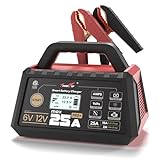
Overview: TowerTop’s 25A Pro+ is a high-speed, fully automatic charger supporting 6V/12V lead-acid and LiFePO4 batteries. It emphasizes rapid charging (25A max), smart diagnostics, and lithium compatibility via six tailored charging modes.
What Makes It Stand Out: Industry-leading 25A speed (1640% faster than 2A chargers) and LiFePO4 support are key differentiators. Its ETL-certified safety suite, 8-stage charging, and 100A engine-start aid deliver exceptional versatility. The HD LCD provides real-time insights, while SMPS efficiency reduces size/weight by 60–70%.
Value for Money: Premium pricing is warranted by LiFePO4 compatibility, unmatched speed, and robust safety features. Beats lower-amp chargers in time savings for large batteries (e.g., RVs), though overkill for small motorcycles. The all-in-one design replaces multiple single-purpose units.
Strengths and Weaknesses: Strengths: Blazing-fast charging, LiFePO4/6V support, comprehensive safety, and detailed LCD. Weaknesses: Higher cost than basic chargers; repair mode limitations on dead batteries. Engine start is temporary (100s only).
Bottom Line: The best investment for RV/marine owners or lithium-battery users needing speed, safety, and future-proof compatibility. Avoid only if budget-constrained for simple 12V maintenance.
10. YONHAN Battery Charger 20A 12V/24V LiFePO4 Lead Acid Fully Automatic Battery Maintainer, Car Battery Trickle Charger Automotive w/Repair, Winter Mode, for AGM, STD, Gel, Deep Cycle Batteries

Overview: YONHAN’s 20A charger handles 12V/24V lead-acid and LiFePO4 batteries with 7-stage charging, repair mode, and winter/summer adaptation. It targets users needing fast, automated care for diverse vehicles—from cars to forklifts—without lithium compatibility caveats.
What Makes It Stand Out: Dual-voltage (12V/24V) support combined with LiFePO4 charging is rare. Its extra-large LCD excels in sunlight readability, displaying detailed metrics. Winter mode and pulse repair enhance longevity, while 20A speed (12V) significantly cuts charge times versus 6A–10A units.
Value for Money: Competitive for a 20A dual-voltage charger with LiFePO4 support. Faster than Products 6/7 yet more affordable than TowerTop’s 25A model. Ideal for fleet managers or boaters needing one charger for varied 12V/24V systems, though the repair mode has limitations.
Strengths and Weaknesses: Strengths: Dual-voltage flexibility, clear LCD, LiFePO4 compatibility, and robust winter mode. Weaknesses: Not a jump starter; repair mode ineffective on dead batteries (<0.3V). Shorter output cables (65cm) than some rivals.
Bottom Line: A versatile, high-value solution for 24V systems (trucks, boats) or users with mixed lead-acid/LiFePO4 batteries. Choose over Product 6 for speed and lithium support, but skip if jump-starting is essential.
Understanding Core Functionality: Charger vs. Jumper
Defining the Dual-Purpose Device
It’s vital to distinguish between a basic trickle charger and a true charger/jumper combo. While all units in this category maintain and recharge batteries, the critical differentiator is the integrated jump-start function. This isn’t merely about boosting amps; it’s about the device’s ability to safely deliver a high current surge instantly to crank a stubborn engine, mimicking the role of another vehicle’s battery without needing one present. Understanding this core dual functionality – sustained charging for health and immediate high-power delivery for rescue – is the foundation for your selection.
The Critical Role of Cranking Amps (CA) and Peak Amps
When evaluating jump-start capability, focus on Cranking Amps (CA) and Peak Amps. CA represents the sustained current the unit can deliver for about 30 seconds, simulating the actual engine cranking demand. Peak Amps is a much higher, very short burst (fractions of a second) designed purely to initiate the jump. For most standard gasoline engines (4-cylinder to V8), a minimum of 400-600 CA is generally sufficient. Diesel engines or vehicles in extreme cold often demand significantly higher CA (800+). Prioritize CA specs over the often-misleadingly high Peak Amp numbers heavily advertised.
Charging Profiles: Beyond Simple Top-Ups
Modern chargers go far beyond dumping raw power into a battery. Look for units offering multiple, selectable charging profiles. A basic “Standard” or “Fast Charge” mode is common, but advanced units include “Maintenance,” “Recondition,” and crucially, profiles specifically tuned for different battery chemistries like Flooded Lead-Acid (FLA), Absorbed Glass Mat (AGM), and increasingly, Lithium-Iron Phosphate (LiFePO4). Using the correct profile is essential for optimal charging, maximizing battery lifespan, and preventing damage, especially with sensitive AGM or newer lithium batteries.
Power Requirements and Vehicle Compatibility
Matching Charger Power to Your Fleet
Your choice hinges directly on the vehicles you own and maintain. A compact car with a small 4-cylinder engine has vastly different demands than a full-size truck with a diesel V8 or a performance vehicle with high electrical loads. Honestly assess your largest engine and consider worst-case scenarios (extreme cold weather). Undersizing leaves you stranded; oversizing is unnecessary bulk and cost. A unit rated for 700-1000 CA comfortably handles most gasoline-powered trucks and SUVs, while serious diesel work often requires 1500+ CA.
The Growing Importance of Lithium Battery Support
Lithium (LiFePO4) batteries are rapidly gaining popularity in automotive applications due to their lighter weight, longer cycle life, and faster charging. However, they require completely different charging algorithms than lead-acid batteries. If you own or plan to install a lithium battery, verifying explicit LiFePO4 charging and jump-start support is non-negotiable. Using a charger designed only for lead-acid on a lithium battery can be ineffective at best and dangerous at worst. This compatibility is becoming a standard requirement, not a niche feature.
Cold Cranking Amps (CCA) vs. Charger Ratings
Don’t confuse your battery’s Cold Cranking Amps (CCA) rating with the charger’s jump-start rating. CCA is a battery specification indicating its ability to start an engine in cold weather. The charger’s CA/peak rating indicates its ability to provide that starting power to the battery. As a rough rule of thumb, your charger’s CA rating should be at least equal to, and preferably 1.5x, your battery’s CCA rating for reliable cold-weather jumps. A battery rated at 600 CCA ideally needs a charger capable of 900 CA or more for dependable winter starts.
Essential Safety Features for the Home Garage
Spark-Proof Technology: Non-Negotiable Protection
This is arguably the most critical safety feature. Spark-proof technology (often called “reverse polarity protection” or “spark-free connection”) ensures that no dangerous sparks occur when you attach the clamps to the battery terminals, even if you accidentally touch them together or connect them in the wrong order. Given the flammable hydrogen gas batteries can emit, preventing sparks during connection is paramount for preventing explosions, especially in the confined space of a home garage. Never compromise on this feature.
Comprehensive Reverse Polarity Protection
Accidentally swapping the positive and negative clamps is a surprisingly common mistake, especially in low-light garage conditions. Robust reverse polarity protection instantly detects this error and prevents any current flow, safeguarding both your vehicle’s sensitive electronics (which can be fried by reverse current) and the charger itself from damage. Look for systems that provide clear visual (and sometimes audible) warnings to alert you of the mistake before you proceed.
Overcharge, Over-Heat, and Short-Circuit Safeguards
A quality unit incorporates multiple layers of electronic protection. Overcharge protection automatically switches to a safe float/maintenance mode once the battery is full, preventing damage from prolonged high-voltage charging. Over-heat protection shuts down the unit if internal components get too hot, crucial during extended use or in warmer environments. Short-circuit protection instantly cuts power if the clamps touch each other or create a direct short, preventing fire hazards and component meltdown. These aren’t luxuries; they’re essential for safe, unattended operation.
Portability, Durability, and Ease of Use
Size, Weight, and Ergonomic Design
Consider where you’ll store and use the unit. Will it live permanently in your garage, or do you need to carry it to the vehicle, or even occasionally take it on the road? Units range from compact, lightweight (5-10 lbs) portable jump boxes to larger, heavier (20+ lbs) workshop chargers. Evaluate handle design, cable length and thickness (thicker = better current flow, but less flexible), and overall footprint. A cumbersome unit you dread moving is less likely to be used promptly when needed.
Build Quality for the Real-World Garage
Your garage isn’t a cleanroom. Look for chargers built with durable, impact-resistant plastics that can withstand bumps, drops, and the occasional solvent splash. Rubber overmolds on critical areas add grip and shock absorption. Check the quality of the clamp construction – robust, corrosion-resistant metal (like copper) with strong springs ensures a solid connection to dirty or corroded terminals, which is half the battle in a real-world DIY scenario. Avoid flimsy, overly lightweight constructions.
Intuitive Controls and Clear Feedback
When you’re frustrated with a dead battery, the last thing you need is a confusing interface. Prioritize units with clear, easy-to-understand indicators: LED lights showing power status, charging mode, fault conditions (like reverse polarity), and battery voltage/state-of-charge. Simple, well-labeled buttons for mode selection (charge, jump, boost) are essential. Digital voltage displays are highly valuable for diagnosing battery health beyond just jump-starting. Avoid overly complex menus or tiny, hard-to-read displays.
Advanced Features Enhancing DIY Experience
Integrated Power Inverters: Beyond Jumping
Some higher-end units incorporate a built-in AC power inverter (e.g., 100W, 200W, 400W). This transforms the DC power from the charger’s internal battery (or the vehicle battery it’s connected to) into standard household AC power. Suddenly, your charger becomes a versatile power source for running a trouble light, phone charger, small air compressor, or laptop right in the garage or at the roadside – a significant bonus for extended projects or emergencies.
USB Charging Ports for Modern Needs
It’s almost expected now. Multiple USB ports (often including USB-A and USB-C) allow you to conveniently charge phones, tablets, diagnostic tools, or Bluetooth scanners directly from the unit while you’re working on the vehicle. This seemingly small feature adds tremendous practical utility during diagnostics or simply staying connected while you wait for a charge cycle to complete.
Battery Health Diagnostics and Testing
Moving beyond simple charging, advanced units offer diagnostic capabilities. They might perform a quick test to indicate the battery’s overall health (good, weak, replace), measure internal resistance, or display real-time voltage during charging/jumping. This diagnostic insight is invaluable for the DIY mechanic, helping you determine if the dead battery was just drained or if it’s actually failing and needs replacement, saving time on future guesswork.
Maximizing Value and Long-Term Use
Understanding Warranty and Support Realities
Warranties vary significantly, from 1 year to 3+ years. A longer warranty often (but not always) indicates the manufacturer’s confidence in the product’s durability. Pay close attention to what the warranty covers – is it just the charger, or does it include coverage for damage caused to your vehicle by the charger (a rare but critical distinction)? Research the brand’s reputation for honoring warranties and providing responsive customer support; a great warranty is useless if claims are denied or support is nonexistent.
Total Cost of Ownership Perspective
While the initial purchase price is obvious, consider long-term value. A slightly more expensive unit with robust build quality, essential safety features, and compatibility with your current and future vehicles (like lithium support) will likely outlast and outperform a cheaper, feature-limited model that becomes obsolete or breaks quickly. Factor in the potential cost of damaging your vehicle’s electronics with an inferior charger – the “bargain” can become very expensive. Invest in capability you’ll rely on.
Maintenance Requirements for Your Charger
Your charger/jumper combo isn’t completely maintenance-free. Units with internal lead-acid batteries (common in jump boxes) require periodic recharging even when not in use to prevent sulfation and permanent damage – typically every 3-6 months. Lithium-based jump boxes have much lower self-discharge but still benefit from occasional top-ups. Check the manual for specific storage and maintenance instructions. Keeping the unit charged and ready ensures it will function when you desperately need it months after the last use.
Frequently Asked Questions
Frequently Asked Questions
What’s the most important feature for a DIY mechanic to prioritize? Spark-proof connection and robust reverse polarity protection are absolutely critical safety features that should never be compromised for home garage use.
Can I use the same charger for my car, motorcycle, and lawnmower? Yes, but ensure the charger has selectable profiles for different battery types (FLA, AGM) and sufficient low-amp settings suitable for smaller batteries like motorcycles and lawn equipment to prevent damage.
How often should I fully charge my battery charger/jumper itself? If it has an internal lead-acid battery, recharge it every 3-6 months even if unused. Lithium-based units can typically go 6-12 months. Always check the specific manufacturer’s recommendation.
Is a higher “Peak Amp” rating always better for jump-starting? Not necessarily. Focus on the sustained Cranking Amps (CA) rating, which reflects the actual power available to turn the engine. Peak Amps is a very brief surge and less indicative of real-world starting capability.
Why does my charger have different modes like “Recondition”? The Recondition mode uses a controlled overcharge cycle to break down sulfate crystals that build up on lead-acid battery plates during chronic undercharging, potentially restoring some lost capacity.
Can I leave the charger connected to my car battery indefinitely? Only if it has an automatic float/maintenance mode that switches to a safe, low-voltage trickle charge once the battery is full. Never leave a basic “dumb” charger connected unattended for long periods.
What should I do if the charger indicates a “Fault” when connecting? Immediately disconnect the clamps. The most common cause is reverse polarity (clamps on wrong terminals). Double-check connections. Other faults could indicate a severely dead battery, short circuit, or internal charger issue.
Are lithium battery compatible chargers significantly more expensive? They often carry a moderate premium due to the more complex charging circuitry required, but the price gap has narrowed considerably as lithium adoption increases in automotive applications.
How can I tell if my battery is actually dead or if it’s just the charger not working? Use a multimeter to check the battery voltage directly. Below 10V under load usually indicates a dead cell. Also, try the charger on a known-good battery if possible.
Can these chargers damage sensitive vehicle electronics like ECUs? High-quality chargers with proper voltage regulation, spike suppression, and reverse polarity protection are designed to be safe. Cheap, poorly made units without these safeguards pose a significant risk to modern vehicle electronics.
See Also
- 10 Affordable Battery Chargers with Jump Start That Don’t Sacrifice Quality in 2026
- 10 Best Battery Chargers with Jump Start for Multi-Vehicle Households in 2026
- 10 Premium Manual Battery Chargers for Off-Grid Mechanics (Worth the Investment)
- 2026’s Top 10 Jump Starter Chargers for Dead Battery Recovery
- How to Jump-Start and Charge Any Vehicle with a Jump Starter Battery Charger