Table of Contents
Ever opened the garage after months of storing your classic car, motorcycle, or seasonal vehicle only to face the dreaded silence of a completely dead battery? That sinking feeling when the engine won’t even crank is all too familiar for many vehicle owners. Long-term storage, whether due to seasonal changes, extended travel, or simply infrequent use, poses a significant threat to lead-acid and AGM batteries. Without proper care, sulfation sets in rapidly, permanently reducing capacity and lifespan, turning what should be a simple restart into a costly replacement or jump-start headache. It’s a preventable frustration that undermines the joy of owning and maintaining your prized vehicles.
This is where intelligent battery maintenance becomes non-negotiable. A dedicated battery maintainer, often called a trickle charger or smart charger, is the unsung hero of vehicle storage. Unlike old-fashioned trickle chargers that could overcharge and damage batteries, modern maintainers use sophisticated multi-stage charging technology to safely keep your battery at its optimal state of charge indefinitely. They’re not just chargers; they’re essential guardians against the slow death of inactivity. Understanding how to choose and use the right one isn’t just convenient—it’s fundamental to preserving your vehicle’s health and ensuring it fires right up when you’re ready to hit the road again. Let’s dive into the essential knowledge you need.
Top 10 Battery Maintainers
Detailed Product Reviews
1. NOCO GENIUS1: 1A 6V/12V Smart Battery Charger – Automatic Maintainer, Trickle Charger & Desulfator with Overcharge Protection & Temperature Compensation – for Lead-Acid & Lithium Batteries

Overview:
The NOCO GENIUS1 is a compact, 1A smart charger designed for 6V/12V lead-acid and lithium (LiFePO4) batteries. It functions as a charger, maintainer, trickle charger, and desulfator, targeting automotive, marine, and powersport applications with advanced safety and recovery features.
What Makes It Stand Out:
Its integration of temperature compensation via an ambient thermal sensor ensures optimal charging in extreme conditions, while “Force Mode” revives dead batteries down to 0V—a rarity in this class. The 35% smaller footprint and broader compatibility (including lithium) outpace competitors like the G750. Overcharge protection and indefinite maintenance capability enhance reliability.
Value for Money:
Priced mid-to-high range, it justifies cost through versatility (lead-acid + lithium), robust safety, and NOCO’s reputation for durability. Cheaper alternatives lack lithium support or reliable dead-battery recovery, making it a long-term investment for multi-battery owners.
Strengths and Weaknesses:
Strengths: Exceptional dead-battery recovery; lithium compatibility; temperature compensation; ultra-compact; safe for indefinite use.
Weaknesses: Lower amperage (1A) slows charging for large batteries; no LCD display for real-time metrics; higher price than basic maintainers.
Bottom Line:
Ideal for owners of lithium or diverse lead-acid batteries needing reliable maintenance and dead-battery revival. Despite the premium price, its safety, versatility, and NOCO’s engineering make it a top-tier choice for discerning users.
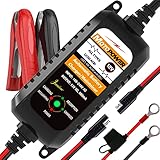
2. MOTOPOWER MP00205A 12V 800mA Automatic Battery Charger, Maintainer, Trickle and Desulfator
Overview:
This 800mA charger targets 12V lead-acid batteries (flooded, AGM, gel) as an all-in-one maintainer, trickle charger, and desulfator. ETL-certified and weather-resistant, it emphasizes safety and automated operation for seasonal vehicles or storage.
What Makes It Stand Out:
Its pulse-current desulfation works automatically during charging without manual input, while the 24-hour timer switches to maintenance mode at 13.6V to prevent gassing. Zero-output standby mode eliminates parasitic drain, and ETL/UL certification ensures robust safety compliance rare in budget units.
Value for Money:
An affordable entry point ($25–$35) for basic maintenance. Outperforms ultra-cheap no-name brands with certified safety and effective desulfation. Lacks multi-voltage support or lithium compatibility, but excels as a dedicated 12V solution for casual users.
Strengths and Weaknesses:
Strengths: Fully automatic desulfation; spark-proof connections; ETL safety certified; energy-efficient standby; budget-friendly.
Weaknesses: 800mA output is slow for larger batteries; no 6V support; no voltage display; limited to lead-acid chemistries.
Bottom Line:
A reliable, safety-focused maintainer for 12V lead-acid batteries in cars or motorcycles. Best for budget-conscious users prioritizing certified safety and hands-off operation over speed or multi-chemistry support.
3. [4-Pack]1.75-Amp Car Battery Charger, 6V and 12V Smart Fully Automatic Battery Charger Maintainer, Trickle Charger, Battery Desulfator for Car, Lawn Mower, Motorcycle, Boat, Marine Lead Acid Batteries
![[4-Pack]1.75-Amp Car Battery Charger, 6V and 12V Smart Fully Automatic Battery Charger Maintainer, Trickle Charger, Battery Desulfator for Car, Lawn Mower, Motorcycle, Boat, Marine Lead Acid Batteries](https://m.media-amazon.com/images/I/51rc2qpU9VL._SL160_.jpg)
Overview:
This 4-pack offers 1.75A smart chargers for 6V/12V lead-acid batteries (flooded, AGM, gel), featuring LCD displays, 7-stage charging, and desulfation. Targets multi-vehicle households with lawn mowers, boats, and motorcycles needing simultaneous charging.
What Makes It Stand Out:
The LCD screen provides real-time metrics (voltage, current, charge %), while the 7-stage program includes dedicated desulfation and repair modes. Forced 12V mode for low-voltage batteries and 6.6ft cords with versatile connectors enhance usability. Multi-protection safeguards cover all critical failure points.
Value for Money:
Unbeatable for managing multiple batteries—the 4-pack costs less per unit than single NOCO/MOTOPOWER chargers. Higher amperage (1.75A) speeds charging versus 1A alternatives. Ideal for fleet owners needing visual feedback and repair tech at scale.
Strengths and Weaknesses:
Strengths: LCD display clarity; 4-pack value; 1.75A speed; forced 12V mode; comprehensive protection; repair-focused stages.
Weaknesses: No lithium support; plastic build less durable than NOCO; inconsistent desulfation results on severely sulfated batteries.
Bottom Line:
The optimal budget solution for households with multiple 6V/12V lead-acid batteries. Prioritize this over single units if you need real-time monitoring, faster charging, and cost efficiency across several vehicles.
4. 2-Pack Smart Fully Automatic 6V 12V Battery Charger Maintainer for Car, Marine, Motorcycle, Lawn Mower

Overview:
Identical to Product 3 but sold as a 2-pack, this 1.75A charger supports 6V/12V lead-acid batteries with LCD displays, 7-stage charging, and desulfation. Shares all features of the 4-pack version but targets users needing fewer units.
What Makes It Stand Out:
Same standout LCD interface and 7-stage repair tech as Product 3, including forced 12V mode and SAE connector versatility. The 2-pack balances cost for dual-battery setups (e.g., car + boat), avoiding over-purchasing while retaining visual charging metrics.
Value for Money:
Slightly higher per-unit cost than the 4-pack, but logical for two-battery needs. Outperforms single-unit competitors (like MOTOPOWER) with its display and repair focus. Still excludes lithium, but excellent value for lead-acid-centric households.
Strengths and Weaknesses:
Strengths: Real-time LCD feedback; 1.75A speed; repair/desulfation modes; 2-year warranty; robust safety suite.
Weaknesses: Identical limitations to Product 3—no lithium; build quality not premium; desulfation effectiveness varies.
Bottom Line:
Choose this over the 4-pack if managing exactly two lead-acid batteries. It delivers the same smart, repair-oriented charging at a sensible quantity discount, ideal for car-and-motorcycle owners.
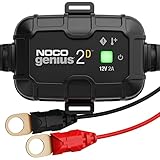
5. NOCO GENIUS2D: 2A 12V Smart Onboard Battery Charger - Direct-Mount Automatic Maintainer, Trickle Charger & Desulfator with Overcharge Protection & Temperature Compensation – for Lead-Acid Batteries
Overview:
The GENIUS2D is a 2A direct-mount charger exclusively for 12V lead-acid batteries, designed to install permanently under the hood. It combines charging, maintenance, and desulfation with thermal compensation for automotive and marine use.
What Makes It Stand Out:
Its snap-fit mounting bracket and weatherproof design enable permanent under-hood installation—unlike portable competitors. Temperature compensation and 0V recovery (“Force Mode”) mirror the GENIUS1, while 2A output speeds charging. Focuses on “set-and-forget” reliability for vehicles in storage.
Value for Money:
Priced higher than portable chargers ($60–$80), but justifies cost through permanent installation convenience and NOCO’s engineering. Beats DIY mounting kits with integrated thermal management. Limited to lead-acid, yet unmatched for garaged vehicles needing hands-off maintenance.
Strengths and Weaknesses:
Strengths: Permanent under-hood fit; 2A faster charging; thermal compensation; robust recovery modes; compact direct-mount design.
Weaknesses: 12V-only; no lithium support; no display for diagnostics; higher cost than basic maintainers.
Bottom Line:
The definitive solution for permanent under-hood maintenance on 12V lead-acid systems. Invest if you prioritize seamless integration and reliability over portability or multi-chemistry support.
6. 12v 2A Battery Charger, Trickle Charger for Lawn Mower Battery, Motorcycle, car, Boat, ATVs, Riding andMore -2000mA Battery Maintainer and Desulfator withIntelligent Interface

Overview: This 2A intelligent maintainer targets 12V lead-acid batteries across vehicles and equipment, emphasizing safety and desulfation to restore performance in dormant batteries like those in lawn mowers or motorcycles. What Makes It Stand Out: Its robust safety suite—reverse polarity, overload, and overvoltage protection—paired with a flame-retardant ABS shell ensures worry-free operation. The desulfation capability actively revives sulfated batteries, while clear LED indicators simplify status monitoring without manual intervention. Value for Money: Priced affordably, it outperforms basic trickle chargers by adding desulfation and multi-layer safety, eliminating the need for separate restoration tools. While not a fast charger, its focus on maintenance offers excellent longevity-focused value for infrequently used batteries. Strengths and Weaknesses: Strengths: Comprehensive safety features, effective desulfation, broad 12V compatibility (AGM/gel/flooded), and intuitive LEDs. Weaknesses: Slow 2A charging rate unsuitable for dead batteries, no lithium support, and lacks advanced climate compensation. Bottom Line: Ideal for maintaining seasonal vehicles, this charger excels as a safe, reliable “set-and-forget” solution for 12V lead-acid batteries, though its slow speed limits emergency use. A smart buy for storage-focused battery care.
7. MOTOPOWER MP00205A 12V 800mA Automatic Battery Charger, Battery Maintainer, Trickle Charger, and Battery Desulfator, 2 Pack

Overview: This ETL-certified 2-pack delivers compact 800mA charging/maintenance for 12V lead-acid batteries, featuring automatic desulfation and robust safety protocols for motorcycles, ATVs, or marine use. What Makes It Stand Out: Pulse-current desulfation operates automatically during charging, revitalizing sulfated batteries without user input. ETL/UL certification, spark-proof connections, and a 24-hour timer that switches to maintenance mode at 14V enhance safety and battery longevity. Value for Money: The dual-pack format offers exceptional value for multi-vehicle households or fleet maintenance. Its energy-saving standby mode (zero drain) and certified safety justify the cost versus single units, though the 800mA rate suits small batteries only. Strengths and Weaknesses: Strengths: True plug-and-play operation, certified safety, effective desulfation, and dual-pack convenience. Weaknesses: Low 800mA output too slow for larger automotive batteries, no voltage adjustment for extreme climates, and no lithium compatibility. Bottom Line: Perfect for maintaining small 12V batteries (e.g., motorcycles, ATVs) with effortless safety, this duo-pack is a cost-effective, reliable choice—just ensure your battery size matches its modest output.
8. Schumacher Electric 1.5A Car Battery Charger and Maintainer, 3-in-1 Solution, for 6V/12V Power Sport, Automotive, and Marine Batteries, SC1355

Overview: A versatile 1.5A charger serving as a 3-in-1 solution (charge/maintain/recondition) for 6V/12V lead-acid batteries across automotive, marine, and powersport applications. What Makes It Stand Out: The dedicated reconditioning mode actively combats sulfation to extend battery life—a rarity in this class. Smart trickle charging prevents overcharging, while dual-voltage support (6V/12V) and compatibility with AGM/deep-cycle types broaden its utility. Value for Money: Competitively priced for a multi-functional unit, it replaces separate chargers and desulfators. The 1.5A rate balances speed for maintenance tasks, making it a practical long-term investment versus single-mode trickle chargers. Strengths and Weaknesses: Strengths: Unique reconditioning feature, 6V/12V flexibility, AGM/deep-cycle support, and reliable maintenance. Weaknesses: No lithium compatibility, lacks advanced diagnostics (e.g., temperature compensation), and reconditioning cycle can be slow. Bottom Line: A well-rounded workhorse for mixed-battery households, especially valuable for its reconditioning capability. Best for standard lead-acid upkeep where lithium support isn’t needed.
9. Battery Tender Plus 12V 1.25 AMP Car & Motorcycle Battery Charger and Maintainer, Float Charge for Automotive, and ATVs - Smarter Than a Trickle Charger

Overview: This 1.25A “smarter” maintainer uses adaptive 4-step charging to optimize 12V battery health for cars, motorcycles, and ATVs, backed by a 10-year warranty. What Makes It Stand Out: The 4-step program (including recovery and float modes) precisely tailors charging to battery needs, while the quick-disconnect harness enables effortless seasonal storage use. Solid-state two-color LEDs provide unambiguous charge-status feedback. Value for Money: The decade-long warranty and lifetime support signal exceptional durability confidence. Though pricier than basic models, its precision charging reduces replacement costs, justifying the investment for critical or high-end batteries. Strengths and Weaknesses: Strengths: Industry-leading warranty, intuitive quick-disconnect system, precise 4-stage charging, and reliable performance. Weaknesses: 1.25A rate is slow for large batteries, no desulfation timer indicator, and limited to 12V lead-acid (no lithium/6V). Bottom Line: Unbeatable for hassle-free, long-term 12V battery preservation where reliability is paramount. The warranty and smart charging make it a premium yet prudent choice for enthusiasts.
10. NOCO GENIUS2: 2A 6V/12V Smart Battery Charger – Automatic Maintainer, Trickle Charger & Desulfator with Overcharge Protection & Temperature Compensation – for Lead-Acid & Lithium Batteries

Overview: A premium 2A smart charger supporting both lead-acid and lithium (LiFePO4) batteries, featuring zero-volt recovery, climate adaptation, and advanced maintenance cycles. What Makes It Stand Out: Force Mode revives dead batteries (<1V), while temperature compensation adjusts charging for hot/cold climates. Lithium compatibility and 24-hour reconditioning cycles set it apart, alongside its ultra-compact, efficient design. Value for Money: Highest upfront cost, but justifies it with unmatched versatility (lead-acid/lithium), future-proof tech, and robust build. Eliminates need for multiple chargers, offering superior long-term value for diverse battery ecosystems. Strengths and Weaknesses: Strengths: Lithium support, zero-volt recovery, climate adaptation, compact size, and automatic reconditioning. Weaknesses: Premium price, complex for casual users, and no 6V mode despite title claim. Bottom Line: The definitive all-in-one solution for modern garages with mixed battery types. Essential for lithium owners and extreme climates—worth every penny for its intelligence and breadth.
Understanding Battery Maintenance Fundamentals
The Science Behind Battery Degradation During Storage
When a vehicle sits unused, its battery slowly loses charge due to natural self-discharge and parasitic drain from onboard electronics like clocks and security systems. This gradual discharge leads to sulfation – the formation of hard lead sulfate crystals on the battery plates. Initially reversible, prolonged sulfation becomes permanent, drastically reducing capacity and cold cranking amps. Understanding this chemical process is key to appreciating why passive storage rarely works.
Why Standard Trickle Chargers Fall Short
Basic trickle chargers deliver a constant, low amperage charge regardless of the battery’s state. This outdated approach risks significant overcharging once the battery reaches full capacity. Overcharging causes excessive gassing, electrolyte loss (in flooded batteries), and accelerated grid corrosion, significantly shortening the battery’s life. They lack the intelligence to adapt, making them unsuitable for the “set it and forget it” demands of long-term storage.
The Multi-Stage Charging Advantage
Modern maintainers utilize a critical multi-stage process: Bulk (rapid recharge to ~80%), Absorption (topping off to 100% at controlled voltage), and crucially, Float (maintaining 100% charge at a safe, lower voltage). Some also include a Desulfation or Recovery stage to gently break down early sulfation. This intelligent cycling prevents overcharge, undercharge, and combats the primary storage killer – sulfation.
Voltage is King: Matching Your Battery Chemistry
The correct float voltage is paramount and varies significantly by battery type. Flooded lead-acid typically requires around 13.2-13.4V, while AGM and GEL batteries need a higher 13.5-13.8V for optimal maintenance. Using a maintainer set to the wrong voltage (e.g., flooded settings on AGM) will either undercharge (causing sulfation) or overcharge (causing damage). Ensuring your maintainer is specifically designed for or configurable to your battery chemistry is non-negotiable.
Key Features to Evaluate for Storage Success
Automatic Float Mode: The Essential Baseline
The absolute minimum requirement is a true automatic float mode. This isn’t just a low-amp setting; it’s an intelligent stage that only activates when needed to maintain 100% charge, then shuts off or reduces to a tiny maintenance current. Avoid any device that lacks this specific, labeled stage – it’s not a true maintainer for long-term use.
Temperature Compensation: Adapting to Real-World Conditions
Battery voltage requirements change with temperature. Cold temperatures necessitate a slightly higher float voltage, while heat requires a lower one. Maintainers with built-in temperature sensors automatically adjust the charging voltage, preventing undercharging in winter or dangerous overcharging in hot garages. This feature is especially critical for vehicles stored in environments with significant seasonal temperature swings.
Desulfation/Recovery Mode: Fighting the Storage Enemy
Look for maintainers explicitly offering a dedicated desulfation or recovery phase. This isn’t a quick fix for dead batteries, but a controlled, periodic process that applies specific voltage patterns to help dissolve early-stage sulfate crystals before they harden permanently. It’s a proactive defense mechanism vital for storage periods exceeding a few months.
Reverse Polarity Protection: A Critical Safety Net
Accidentally connecting the clamps backward can cause sparks, damage the maintainer, fry vehicle electronics, or even create a fire hazard. Robust reverse polarity protection (indicated by LEDs or automatic shutdown) is a fundamental safety feature that prevents catastrophic mistakes during setup, especially important for infrequent users.
Spark-Proof Connections: Safe Hookup Every Time
Quality maintainers are designed to be connected to the battery before being plugged into the wall outlet. Internal circuitry ensures no spark occurs when the clamps touch the terminals, significantly reducing the risk of igniting potentially flammable hydrogen gas emitted by batteries, particularly in enclosed spaces like garages.
Installation and Usage Considerations
Optimal Placement: Garage Safety and Accessibility
Position the maintainer itself safely away from direct battery exposure (acid, sparks), moisture sources, and high-traffic areas. Ensure the power cord and battery leads have a clear, unobstructed path without sharp bends or pinch points. Mounting on a wall hook or placing on a stable shelf is often ideal, keeping it visible but out of harm’s way.
Cable Length and Gauge: Practicality Matters
Evaluate the length of both the AC power cord and the battery leads. Leads that are too short create strain and unsafe tension; excessively long leads can be cumbersome. More importantly, ensure the lead gauge (thickness) is sufficient for the maintainer’s output – thinner wires over long distances can cause voltage drop, reducing effectiveness. 16-18 AWG is common for maintainers.
Terminal Compatibility: Matching Your Battery
Confirm the maintainer’s clamp style (alligator, ring terminal, SAE plug) matches your battery posts. While alligator clips are universal, ring terminals or SAE plugs offer more secure, permanent connections ideal for storage. Adapters are available, but a direct, snug fit is safest and most reliable for months-long use.
Maximizing Effectiveness and Longevity
The Pre-Storage Charge Imperative
Never connect a maintainer to a deeply discharged battery. Always fully charge the battery using an appropriate charger before initiating long-term storage with a maintainer. Starting from a low state accelerates sulfation during the initial recharge phase and puts unnecessary stress on both the battery and maintainer.
Periodic Visual Checks: Simple Vigilance
While designed for “set and forget,” a quick monthly visual check is wise. Look for secure connections, signs of excessive corrosion on terminals (clean if needed), and that the maintainer’s status lights indicate proper operation (e.g., showing “Float” or “Maintain” mode). This takes seconds but catches potential issues early.
Understanding Storage Duration Realities
No maintainer can work miracles on a battery already significantly degraded or deeply discharged before storage. They excel at maintaining a healthy, fully charged battery. If your battery is several years old or has shown previous weakness, consider replacing it before long-term storage, even with a maintainer. Prevention is cheaper than replacement.
Integration with Vehicle and Environment
Managing Parasitic Drain Awareness
Modern vehicles have numerous systems drawing small amounts of current even when off (computers, alarms, etc.). While a maintainer compensates for this, knowing your vehicle’s typical parasitic drain (often 20-50mA) helps set realistic expectations. A maintainer rated slightly above this drain (e.g., 1-2A output) ensures it can easily keep pace without constantly running in bulk/absorption mode.
Solar Charging Synergy: Off-Grid Storage Solutions
For vehicles stored where AC power isn’t available (boats on moorings, RVs in remote areas), solar panels paired with a compatible solar charge controller offer an excellent solution. Ensure the controller has a dedicated “battery maintainer” or “float” mode specifically designed for long-term storage, not just daily cycling. Standard solar controllers often lack the precise float control needed.
Winter Storage Nuances: Cold Weather Strategies
Extreme cold significantly slows chemical reactions and increases the risk of a battery freezing if discharged. Maintain full charge vigilantly. Temperature compensation becomes crucial here. Avoid placing the maintainer itself in freezing conditions if possible, as extreme cold can affect its electronics; route the leads so it stays in a slightly warmer spot while the battery end is at the vehicle.
Frequently Asked Questions
Frequently Asked Questions
How long can I safely leave a vehicle stored with a maintainer connected?
When using a properly matched, modern smart maintainer, you can typically leave it connected indefinitely – for years, not just months. The key is ensuring it has a true automatic float mode and is correctly set for your battery type.
Will a battery maintainer overcharge my battery?
A quality maintainer with true multi-stage charging, including automatic float mode, is specifically designed not to overcharge. It stops or reduces charging once the battery is full. Cheap or outdated “trickle” chargers without this intelligence absolutely can overcharge and damage batteries.
Can I use the same maintainer for both my car (flooded) and my motorcycle (AGM)?
Only if the maintainer has a manual or automatic setting specifically for different battery chemistries (Flooded, AGM, GEL). Using the wrong setting (e.g., flooded mode on AGM) will lead to undercharging or overcharging. Verify the maintainer’s compatibility features.
Is it safe to leave the maintainer plugged in during very hot summer months in the garage?
Yes, but temperature compensation is highly recommended. High heat increases the risk of overcharging at standard voltages. A maintainer with a temperature sensor will automatically lower the float voltage in hot conditions, protecting your battery.
Do I need to disconnect the battery from the vehicle when using a maintainer?
Generally, no. Maintainers are designed to work safely while connected to the vehicle’s electrical system. Disconnecting isn’t necessary for modern vehicles and can sometimes cause issues with computer memory settings. Always connect the maintainer directly to the battery posts.
Can a maintainer revive a completely dead, sulfated battery?
Maintainers with a dedicated desulfation mode can sometimes recover batteries with early-stage sulfation if caught quickly. However, they are not magic. A battery that is deeply discharged for a very long time or has severe, hardened sulfation is usually beyond recovery. Prevention is key.
How do I know if my maintainer is actually working correctly on float mode?
Check the status indicator lights – most show a specific light (e.g., green, “Maintain”) when in float. You can also carefully measure the voltage at the battery terminals with a multimeter; it should read within the correct float voltage range for your battery type (e.g., ~13.2-13.8V depending on chemistry).
Are there any fire risks associated with leaving a maintainer connected for months?
Reputable maintainers from known manufacturers with safety certifications (UL, CE, etc.) and features like reverse polarity protection, thermal shutdown, and spark-proof connections pose minimal fire risk when used correctly. Avoid cheap, uncertified units and ensure proper ventilation.
Can I use a maintainer with a lithium (LiFePO4) battery?
Only if the maintainer explicitly states compatibility with lithium iron phosphate (LiFePO4) batteries. Lithium chemistries have vastly different voltage requirements and charging profiles. Using a standard lead-acid maintainer on lithium can be dangerous and will damage the battery.
What’s the single most important feature to look for in a storage maintainer?
Without question, a true, automatic float mode designed for long-term maintenance is the absolute essential. Without this specific stage, the device cannot safely keep a battery at 100% charge indefinitely and risks damage. Always verify this feature before purchasing.
See Also
- 10 Game-Changing Multi-Stage Battery Chargers for Long-Term Performance in 2026
- 10 Must-Have Battery Tenders for Winter Storage to Keep Your Car Running Smoothly in 2026
- Best Battery Maintainers for Classic Cars: 10 Expert Picks for 2026
- 10 Top-Rated Battery Maintainers According to Experts in 2026
- 10 Affordable Battery Maintainers That Don’t Sacrifice Quality in 2026