Table of Contents
Ever felt that unsettling wobble in your steering wheel during a routine drive? Or noticed your fuel economy mysteriously dipping despite unchanged habits? Chances are, your tires weren’t telling the whole story—specifically, their pressure. Maintaining precise tire inflation isn’t just about a smoother ride; it’s a non-negotiable pillar of vehicle safety, tire longevity, and wallet-friendly efficiency. Underinflated tires increase rolling resistance, guzzling extra fuel and generating excessive heat that can lead to dangerous blowouts. Overinflated tires, meanwhile, sacrifice traction and wear unevenly, compromising handling especially in wet conditions. In today’s world of advanced driver-assistance systems (ADAS), even minor pressure deviations can throw off critical sensors, making accurate monitoring more vital than ever.
Yet, how many of us actually trust the readings from that dusty analog gauge rolling around in the trunk? Or worse, rely solely on the vehicle’s built-in TPMS, which often only alerts after pressure drops dangerously low? Digital tire pressure gauges have revolutionized how we stay proactive, offering instant, precise readings that put control firmly in the driver’s hands. But with a dizzying array of options flooding the market—featuring lasers, Bluetooth, and claims of “military-grade accuracy”—navigating the noise to find a tool that genuinely delivers reliable results can feel overwhelming. This guide cuts through the marketing hype, focusing squarely on the technical and practical factors that separate truly dependable digital gauges from expensive novelties, ensuring you invest in accuracy that lasts.
Top 10 Digital Tire Pressure Gauges
Detailed Product Reviews
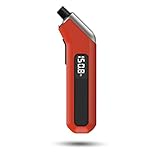
1. ETENWOLF T300 Digital Tire Pressure Gauge 3-200 PSI, Industrial Tire Gauge Calibrated to ANSI B40.7 Grade 2A(Plus-Minus 0.5%), Replaceable AAA Batteries (Vivid Orange)
Overview:
The ETENWOLF T300 is a single-unit digital tire pressure gauge engineered for precision across diverse vehicles. Calibrated to ANSI B40.7 Grade 2A standards (±0.5% accuracy), it covers a broad 3–200 PSI range and features replaceable AAA batteries with an integrated LED light for low-light use. Note that a Presta valve adapter is sold separately.
What Makes It Stand Out:
Its standout features include exceptional accuracy in extreme conditions—maintaining reliability below 12 PSI or above 140 PSI, and functioning flawlessly from -4°F to 130°F (-20°C to 54°C) via thermal compensation AI. The vivid orange casing enhances visibility, while the replaceable batteries significantly extend lifespan compared to sealed units.
Value for Money:
Priced competitively for its industrial-grade calibration, the T300 offers excellent value for drivers needing high-pressure range versatility. Though lacking a Presta adapter, its durability and weather resistance justify the cost over cheaper, less accurate alternatives, especially for truck/RV owners.
Strengths and Weaknesses:
Strengths: Unmatched pressure/weather resilience; long battery life; bright LED; ANSI-certified accuracy. Weaknesses: Presta adapter not included (problematic for cyclists); no unit-switching capability; basic nozzle design may leak if misaligned.
Bottom Line:
Ideal for automotive enthusiasts prioritizing rugged accuracy in harsh conditions, the T300 is a reliable single-purchase investment. Avoid if you need Presta compatibility without additional purchases.
2. ETENWOLF Digital Tire Pressure Gauge 2 Pack, Industrial Tire Gauge 3-200 PSI, Calibrated to ANSI B40.7 Grade 2A(Plus-Minus 0.5%), Air Pressure Gauge with Replaceable AAA Batteries (Vivid Orange)

Overview:
This ETENWOLF 2-pack delivers identical industrial-grade performance to the T300 model but provides two gauges. Both units cover 3–200 PSI, feature ANSI B40.7 Grade 2A calibration (±0.5%), thermal compensation for extreme temperatures (-4°F to 130°F), and replaceable AAA batteries with LED illumination.
What Makes It Stand Out:
The dual-unit bundle is its prime differentiator, offering redundancy for households with multiple vehicles or professional workshops. Like the T300, it excels in extreme pressure/weather accuracy and longevity via user-replaceable batteries—uncommon in budget gauges.
Value for Money:
Buying two gauges at a marginal cost increase over a single unit provides exceptional value. It’s cost-effective for families, fleet managers, or as a gift pair, eliminating the need for secondary purchases while ensuring consistent calibration across devices.
Strengths and Weaknesses:
Strengths: Two ANSI-certified gauges; weather/pressure resilience; battery replaceability; shared rugged design. Weaknesses: Still excludes Presta adapters; no unit conversion; identical nozzle limitations as single-pack models.
Bottom Line:
A smart buy for multi-vehicle households or professionals needing backup tools. The 2-pack maximizes durability and convenience, though cyclists must budget for separate Presta adapters.
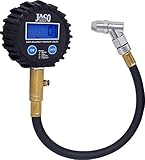
3. JACO ElitePro Digital Tire Pressure Gauge - Professional Accuracy - 100 PSI
Overview:
The JACO ElitePro is a premium single-gauge solution targeting mechanics and performance drivers. It boasts professional ANSI 2A calibration (±0.50 PSI accuracy up to 100 PSI), solid brass/steel construction, and a 10" rotational HybridFlex hose. Includes a lifetime warranty and 2x AAA batteries.
What Makes It Stand Out:
Its dual-sensor technology ensures ±0.10 PSI resolution—a rarity in consumer gauges—while the shock-resistant guard and brass components guarantee longevity. Unique features include a real-time air bleeder valve, display lock, and swappable 1/4" NPT chuck for versatile valve compatibility.
Value for Money:
Though pricier, the ElitePro justifies cost with shop-grade engineering, a lifetime warranty, and features absent in competitors (e.g., precision bleed valve). Ideal for enthusiasts seeking mechanic-level accuracy without recurring replacement costs.
Strengths and Weaknesses:
Strengths: Unrivaled 0.10 PSI resolution; rugged brass build; bleed valve; lifetime warranty; comfortable grip. Weaknesses: Limited to 100 PSI (unsuitable for heavy trucks); higher initial cost; hose may tangle.
Bottom Line:
Top-tier for cars, motorcycles, and performance tuning. Worth the investment for accuracy-focused users despite the PSI cap—avoid only if measuring >100 PSI tires regularly.
4. AstroAI Digital Tire Pressure Gauge 0-150PSI Calibrated to ANSI B40.7 +/-1PSI, Accurate in 0.1 Increments, 4 Units for Car Truck Bicycle with Backlight LCD, Silver

Overview:
The AstroAI gauge offers versatile 0–150 PSI measurement with ANSI B40.7 calibration (±1 PSI), four pressure units (PSI/Bar/Kgf/cm²/KPA), and a backlight for low-light use. Its ergonomic silver design includes 3 LR44 batteries and auto-shutoff after 30 seconds.
What Makes It Stand Out:
Multi-unit flexibility (switchable via one button) and dual illumination—backlit LCD plus an illuminated nozzle—set it apart. The 0.1 PSI resolution and compact size cater to cyclists and drivers, though Presta compatibility isn’t explicitly confirmed.
Value for Money:
At mid-tier pricing, it delivers strong value with unit versatility and solid accuracy for everyday use. The included batteries and nozzle light enhance usability, though calibration is slightly less precise than ETENWOLF/JACO models.
Strengths and Weaknesses:
Strengths: Four-unit conversion; dual lighting; pocket-friendly; good resolution; affordable. Weaknesses: ±1 PSI accuracy lags behind competitors; short auto-shutoff; nozzle seal reliability varies; no Presta mention.
Bottom Line:
A practical, user-friendly choice for casual drivers and cyclists needing unit flexibility. Opt for JACO/ETENWOLF if professional calibration is critical.
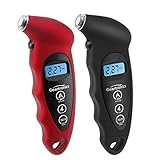
5. Geartronics Digital Tire Pressure Gauge 150 PSI 4 Settings with Backlight LCD Tire Gauge for Cars, Motorcycles and Bikes with Non-Slip Grip, 2 Pack
Overview:
This Geartronics 2-pack provides dual gauges with 0–150 PSI range, four pressure units, backlighting, and a non-slip grip. Designed for portability, it auto-shuts off after 30 seconds and targets cars, motorcycles, and bicycles—but excludes Presta valves.
What Makes It Stand Out:
The bundle’s tight-seal nozzle and ergonomic non-slip handle ensure reliable readings in motion (e.g., off-roading). Dual-gauge convenience paired with immediate unit switching offers practicality for active users prioritizing ease of use.
Value for Money:
The 2-pack price undercuts buying two singles elsewhere, making it economical for multi-vehicle households. However, the lack of Presta support and lower 150 PSI max limit reduce value for cyclists or truck owners.
Strengths and Weaknesses:
Strengths: Non-slip grip; bright backlight; compact 2-pack; simple unit switching; auto-shutoff. Weaknesses: Presta incompatibility; max 150 PSI (unsuitable for RVs); inconsistent nozzle seal reports; no accuracy certification details.
Bottom Line:
A budget-friendly bundle for casual Schrader-valve users, but avoid if Presta valves or >150 PSI measurements are needed. Prioritize ETENWOLF/JACO for certified accuracy.
6. AstroAI Digital Tire Pressure Gauge 0-150PSI, Accurate in 0.1 Increments, Backlit LCD and Presta Valve Adaptor Included, 4 Units of Measurement for Car Truck Bicycle, Black

Overview: This compact digital gauge replaces analog models with precise 0.1PSI accuracy and essential versatility for cars, trucks, and bicycles. Its focus on simplicity and reliability makes it ideal for routine tire checks.
What Makes It Stand Out: The AAA battery upgrade (over coin cells) ensures longer life and easier replacement. The backlit LCD guarantees readability in darkness, while the included Presta adapter and four measurement units (PSI, Bar, Kgf/cm², KPA) cover all vehicle types without extra purchases.
Value for Money: Priced moderately, it outperforms cheaper analog gauges in accuracy and durability. Though pricier than basic digital models, the Presta adapter inclusion and extended battery life justify the cost for cyclists and drivers alike.
Strengths and Weaknesses: Strengths: Intuitive one-button operation, ergonomic non-slip grip, consistent 0.1PSI readings, and automatic shutoff conserve power. Weaknesses: Limited to 150PSI (unsuitable for heavy trucks), and the backlight is less bright than competitors’.
Bottom Line: An excellent entry-level digital gauge for everyday drivers and cyclists seeking accuracy and convenience. Its thoughtful design and included adapter make it a smart, hassle-free investment for tire maintenance.
7. Tire Pressure Gauge Digital 200 PSI, HYVOHEX Tire Gauges for Tire Pressure with AAA Batteries, Visual LED Display Tire Gauge with Backlight, Digital Tire Gauge for Car Truck Motorcycle Bicycle

Overview: HYVOHEX delivers a premium digital tire gauge certified to ANSI B40.7 Grade 2A standards, emphasizing precision, durability, and user-friendly operation for all vehicles up to 200 PSI.
What Makes It Stand Out: ANSI certification and ±0.1 PSI accuracy ensure professional-grade reliability. The 360° rotating valve adapts to awkward tire angles effortlessly, while the large LED backlight and bold font cater to all users, including those with visual impairments.
Value for Money: Competitively priced for its certified accuracy and robust build. It surpasses budget models with its temperature resilience (-4°F–130°F) and aviation-grade aluminum nozzle, offering long-term value over frequent replacements.
Strengths and Weaknesses: Strengths: Exceptional readability in any light, tool-free battery replacement, universal Schrader/Presta compatibility (with adapter), and impact-resistant rubber casing. Weaknesses: No auto-inflation/bleed function, and the rotating valve may loosen over time.
Bottom Line: A top-tier choice for drivers prioritizing certified accuracy and ease of use. Ideal for households with diverse vehicles, it’s a dependable tool that balances performance and practicality.
8. AstroAI Digital Tire Pressure Gauge with Inflator, 3-250 PSI Air Chuck & Compressor Accessories Heavy Duty with Quick Connect Coupler, 0.1 Display Resolution, 1pack

Overview: This all-in-one kit merges a precision gauge with a heavy-duty inflator, supporting pressures up to 250 PSI for trucks, RVs, and off-road vehicles. It’s designed for active inflation and deflation tasks.
What Makes It Stand Out: The integrated inflator with bleed valve and quick-connect coupler eliminates guesswork—check, inflate, or deflate in one tool. Stainless steel and brass construction handle extreme pressures, while the 0.1 PSI resolution ensures meticulous adjustments.
Value for Money: Higher upfront cost is justified by replacing separate gauges and inflators. The comprehensive kit (hose, chuck, adapters) saves money long-term for RV/truck owners versus buying components individually.
Strengths and Weaknesses: Strengths: Unmatched versatility for inflation tasks, leak-proof chuck, 1% calibration accuracy, and rugged durability. Weaknesses: Bulky for glove-box storage; requires an air compressor for inflation (not standalone).
Bottom Line: Essential for heavy-duty vehicle owners needing precise inflation control. While overkill for basic car use, it’s indispensable for fleets, trailers, or off-road enthusiasts seeking professional results.
9. GERCHWAY Digital Tire Pressure Gauge for Cars - Accurate Air Pressure Gauge for Tires with 360° Swivel Chuck - 200 PSI

Overview: GERCHWAY combines industrial durability with user-focused features in a 200 PSI digital gauge, targeting drivers who prioritize longevity and ease of use across cars, motorcycles, and bikes.
What Makes It Stand Out: The solid brass body encased in rubber absorbs impacts, while the 360° swivel chuck effortlessly connects to stubborn valves. The built-in air bleeder valve allows micro-adjustments without separate tools.
Value for Money: Priced mid-range, it outlasts plastic competitors. Brass construction justifies the cost for frequent users, though casual drivers might find it pricier than basic models with similar accuracy (±1%).
Strengths and Weaknesses: Strengths: Exceptional durability, precise pressure tweaks via bleeder valve, universal valve compatibility, and clear digital display. Weaknesses: No backlight (limits low-light use), and the bleeder valve requires manual operation.
Bottom Line: A durable workhorse for mechanics or daily drivers facing tight valve angles. Choose it for rugged reliability, but opt for backlit models if nighttime use is frequent.
10. AstroAI Heavy Duty Digital Tire Pressure Gauge 0-230 PSI Calibrated to ANSI B40.7 Grade 2A (0.5%) with Backlit LCD & Flashlight, Stainless Steel for Truck RV Car Motorcycle Bike

Overview: Engineered for heavy vehicles, this ANSI-certified gauge offers 0.5% accuracy up to 230 PSI, featuring stainless steel durability and dual lighting for RVs, trucks, and all standard vehicles.
What Makes It Stand Out: The integrated flashlight—beyond standard backlighting—illuminates tire valves in pitch darkness. ANSI certification and stainless steel construction ensure commercial-grade reliability, while the 0.1 PSI resolution surpasses most consumer gauges.
Value for Money: Premium pricing aligns with its truck/RV focus. It’s cost-effective versus professional tools, offering certified accuracy and ruggedness that outlasts cheaper alternatives in demanding conditions.
Strengths and Weaknesses: Strengths: Unbeatable low-light usability, extended 230 PSI range, ergonomic grip, and multi-unit support. Weaknesses: Slightly heavier than compact models; flashlight drains battery faster if overused.
Bottom Line: The definitive choice for truckers and RV owners needing precision in challenging environments. Its lighting and durability make it worth the investment for serious fleet maintenance.
Why Precision Matters More Than You Think
The Hidden Costs of Inaccurate Readings
A variance of just 3-4 PSI might seem trivial, but it significantly impacts tire contact patch distribution. This uneven pressure accelerates center or shoulder wear, potentially halving your tire’s lifespan and costing hundreds in premature replacements. More critically, underinflation by 8 PSI increases stopping distance by up to 20 feet at 60 mph—a difference between safety and collision. Digital gauges minimize these risks through consistent precision, unlike analog counterparts prone to calibration drift from everyday bumps.
How Modern Vehicles Depend on Correct Pressure
Today’s sophisticated stability control, traction control, and adaptive cruise systems rely on precise wheel speed data. Even slight pressure discrepancies between tires cause rotational speed variations, confusing these systems. A high-accuracy digital gauge ensures all tires rotate at intended speeds, keeping advanced safety features functioning as engineers designed. Ignoring this can trigger false error codes or degrade system performance silently.
Decoding Digital Gauge Specifications
Understanding Accuracy Ratings (The ± Mystery)
Don’t skim over the “±” symbol in specs—it’s your gauge’s truthfulness guarantee. A rating of ±1% of full scale (e.g., ±0.5 PSI on a 50 PSI gauge) is the professional benchmark. Cheaper models often hide vague claims like “high accuracy” without quantifiable data. Always verify the exact tolerance; ±2% might seem adequate but translates to ±1 PSI error on common 50 PSI ranges, risking significant miscalibration.
PSI vs. Bar vs. kPa: Why Unit Flexibility is Non-Negotiable
Your vehicle’s door jamb sticker might list pressure in kPa, while your compressor displays Bar. Switching units mid-check invites dangerous mistakes. Top-tier gauges offer seamless toggling between all three major units without menu diving. Test this feature mentally: if changing from PSI to Bar requires five button presses in freezing weather, you’ll skip it—compromising accuracy.
ISO Classifications: The Industry’s Quality Seal
Look for gauges certified to ISO 1181 or ISO 12831 standards. These rigorous international benchmarks test durability across temperature extremes (-10°C to +50°C), shock resistance (1m drops), and long-term accuracy retention. Non-certified gauges often fail within months of regular use. This certification isn’t marketing fluff—it’s proof the tool meets global metrology requirements.
Critical Design Features for Real-World Use
Display Technology: Beyond Just Backlighting
A bright LED backlight is essential for pre-dawn checks, but superior gauges add electro-luminescent (EL) panels that illuminate evenly across the entire display—no dark corners obscuring digits. High-contrast LCDs with large, segmented numbers (minimum 0.5 inches tall) prevent misreading under glare. Avoid gauges requiring you to tilt them for visibility; your driveway isn’t a photo shoot.
Hose Length and Swivel Mechanics
That stiff 2-inch hose forces awkward angles, risking valve stem damage and air leaks during measurement. Opt for flexible, reinforced hoses of 3+ inches with 360-degree swivel fittings. This lets you attach perpendicularly to the valve, ensuring airtight seals and eliminating the “hose tug” that causes inaccurate spikes. Short hoses aren’t just inconvenient—they’re measurement saboteurs.
Ergonomic Grip and One-Handed Operation
Struggling to hold a slippery gauge while wrestling a tire valve? Precision demands stability. Look for textured, contoured grips that fit naturally in your palm, paired with a trigger mechanism requiring minimal finger pressure. The best designs let you take readings with one hand while supporting the gauge body against the wheel rim, eliminating shake-induced errors.
Durability Factors Often Overlooked
Temperature Resilience Testing
Plastic housings crack at -20°F; cheap electronics drift wildly at 100°F+. Reliable gauges undergo thermal shock testing: rapid shifts from freezer to oven conditions while maintaining accuracy. Check if the manual specifies operating range (e.g., -22°F to 140°F). If it’s missing, assume it’s not built for real seasons.
Valve Core Protection Mechanisms
Forcing a gauge onto a valve stem can dislodge the delicate core inside, causing slow leaks. Advanced models include self-sealing valves or spring-loaded probes that gently engage the core without twisting. This isn’t just convenience—it prevents a $5 valve core from turning into a stranded-on-the-highway emergency.
Drop and Vibration Resistance
Your gauge will inevitably hit concrete. Military-grade MIL-STD-810G certification validates survival after multiple 6-foot drops onto plywood. Without it, internal solder joints often fracture, causing intermittent failures. Vibration resistance (tested on simulated road surfaces) ensures accuracy isn’t compromised when stored in a bumpy trunk.
Calibration: The Lifeline of Long-Term Accuracy
Why Factory Calibration Isn’t Enough
Even top-tier gauges experience minor calibration shifts after 500+ uses or extreme temperature exposure. Factory calibration certificates are snapshots in time. Sustainable accuracy requires user-accessible recalibration—either via internal dials or companion apps that guide adjustments against master standards. If recalibration means mailing it overseas, you won’t do it.
Spot-Checking Techniques You Can Do Monthly
No master gauge? Use hydrostatic comparison: submerge your gauge’s hose in water while pressurizing to 30 PSI. Bubbles indicate leaks causing low readings. Or compare two digital gauges simultaneously; consistent 1+ PSI differences signal one needs service. These quick checks catch drift before it impacts safety.
The Calibration Frequency Myth
“Don’t calibrate more than yearly” is dangerous advice. Heavy users (fleet managers, RV owners) should verify monthly. For daily drivers, quarterly checks suffice. Environmental factors dominate—garage-stored gauges in stable climates last longer than those baking in summer trunks. Tie calibration to oil changes for effortless habit-building.
Usage Scenarios and Specialized Needs
Handling High-Pressure Applications
SUVs and light trucks often require 50+ PSI. Standard gauges maxing at 60 PSI operate near their error-prone upper limits. For vehicles exceeding 45 PSI, choose gauges rated to at least 100 PSI—this keeps measurements in the optimal mid-range where accuracy peaks. Never use a 60 PSI gauge for a 55 PSI requirement; error margins balloon near maximum capacity.
Cold Weather Performance Pitfalls
LCD displays slow down below freezing, causing laggy readings. Premium gauges use specialized liquid crystals that remain responsive to -4°F. Also, metal components contract in cold, potentially creating micro-gaps. Look for gauges specifying “low-temp seals” or “cryogenic O-rings” to prevent air seepage during winter checks.
Integration with Modern Workflows
Bluetooth-enabled gauges that auto-log pressure history via smartphone apps are invaluable for fleets or meticulous DIYers. But ensure data syncs without draining your phone battery in 10 minutes. More crucially, verify the app allows exporting CSV files—proprietary silos render historical data useless for long-term tire health analysis.
Maintenance Habits for Lasting Reliability
Cleaning Methods That Won’t Damage Sensors
Wiping the probe with a damp cloth seems harmless, but moisture ingress destroys pressure sensors. Instead, use dry, compressed air to blow debris from the nozzle. For stubborn grime, lightly dampen a cotton swab with isopropyl alcohol, let it dry completely before use. Never immerse the gauge head—seals aren’t waterproof.
Proper Storage to Prevent Internal Drift
Leaving gauges in direct sunlight (like on a dashboard) cooks internal components. Store in a ventilated, temperature-stable compartment—not your glovebox, which acts like an oven. For long storage, release all pressure from the hose to prevent seal deformation. A hard-shell case isn’t luxury; it’s insurance against accidental calibration-killing impacts.
Battery Management Beyond Simple Replacement
CR2032 batteries can leak and corrode contacts if left dead for months. Enable auto-shutdown (under 15 seconds) to prevent this. When replacing, wipe contacts with a pencil eraser to remove oxidation—corroded contacts cause intermittent power loss mid-measurement. Pro tip: note the installation date on the battery with a marker; replace proactively every 18 months regardless of use.
Frequently Asked Questions
Frequently Asked Questions
How often should I check my tire pressure with a digital gauge?
Check monthly and before long trips, always when tires are cold (parked >3 hours). Temperature swings of 10°F change pressure by ~1 PSI, so seasonal changes demand verification.
Can digital gauges be more accurate than my car’s TPMS?
Absolutely. TPMS sensors typically have ±7% accuracy and only alert after 25% underinflation. Digital gauges offer ±1% precision, letting you maintain optimal pressure before safety margins are breached.
Why does my digital gauge show different readings than my friend’s?
Variations exceeding 1 PSI indicate one gauge needs calibration. Even quality tools have slight manufacturing tolerances; consistent discrepancies mean spot-checking against a known-accurate reference is essential.
Do I need to reset the gauge between tires?
Most auto-zero when turned on, but always power it down after use. Residual pressure in the hose from the previous tire can skew the next reading if not fully vented.
Are Bluetooth gauges less accurate than wired models?
Not inherently—the wireless component doesn’t affect the pressure sensor. However, cheap Bluetooth models may cut corners on core accuracy to fund the tech. Verify the ± spec first.
How do I know if my gauge needs recalibration?
If readings consistently differ by >1 PSI from a newly calibrated reference gauge, or if the zero point drifts when powered on in a stable environment, recalibration is overdue.
Can extreme heat permanently damage a digital gauge?
Yes. Prolonged exposure above 140°F can warp plastic housings and degrade internal sensors. Never leave it on a dashboard in summer; store in the cabin or a shaded compartment.
Why do some gauges have a “bleed” button?
This slowly releases air from the hose after measurement, preventing sudden bursts that could dislodge the valve core. Crucial for high-pressure applications to avoid inaccurate final readings.
Is a longer hose always better for accuracy?
Not necessarily. Excessively long hoses (over 6 inches) can trap air volume, delaying stabilization. 3-5 inches is optimal—long enough for comfortable access, short enough for instant response.
What’s the biggest mistake people make with digital gauges?
Forgetting to check the battery. Low voltage causes erratic readings that mimic sensor failure. Replace batteries at the first sign of sluggish display response or inconsistent results.
See Also
- 10 Best Digital Tire Pressure Gauges for Accurate Inflation in 2026
- 10 Must-Have Digital Tire Pressure Gauges for Fleet Maintenance in 2026
- 10 Expert-Recommended Digital Tire Pressure Gauges for Fleet Maintenance in 2026
- 10 Most Durable Digital Tire Pressure Gauges Based on Real User Reviews in 2026
- Stop Guessing Tire Pressure with the 10 Best Air Compressors with Gauges This Year