Table of Contents
Imagine bouncing along a rugged trail, the rhythmic thump of tires over rocky terrain, when suddenly—a sharp hiss. You’ve picked up a slow leak, and your carefully aired-down tires for traction are now dangerously low. Stranded miles from pavement, the frustration is real. This isn’t just an inconvenience; it’s a potential adventure-ender. Off-roading demands self-reliance, and few tools embody that spirit more than a dependable portable air compressor. It’s not merely about fixing flats; it’s the key to optimizing tire pressure for sand, mud, or rock crawling, inflating recovery gear, and ensuring you can confidently tackle the next section of trail knowing you have the power to reset your tires for the highway ride home.
For serious trail riders, a portable air compressor transcends being a simple accessory—it’s an essential piece of safety and capability equipment. Unlike the compressor built into your vehicle (if you have one), a dedicated portable unit offers the freedom to adjust pressure anywhere, anytime, without draining your main battery or relying on engine runtime. But navigating the sea of options can be overwhelming. Wattage ratings, CFM outputs, duty cycles, power sources—it’s easy to get lost in technical jargon. The wrong choice could mean a unit that dies mid-inflation, fails in dusty conditions, or simply can’t keep up with the demands of larger off-road tires. This guide cuts through the noise, focusing purely on the critical factors that determine which portable air compressor will be your reliable partner when the pavement ends and the adventure truly begins.
Top 10 Portable Air Compressors
Detailed Product Reviews
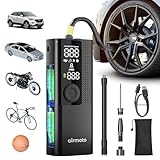
1. Airmoto Tire Inflator Portable Air Compressor - Air Pump for Car Tires with Digital Pressure Gauge, LED Light and Auto Shut-Off Function - Cordless Pump for Car, Motorcycle, Bicycle, Ball
Overview:
This palm-sized cordless compressor delivers quick, accurate inflation for cars, motorcycles, bikes, and sports equipment. Its 2000mAh battery, digital gauge, and auto shut-off make it a practical emergency tool for maintaining tire pressure on the go.
What Makes It Stand Out:
The intuitive interface switches seamlessly between PSI, kPa, BAR, and kg/cm² units, while the bright LCD and built-in LED light ensure usability in any condition. Auto shut-off at preset pressure (up to 120 PSI) prevents overinflation, and the compact storage pouch fits glove compartments effortlessly. Three included adapters cover Schrader, Presta, and needle valves.
Value for Money:
Priced competitively for a feature-rich cordless unit, it outperforms basic 12V pumps with its portability and precision. Though battery life diminishes in cold weather or with large tires, it’s ideal for routine top-ups—unlike cheaper models lacking digital accuracy or auto shut-off.
Strengths and Weaknesses:
Strengths: Ultra-portable; multi-unit gauge; reliable auto shut-off; versatile attachments; USB-C charging. Weaknesses: Limited battery capacity for multiple large tires; not suited for air mattresses; performance dips below freezing.
Bottom Line:
A reliable, user-friendly emergency inflator for daily drivers and cyclists. Best for quick top-ups, not heavy-duty use—worth the investment for peace of mind at this price point.
2. DEWALT Tire Inflator Portable Air Compressor 20V MAX, Car Air Pump with Automatic Shut Off, LED Light, Tool Only (DCC020IB)

Overview:
This rugged, professional-grade inflator leverages DEWALT’s 20V MAX battery system for high-pressure inflation. It handles cars, bikes, and large-volume items like rafts, featuring automatic shut-off and versatile power options for workshops or job sites.
What Makes It Stand Out:
Triple power sources (20V battery, 12V DC, or 110V AC) ensure flexibility anywhere. The threaded chuck guarantees leak-free connections, while heavy-duty rubber feet prevent “walking” during operation. High-volume mode inflates air mattresses rapidly, and onboard storage keeps accessories organized.
Value for Money:
Justified for DEWALT battery owners or professionals needing durability. The 3-year warranty and multi-scenario utility offset its premium cost, though casual users might find cordless alternatives more convenient for simple tire top-ups.
Strengths and Weaknesses:
Strengths: Exceptional versatility with three power modes; robust build; high-volume capability; secure chuck; strong warranty. Weaknesses: Requires separate battery purchase; bulkier than pure cordless models; no integrated pressure unit switching.
Bottom Line:
A powerhouse for tradespeople or outdoor enthusiasts with DEWALT ecosystems. Opt for this if you prioritize adaptability and heavy-duty use over ultra-portability.
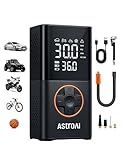
3. AstroAI L7 Tire Inflator Portable Air Compressor Cordless Mini Bike Pump with Digital Dual Values Display, 150 PSI Car Tires Air Pump with LED Lights&Pressure Gauge for Auto, Motorcycles, Bikes, Balls
Overview:
Weighing under 1 lb, this featherlight cordless inflator uses advanced sensor tech for rapid, precise inflation (up to 150 PSI). Its 4000mAh battery and dual USB ports make it a multifunctional travel essential for cars, e-bikes, and emergencies.
What Makes It Stand Out:
TrueGauge technology samples pressure 200x/sec for 80%+ accuracy—60% better than average. It inflates tires 2x faster (1.5 mins for a standard car tire) and doubles as a power bank via USB-C. The 3-mode LED flashlight (SOS/strobe included) and 4 preset modes (car, bike, ball, custom) enhance safety.
Value for Money:
Offers exceptional bang-for-buck with its speed, accuracy, and emergency features. Though pricier than basic models, the 4000mAh battery (8+ tires per charge) and multi-use design justify the cost versus single-function competitors.
Strengths and Weaknesses:
Strengths: Blazing-fast inflation; long battery life; emergency power bank; superb accuracy; ultra-portable. Weaknesses: Not for heavy-duty tires; preset mode limits customization; smaller hose than rivals.
Bottom Line:
The top pick for cyclists and commuters seeking speed, reliability, and emergency utility. Its tech-forward features deliver unmatched value for active lifestyles.
4. AstroAI Tire Inflator Portable Air Compressor Air Pump for Car Tires-Car Accessories, 9.8Ft Cord-12V DC-Powered Auto Pump with Digital Pressure Gauge, Emergency LED Light for Bicycle, Balloons, Yellow

Overview:
This affordable 12V DC-powered inflator plugs into your vehicle’s cigarette lighter for reliable tire top-ups. Its 9.8-foot cord reaches all tires easily, featuring digital pressure control, a backlit screen, and an emergency flashlight.
What Makes It Stand Out:
The extra-long cord eliminates repositioning hassles for SUVs or trucks. Programmable auto shut-off and four pressure units (PSI, Bar, kPa, kg/cm²) ensure precision, while the one-touch LED flashlight aids nighttime use. Its compact size disappears into glove boxes when stored.
Value for Money:
A budget-friendly solution for drivers prioritizing simplicity over cordless freedom. Cheaper than battery models but requires a running vehicle—ideal for those who regularly service their own tires without needing portability.
Strengths and Weaknesses:
Strengths: Very affordable; long cord; intuitive preset controls; bright flashlight; compact storage. Weaknesses: Must use with running engine; cord limits mobility; no battery backup; slower for multiple tires.
Bottom Line:
A solid, no-frills choice for home garages or frequent DIYers. Skip if you need cordless convenience, but excellent value for straightforward inflation tasks.
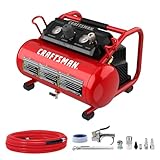
5. CRAFTSMAN Air Compressor, 2 Gallon Portable Air Compressor 1/3HP Max 125 PSI Oil-Free Light Weight with 10 PCS Accessory Kit
Overview:
This 2-gallon oil-free compressor blends portability (19 lbs) with workshop versatility. Designed for automotive, painting, or nailing tasks, it includes a 10-piece accessory kit and delivers 125 PSI max pressure for sustained projects.
What Makes It Stand Out:
The oil-free pump ensures maintenance-free operation and quiet performance, while dual quick couplings enable simultaneous tool use. Rubber-reinforced handles and a heat-dissipation system enhance durability. The included kit covers tire inflation, blow guns, and pressure gauges out of the box.
Value for Money:
Represents strong value for DIYers needing occasional heavy-duty power. Though heavier than tire-specific inflators, its multi-tool capability and CRAFTSMAN’s reputation justify the cost versus single-use compressors.
Strengths and Weaknesses:
Strengths: Versatile for multiple tasks; durable oil-free pump; comprehensive accessory kit; stable 125 PSI output. Weaknesses: Bulky for car-trunk storage; not truly portable like cordless inflators; slower refill for tires alone.
Bottom Line:
The go-to for garage enthusiasts tackling diverse projects. Not ideal for quick tire fixes, but unmatched utility for workshops at this price tier.
6. KeenPower Tire Inflator Portable Air Compressor - Super Fast - 21V Rechargeable Battery Powered Handheld 160PSI Tire Inflator, Dual Power Supply Modes, Portable Air Pump for Car Motorcycle E-Bike
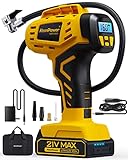
Overview: The KeenPower is a versatile handheld tire inflator designed for cars, motorcycles, and e-bikes, featuring a 21V rechargeable battery and dual power options for reliable on-the-go inflation up to 160 PSI.
What Makes It Stand Out: Its dual power modes (cordless battery or 12V DC car charger) eliminate downtime during emergencies, while the rapid 1-hour battery recharge and QC3.0 USB output for device charging add significant utility. The auto-shutoff at preset pressure and multi-mode LED flashlight enhance safety and usability in low light.
Value for Money: Priced competitively for its feature set, it outshines basic single-mode inflators by offering uninterrupted operation and emergency device charging. The inclusion of robust warranty coverage (30-day return, 12-month support) strengthens its value proposition for daily commuters and adventurers.
Strengths and Weaknesses: Strengths: Dual power flexibility, fast recharge, useful flashlight, and USB device charging. Weaknesses: 160 PSI limit excludes large trucks; battery runtime isn’t specified for multiple tires; ergonomic handle may not suit all hand sizes.
Bottom Line: An excellent, well-rounded choice for drivers prioritizing reliability and emergency preparedness, especially given its dual power and rapid recharge. Highly recommended for personal vehicles and e-bikes.
7. CRAFTSMAN Tire Inflator Portable Air Compressor, Cordless Mini Air Pump for Car Tires with Digital Tire Pressure Gauge, 6000mAh Battery Powered Air Pump, Max Pressure 150 PSI, 12V DC Corded

Overview: This compact CRAFTSMAN inflator combines a 6000mAh battery with corded 12V DC support, offering portable inflation up to 150 PSI for cars, bikes, and sports equipment, complete with a digital pressure gauge.
What Makes It Stand Out: Five preset inflation modes (car, bike, motorcycle, ball, custom) and four pressure units cater to diverse needs. The bright LED screen displays real-time pressure, while the dual USB-C/USB-A ports enable device charging. Its ultra-portable 1.28 lb design includes essential accessories like extra nozzles and fuses.
Value for Money: Justifies its price with versatility and CRAFTSMAN’s trusted build quality. The ability to inflate four car tires rapidly (45 seconds per tire from 30→36 PSI) and charge devices makes it cost-effective versus single-use alternatives, especially for frequent travelers.
Strengths and Weaknesses: Strengths: Multi-mode presets, accurate digital display, lightweight portability, and useful emergency LED. Weaknesses: 150 PSI max pressure is lower than competitors; no explicit continuous-duty claim; USB output limited to 1A.
Bottom Line: A top pick for versatility and ease of use, ideal for drivers needing quick, accurate inflation for varied objects. Best suited for cars and smaller vehicles due to pressure limits.
8. Inzeetor 150 PSI Tire Inflator Portable Air Compressor, 12V DC Auto Shutoff Air Pump with Digital Pressure Gauge and Emergency LED Light for Car Tires, Bicycle & Balloons, Black
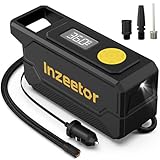
Overview: The Inzeetor TIT001 is a no-frills, budget-friendly portable inflator targeting cars, bikes, and inflatables with 150 PSI capacity, auto shutoff, and an emergency LED light.
What Makes It Stand Out: It boasts industrial-grade speed (50 seconds to inflate a car tire from 30→36 PSI) and unique continuous operation—no cooldown needed between tires. Low vibration/noise design and a simple preset interface via +/- buttons enhance user experience during routine use.
Value for Money: Exceptional for cost-conscious buyers, offering reliable core functionality at an entry-level price. While lacking advanced features like device charging, its speed and durability for basic tire maintenance deliver solid ROI compared to pricier models with unused extras.
Strengths and Weaknesses: Strengths: Rapid inflation, zero rest time between tires, quiet operation, and included valve adapters. Weaknesses: No battery runtime details; limited to 150 PSI; no USB ports or custom pressure memory; basic LED lacks SOS modes.
Bottom Line: A dependable, efficient workhorse for straightforward tire inflation tasks. Recommended for budget-focused users prioritizing speed and simplicity over smart features.
9. ETENWOLF VORTEX S6 Tire Inflator Portable Air Compressor for Heavy-duty Vehicle, Cordless Air Pump for Car & Inflatables with 19200 mAh Battery, 100% Duty Cycle & Dual Cylinder Bike Pump, Vivid Orange

Overview: Engineered for heavy-duty use, the ETENWOLF VORTEX S6 is a powerhouse cordless inflator with a massive 19200 mAh battery, 100% duty cycle, and dual-cylinder motor for trucks, SUVs, and large tires up to 160 PSI.
What Makes It Stand Out: Unmatched capacity inflates 18 F-150 tires on one charge and tackles continuous heavy loads without overheating. Ultra-fast 1.5 CFM output fills a 31" tire in 60 seconds, while the 45W USB-C port powers laptops. Seven preset modes, pressure memory, and a 1000-lumen LED camping light add versatility.
Value for Money: Commands a premium price but justifies it for truck/SUV owners needing relentless performance. Beats shop compressors in portability and outperforms rivals in runtime—ideal for off-roaders or fleets where downtime is costly.
Strengths and Weaknesses: Strengths: Heavy-duty 100% duty cycle, exceptional battery life, blazing speed, and robust USB-C charging. Weaknesses: Bulky/heavy for casual use; high price; not for SUPs; vivid orange may not suit all.
Bottom Line: The undisputed king for heavy vehicles and extreme demands. Essential for truck owners and off-grid adventurers despite the cost.
10. Craftsman Air Compressors 6 Gallon Portable Pancake Air Compressor,Oil Free Max 150 Psi 1.0HP 2.6 CFM@90PSI Electric Air Compressor Shop Air Compressor, CMXECXA02106410

Overview: This Craftsman 6-gallon pancake compressor is a traditional oil-free electric shop unit built for stationary workshop use, delivering 150 PSI max pressure and powering multiple air tools simultaneously.
What Makes It Stand Out: Combines portability (30.8 lbs with handle) with serious workshop capability: 2.6 SCFM at 90 PSI, dual quick couplers, and low-voltage start. Its oil-free design ensures clean operation for painting and delicate tasks, backed by Craftsman’s U.S. warranty support.
Value for Money: A smart investment for DIYers and pros needing reliable, continuous shop air. Outperforms portable inflators in sustained tool use (e.g., framing nailers), making it cost-effective versus frequent portable recharges for heavy projects.
Strengths and Weaknesses: Strengths: High CFM for tools, dual couplers, lightweight for its class, and durable build. Weaknesses: Not truly portable (requires outlet); louder than handheld inflators; limited to stationary use.
Bottom Line: The go-to workshop companion for air tools and tire inflation where mobility isn’t critical. Highly recommended for home garages and job sites demanding consistent power.
Understanding Your Off-Road Air Compressor Needs
Before diving into specs, it’s crucial to honestly assess how you’ll use the compressor. This shapes every subsequent decision.
Defining Your Primary Use Case
Your most frequent application dictates the required power and features. Are you primarily topping off a slow leak after a trail run, performing routine pressure adjustments between terrains, or needing the capability to fully inflate a large, deeply aired-down tire from near-flat? If you run massive 37-inch+ tires or frequently drive in extremely soft sand requiring very low pressures (like 10-12 PSI), you’ll need significantly more airflow than someone with smaller tires adjusting from 15 to 25 PSI. Consider the maximum pressure you’ll need to achieve (often 35-45 PSI for highway driving with large tires) and the volume of air required to get there from your typical aired-down pressure.
Evaluating Tire Size and Volume
Larger diameter and wider tires hold substantially more air volume. A compressor that easily handles 33-inch tires might struggle immensely with 37-inch or 40-inch tires, taking an impractical amount of time to inflate. Calculate the approximate air volume difference: inflating a tire from 10 PSI to 35 PSI requires adding three and a half times the air volume compared to inflating from 25 PSI to 35 PSI. This dramatic difference underscores why understanding your specific tire setup is non-negotiable. Don’t just look at the compressor’s max PSI; focus intensely on its airflow rate (CFM) at the pressures you’ll actually be working within.
Considering Your Power Source Constraints
How will you power the unit? This is often the make-or-break factor for reliability off-grid. Will you rely solely on your vehicle’s 12V socket (cigarette lighter), which can be prone to blowing fuses under high load? Will you connect directly to the battery terminals for maximum current? Do you need the flexibility of a built-in rechargeable battery for true independence from your vehicle, especially useful if your main battery is compromised? Each source has implications for cable length, safety cutoffs, and overall usability in different emergency scenarios. Assess your vehicle’s electrical system robustness and your comfort level with direct battery connections.
Decoding Critical Performance Specifications
Raw numbers matter, but understanding how they apply to real-world off-roading is key. Don’t be fooled by peak or max ratings alone.
CFM (Cubic Feet per Minute) - The True Measure of Speed
This is arguably the most important spec, yet it’s often presented misleadingly. CFM measures how much air the compressor can move. Crucially, CFM decreases significantly as pressure (PSI) increases. A compressor might boast “2.0 CFM,” but that’s likely only at very low pressure (e.g., 0-30 PSI). What you really need is the CFM rating at the pressure range you’ll be working in, typically between 20 PSI and your target highway pressure (e.g., 35-45 PSI). A unit delivering 0.8 CFM at 35 PSI will inflate your tires much faster than one delivering 0.4 CFM at the same pressure, even if their “max CFM” numbers look similar. Prioritize CFM data at realistic operating pressures.
PSI (Pounds per Square Inch) - Ensuring Sufficient Pressure
While most quality portable compressors can reach 150+ PSI (far beyond tire needs), the critical factor is whether they can sustain the airflow (CFM) needed to reach your target tire pressure in a reasonable time. Don’t just check the max PSI; ensure the unit can comfortably deliver its rated CFM up to at least 40-45 PSI. Some lower-powered units might technically reach 50 PSI, but the airflow becomes so negligible that inflation times become excessive. Verify the CFM/PSI curve if available.
Duty Cycle - Avoiding Burnout on the Trail
This specification indicates how long the compressor can run continuously before it needs to cool down. It’s expressed as a percentage (e.g., 50% duty cycle at 30 PSI means 5 minutes on, 5 minutes off). A low duty cycle (like 25-30%) is problematic for off-roading, as inflating multiple large, low-pressure tires can easily take 15-20 minutes of continuous runtime. Look for units with a minimum 50% duty cycle, and preferably higher (70-100%), especially if you run large tires. A high duty cycle or continuous duty rating is essential for reliability when you need it most – during a time-sensitive recovery or pressure adjustment session.
Amp Draw and Electrical System Compatibility
High airflow requires significant electrical current. Check the amp draw, especially at the pressures you’ll use. A compressor drawing 25+ amps might overwhelm a standard 15-20 amp vehicle 12V socket circuit, causing fuses to blow. Units designed for larger tires often require direct connection to the battery via heavy-gauge cables with proper fusing. Understand your vehicle’s 12V circuit limitations and whether the compressor includes robust battery clamps and sufficiently thick power cables. Safety cutoffs for overheating and over-current are vital features.
Essential Build Quality and Feature Considerations
Beyond raw specs, durability and usability features determine if a compressor survives the trail and gets used effectively.
Rugged Construction for Harsh Environments
Off-roading means dust, mud, water splashes, and constant vibration. Look for compressors housed in impact-resistant, non-corrosive materials like reinforced polymer or powder-coated metal. Sealed motors and electrical components (often indicated by an IP rating like IP65 for dust/water resistance) are highly advantageous. Avoid units with excessive vents or flimsy plastic housings that invite dirt ingress. Consider the weight – while portability matters, an overly light unit might sacrifice durability. Metal-bodied compressors often offer superior longevity in demanding conditions.
Hose Length, Quality, and Coupler Type
A frustratingly short hose limits where you can position the compressor relative to your tire valve. Aim for a minimum 18-24 inch hose, but longer (3-5 feet) offers much greater flexibility, especially under a vehicle. The hose should be reinforced, oil-resistant, and kink-resistant. The coupler (the end that attaches to your tire valve) must be a standard Schrader valve type (same as bike/car tires). Some include dual-head couplers or quick-connect features; ensure compatibility with your valve stems. A poorly designed coupler that leaks air or is hard to attach defeats the purpose.
Integrated Gauges and Pressure Controls
Accurate pressure monitoring is non-essential but highly recommended. An integrated, easy-to-read analog or digital gauge eliminates guesswork and the need for a separate tire gauge, speeding up the process. More advanced units offer preset pressure settings – dial in your desired PSI, start the compressor, and it automatically shuts off when reached. This prevents over-inflation, saves time, and is incredibly convenient, especially in low-light conditions. Ensure the gauge is protected from damage and clearly visible.
Portability and Mounting Solutions
While “portable” is the name, consider where and how you’ll store it. A unit that’s awkwardly shaped or lacks secure mounting points becomes a nuisance. Look for integrated handles, mounting brackets, or compatibility with common storage solutions (like under-seat trays or recovery boards). Weight is a factor, but balance it against the power needed; a slightly heavier unit that gets the job done quickly is far better than a featherweight one that takes forever. Compactness matters for stowing in crowded rigs.
Power Source Options Deep Dive
Choosing how to power your compressor impacts performance, safety, and convenience significantly.
Vehicle 12V Socket (Cigarette Lighter) Pros and Cons
The most convenient plug-and-play option. However, standard vehicle sockets are often fused for only 10-20 amps. High-powered compressors can easily exceed this, blowing fuses mid-inflation. Voltage drop over the long, thin wiring to the socket also reduces effective power, slowing inflation. Best suited only for very low-power compressors or small tires. If using this method, ensure the compressor has low amp draw (<10A) and be prepared for potential fuse issues.
Direct Battery Connection - The Reliable Choice
Connecting directly to the vehicle’s battery terminals using heavy-duty clamps provides the cleanest, highest-current power source, minimizing voltage drop and maximizing compressor performance. This is the recommended method for any compressor drawing more than 15 amps or for inflating larger tires. Ensure the unit includes robust, well-insulated clamps and sufficiently thick (low-gauge) power cables (10-gauge or thicker is ideal). Always follow safety procedures: connect positive first, then negative (to a clean chassis ground away from the battery if possible), and disconnect negative first.
Built-In Rechargeable Battery Systems
These offer true independence from your vehicle’s electrical system. Ideal for situations where the main battery is dead, for quick top-offs without starting the engine, or for use with non-vehicle applications (like inflating boats or sports equipment). However, battery capacity (measured in Watt-hours or Amp-hours) directly limits runtime. A small battery might only handle one tire inflation. Charging times can be long, and battery performance degrades in cold weather. They add significant cost and weight. Evaluate if the convenience outweighs the limitations for your specific needs.
Dual-Power Capabilities - The Best of Both Worlds?
Some advanced units combine a direct battery connection option with a built-in rechargeable battery. This provides maximum flexibility: use the battery for quick tasks or emergencies, and plug into the vehicle battery for sustained high-power inflation or to recharge the internal battery while driving. This is a premium feature that solves many power source dilemmas but comes at a higher price point and complexity. Assess if the added cost justifies the versatility for your usage patterns.
Maximizing Reliability and Longevity
A compressor that fails when you need it is worse than useless. Smart usage and maintenance prevent trailside disappointments.
Proper Ventilation and Heat Management
Compressors generate significant heat during operation. Running one continuously in a confined space, like inside a closed storage box or buried under gear, traps heat and drastically shortens its duty cycle or causes overheating shutdowns. Always operate the compressor in open air, away from direct contact with insulating materials. If the unit feels excessively hot to the touch (beyond warm), stop and let it cool down according to its duty cycle specifications. Never cover vents during operation.
Dust and Moisture Protection Strategies
While some units have decent ingress protection, proactive measures help. Store the compressor with the air intake and exhaust vents covered by a simple cloth or in a breathable storage bag to prevent fine trail dust from settling inside the motor and mechanisms. Avoid operating it in heavy rain or submerging it. After use in wet or muddy conditions, wipe it down and allow it to dry thoroughly before storage. Periodically check and clean any accessible air intake filters if equipped.
Regular Operational Checks
Don’t wait for an emergency to discover a problem. Periodically test your compressor: run it for a few minutes to ensure it starts easily, builds pressure, and the gauge (if present) functions. Check power cables and clamps for fraying or corrosion. Ensure the hose isn’t cracked and the coupler seals properly. Verify that any safety cutoffs (overheat, over-current) seem functional. A quick 5-minute check before a major trip provides invaluable peace of mind.
Storage Best Practices
Store the compressor clean, dry, and with the power cables neatly coiled (avoiding sharp bends). Keep it in a temperature-controlled environment if possible; extreme cold or heat during long-term storage can degrade components and batteries. If it has an internal battery, follow the manufacturer’s guidance on storage charge level (often around 50%). Keeping it easily accessible in your vehicle, not buried under other gear, ensures you can grab it quickly when needed.
Frequently Asked Questions
Frequently Asked Questions
Can a portable air compressor inflate all four large off-road tires from aired-down pressure? Yes, but inflation time varies significantly. Units with higher sustained CFM (0.7+ at 35 PSI) and a high/continuous duty cycle can typically inflate four large (35"+) tires from 15 PSI to 35 PSI in 15-25 minutes. Lower-powered units may take 40+ minutes or require cooling breaks, making the process impractical.
How long does it take to inflate a single large off-road tire? From 10-15 PSI to 35 PSI, a capable compressor (0.8+ CFM at 35 PSI) usually takes 3-6 minutes per large tire (35-37"). Inflation time increases dramatically the lower the starting pressure and the larger the tire volume. Always factor in potential cooling breaks for the compressor.
Will using a compressor drain my vehicle’s battery? If connected directly to the battery while the engine is running, the alternator replenishes the power. If running the engine off, even for short periods, it will drain the battery. Direct battery connection without the engine running is only safe for brief use (a few minutes) with modern vehicles; prolonged use risks a dead battery. Built-in battery units avoid this issue.
What’s the difference between “max PSI” and “working PSI”? Max PSI is the absolute highest pressure the compressor can theoretically reach, often irrelevant for tires. Working PSI refers to the pressure range (e.g., 0-40 PSI) where the compressor delivers its useful, sustained airflow (CFM). Focus on CFM within your target tire pressure range (typically 20-45 PSI).
Do I need an oil-free compressor? Yes, for portability and maintenance. Oil-lubricated compressors require periodic oil changes and are generally heavier and less suitable for the vibrations of off-roading. Modern oil-free piston or diaphragm compressors are reliable, lighter, maintenance-free, and perform well for tire inflation tasks.
Can I leave the compressor connected to my battery permanently? It’s generally not recommended due to potential parasitic drain, even if small. Most units draw a tiny current when plugged in but switched off. This could flatten your battery over weeks/months of inactivity. Connect only when needed and disconnect after use.
Are digital gauges more accurate than analog ones? Digital gauges often provide more precise readings and are easier to read in low light. However, quality analog gauges can be very accurate. The critical factor is gauge calibration and protection from damage; a poorly made digital gauge is worse than a robust analog one. Look for gauges with protective covers.
How do extreme temperatures affect performance? Cold weather thickens lubricants slightly, potentially reducing initial airflow slightly until warmed up, but rarely causes failure. Very high ambient heat significantly reduces duty cycle and increases the risk of overheating shutdowns. Avoid running the compressor in direct, scorching sun if possible.
Why does my compressor shut off before the tire is full? This is almost always an overheating safety shutdown due to exceeding the duty cycle. It’s working as designed to prevent damage. Let the unit cool completely (15-30 mins) before restarting. If it shuts off prematurely consistently, the unit may be undersized for your tire volume/pressure needs.
Can I use it for inflating other things like air mattresses or sports balls? Absolutely. The same airflow that fills tires works for other inflatables. However, very high-volume items (like large rafts) will take much longer than tires. Use the appropriate nozzle adapter, and be mindful that extremely low-pressure items might not trigger an auto-shutoff feature if equipped.
See Also
- 10 Game-Changing DC Air Compressors for Off-Road Enthusiasts in 2026
- Best Portable Air Compressors for Road Trips: 10 Expert Picks for 2026
- 10 Best Portable Air Compressors for Solving Underinflated Tires in 2026
- Top 10 Best Portable Air Compressors for On-the-Go Tire Inflation in 2026
- How to Solve Slow Inflation with the 10 Best Portable Air Compressors in 2026