Table of Contents
Imagine transforming your home garage into a truly mobile workshop where you’re no longer tethered to electrical outlets or tripping over cords. Cordless air compressors have quietly revolutionized DIY projects and light automotive tasks, offering unprecedented freedom for inflating tires, powering nail guns, or even tackling small paint jobs. For the weekend warrior or hobbyist, this technology eliminates the frustration of limited reach and setup time, turning what was once a cumbersome chore into a seamless part of your workflow. As battery innovations accelerate, 2026 brings models that balance power, portability, and practicality like never before—making it the perfect moment to rethink how you approach garage efficiency without breaking the bank.
But let’s cut through the marketing hype: “value” isn’t just about the sticker price. It’s about investing in a tool that aligns precisely with your real-world needs, avoiding the trap of overspending on industrial-grade features you’ll never use or under-buying a unit that constantly falls short. Many beginners assume all cordless compressors are created equal, only to discover too late that runtime limitations or inadequate pressure cripple their projects. This guide cuts through the noise by focusing on what actually matters for home garage use—helping you decode specifications, prioritize essential features, and identify hidden costs that impact long-term satisfaction. Whether you’re patching up the family SUV or building backyard furniture, understanding these nuances ensures your compressor becomes a reliable ally, not an expensive paperweight.
Top 10 Cordless Air Compressors
Detailed Product Reviews
1. DEWALT Tire Inflator Portable Air Compressor 20V MAX, Car Air Pump with Automatic Shut Off, LED Light, Tool Only (DCC020IB)

Overview: The DEWALT DCC020IB is a professional-grade portable air compressor designed for reliable tire inflation. Compatible with DEWALT’s 20V MAX battery system, it also supports 12V DC and 110V AC power sources, making it versatile for garage, vehicle, or home use. Its rugged build targets drivers needing quick, precise inflation for cars, bikes, and inflatables. What Makes It Stand Out: Triple power flexibility (battery, car adapter, wall outlet) ensures operation anywhere. The threaded chuck guarantees a secure valve connection, while heavy-duty rubber feet prevent “walking” during use. High-volume mode handles rafts or mattresses, and the 3-year warranty exceeds industry standards, signaling exceptional durability. Value for Money: Priced moderately for its professional lineage, it justifies cost through DEWALT’s ecosystem compatibility and multi-scenario utility. Cheaper single-power inflators lack its adaptability, while similarly versatile models often omit the robust warranty and tool-free accessory storage. Strengths and Weaknesses: Strengths: Universal power options; secure threaded chuck; stable operation; 3-year warranty; onboard storage. Weaknesses: Battery sold separately (increasing total cost); slightly bulkier than ultra-compact rivals; no USB charging for devices. Bottom Line: Ideal for DEWALT tool owners or those prioritizing reliability and power flexibility. Despite the battery-in-box omission, its durability and triple-power versatility make it a top-value investment for frequent users.
2. KeenPower Tire Inflator Portable Air Compressor - Super Fast - 21V Rechargeable Battery Powered Handheld 160PSI Tire Inflator, Dual Power Supply Modes, Portable Air Pump for Car Motorcycle E-Bike
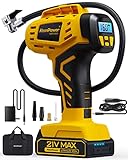
Overview: The KeenPower 21V inflator delivers rapid, cordless tire inflation for cars, motorcycles, and e-bikes up to 160 PSI. Engineered for emergencies, it features dual power modes (rechargeable battery or 12V car adapter), an auto-shutoff function, and integrated lighting, positioning itself as an all-in-one roadside solution. What Makes It Stand Out: Its standout feature is a 1-hour rapid battery recharge and QC3.0 USB output for charging phones—a lifesaver during breakdowns. The 3-mode LED flashlight (SOS/strobe/steady) enhances safety in darkness, while the ergonomic handle ensures comfortable handling during extended use. Value for Money: Competitive pricing for its dual functionality (inflator + power bank). Budget models rarely include device charging, and pricier alternatives often lack the 1-hour recharge speed. The 12-month warranty and lifetime support add significant peace-of-mind value. Strengths and Weaknesses: Strengths: Ultra-fast battery recharge; phone charging capability; versatile flashlight; lightweight ergonomic design; dual power modes. Weaknesses: Plastic construction feels less durable than metal rivals; no explicit continuous-run time specified; 12-month warranty lags behind DEWALT’s 3 years. Bottom Line: Perfect for commuters and adventurers needing emergency power for tires and devices. Its rapid recharge and USB output justify the price, though heavy-duty users may prefer more rugged builds.
3. AstroAI Cordless Tire Inflator Air Compressor 20V Rechargeable Battery Powered 160PSI Portable Air Pump with 12V Car Power Adapter Digital Pressure Gauge for Cars Motorcycles JY16P160-18(C2)Yellow

Overview: AstroAI’s JY16P160-18 combines metal durability with dual power (20V battery/12V car adapter) for inflating cars, motorcycles, and sports gear up to 160 PSI. Its 20-minute continuous runtime and backlit LCD gauge cater to practicality-focused users seeking reliability without professional pricing. What Makes It Stand Out: A full metal cylinder and gear train enable sustained high-pressure operation—uncommon in this price tier. The auto-shutoff with dual-display LCD (current vs. preset pressure) and unit-switching (PSI/bar/kPa) ensure precision, while the included storage bag enhances portability. Value for Money: Excellent mid-range value. Its metal internals outperform cheaper plastic competitors prone to overheating, and the included battery/charger (unlike DEWALT) avoids hidden costs. It matches premium features (auto-shutoff, multi-unit display) at a fraction of Milwaukee’s price. Strengths and Weaknesses: Strengths: Metal construction for durability; clear dual-pressure display; fast 1-hour battery recharge; includes storage bag; versatile for multiple vehicles. Weaknesses: Yellow color may not appeal to all; no device charging capability; 2000mAh battery limits multi-tire sessions vs. AstroAI L7. Bottom Line: A robust, user-friendly choice for everyday drivers needing dependable inflation. Its metal build and included accessories offer exceptional bang-for-buck in the mid-tier market.
4. Milwaukee M18 Inflator 2848-20
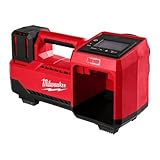
Overview: Milwaukee’s M18 Inflator 2848-20 is a no-frills, high-speed cordless tool optimized for rapid tire top-offs. Built for professionals, it leverages Milwaukee’s M18 battery ecosystem to inflate light truck and passenger tires faster than most competitors, with minimal accessories for streamlined operation. What Makes It Stand Out: It’s marketed as the “fastest” 18V inflator, claiming sub-1-minute fills for 33" light truck tires—a standout for fleet maintenance or time-critical jobs. The all-brass Schrader chuck and Presta adapter ensure broad valve compatibility, while Milwaukee’s rugged tool heritage promises longevity. Value for Money: Premium-priced but justified for tradespeople. Its speed reduces downtime during tire checks, and M18 battery compatibility (if you own Milwaukee tools) eliminates extra power costs. However, DIYers may find it overkill versus cheaper all-in-one inflators. Strengths and Weaknesses: Strengths: Unmatched inflation speed; durable all-brass components; M18 battery ecosystem integration; compact professional design. Weaknesses: No built-in light or display; requires separate M18 battery (not included); limited functionality beyond tire inflation; no auto-shutoff mentioned. Bottom Line: A specialist tool for contractors or enthusiasts with Milwaukee batteries. Skip if you need multifunctionality, but essential for pros prioritizing speed and reliability in tire maintenance.
5. AstroAI L7 Tire Inflator Portable Air Compressor Cordless Mini Bike Pump with Digital Dual Values Display, 150 PSI Car Tires Air Pump with LED Lights&Pressure Gauge for Auto, Motorcycles, Bikes, Balls
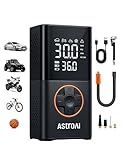
Overview: The AstroAI L7 is a featherlight (under 1 lb), ultra-portable inflator with advanced sensor tech for cars, bikes, and sports gear up to 150 PSI. Its standout features include a high-accuracy TrueGauge display, dual USB ports, and 3-mode emergency lighting, targeting cyclists and minimalist drivers. What Makes It Stand Out: Its sensor captures pressure data 200x/second (80%+ accuracy)—60% better than average—ensuring precision. The 4000mAh battery supports 8 car tires per charge, while USB-C input/output doubles as a power bank. Mini size fits bike frames or glove compartments effortlessly. Value for Money: Outstanding for its niche. The accuracy rivals pricier models, and USB device charging adds utility absent in most inflators. At its price, it outperforms bulkier competitors for cyclists and commuters needing discreet, reliable inflation. Strengths and Weaknesses: Strengths: Industry-leading pressure accuracy; compact portability; USB power bank functionality; 3 emergency light modes; 2x faster inflation rate. Weaknesses: Lower 150 PSI max vs. 160 PSI rivals; not for SUVs/trucks; smaller air capacity than AstroAI’s metal-cylinder model. Bottom Line: The top pick for cyclists, e-bike riders, and space-conscious drivers. Its accuracy, portability, and power-bank feature deliver exceptional value where size and precision matter most.
6. OlarHike Cordless Tire Inflator Portable Air Compressor, 150PSI Dual Power - 6000mAh & 12V DC, Air Pump for Car Tires, Bike, Motorcycle, Balls with LED & Digital Pressure Gauge, Car Gifts

Overview: The OlarHike Cordless Tire Inflator is a versatile, dual-power portable air compressor designed for quick tire top-offs and inflating various items like bikes, balls, and motorcycles. Its 6000mAh battery and 12V DC corded option provide flexibility for on-the-go or continuous use. What Makes It Stand Out: Dual power modes (cordless battery or car outlet) and an impressive 6000mAh battery capacity stand out, enabling up to 18 standard car tire top-offs per charge. The ultra-bright dual LED display with precise digital pressure gauge and reliable auto shut-off at preset PSI prevent over-inflation. Four preset modes and unit switching simplify operation. Value for Money: Priced competitively, it offers excellent value for daily drivers and road trippers needing reliable, frequent top-offs. While cheaper single-mode inflators exist, OlarHike’s dual-power flexibility, high battery capacity, and USB device charging justify a slight premium over basic models. Strengths and Weaknesses: Strengths: Rapid inflation (55s for car tire top-off), robust battery life, clear display, dual power, USB charging port, and comprehensive accessory kit. Weaknesses: Limited to 51 PSI max for car/truck tires (unsuitable for some heavy-duty applications), and the dual LED screen, while bright, can be slightly overwhelming in dark settings. Bottom Line: Highly recommended for car, bike, and motorcycle owners needing a dependable, portable inflator for routine maintenance and emergencies; its dual power and strong battery life make it a versatile roadside essential, though heavy-truck users should verify PSI requirements.
7. CRAFTSMAN Tire Inflator Portable Air Compressor, Cordless Mini Air Pump for Car Tires with Digital Tire Pressure Gauge, 6000mAh Battery Powered Air Pump, Max Pressure 150 PSI, 12V DC Corded

Overview: This compact CRAFTSMAN inflator delivers 150 PSI max pressure in a lightweight (1.28 lbs), cordless design, ideal for quick car tire top-offs, bikes, motorcycles, and sports equipment. It combines portability with essential smart features for everyday use. What Makes It Stand Out: Its exceptional portability (ultra-compact size, under 1.3 lbs) and 5 inflation modes (including custom presets) cater to diverse needs. The built-in 6000mAh battery supports up to 4 car tires per charge, while the versatile LED light (three modes) doubles as an emergency tool. USB-C charging and a 5V output add utility. Value for Money: Excellent value for drivers prioritizing space-saving storage and ease of use. It matches competitors on core features but excels in portability and includes useful extras like multiple nozzles and a long 10ft cord. Slightly pricier than budget models, but the CRAFTSMAN durability and included accessories justify the cost. Strengths and Weaknesses: Strengths: Extremely lightweight and compact, bright multi-mode LED light, intuitive digital display, automatic shut-off, and USB device charging. Weaknesses: Battery life is limited to ~4 car tires (less than OlarHike’s 18), and the 6000mAh battery capacity is shared with device charging, reducing inflation runtime. Bottom Line: A top pick for commuters and road trippers seeking a no-fuss, ultra-portable inflator; its small footprint, reliability, and added emergency light make it perfect for glovebox storage, though frequent heavy users may need supplemental charging.
8. ETENWOLF VORTEX S6 Tire Inflator Portable Air Compressor for Heavy-duty Vehicle, Cordless Air Pump for Car & Inflatables with 19200 mAh Battery, 100% Duty Cycle & Dual Cylinder Bike Pump, Vivid Orange

Overview: The ETENWOLF VORTEX S6 is a heavy-duty cordless inflator built for demanding tasks, featuring a massive 19200mAh battery and dual-cylinder design. It targets truck, off-road, and RV owners needing rapid, continuous inflation for large tires and inflatables. What Makes It Stand Out: Its standout features are the industry-leading 19200mAh battery (inflating 18 F-150 tires per charge), 100% duty cycle (no cooldown breaks), and ultra-fast 1.5 CFM airflow. The 1000-lumen LED doubles as a camping lantern, while 45W USB-C fast charging powers devices quickly. Handles up to 160 PSI for diverse applications. Value for Money: Premium-priced but exceptional value for heavy-vehicle owners. While overkill for standard cars, its ability to inflate large truck tires continuously without overheating justifies the cost for commercial or off-road use. Competitors lack its sustained power and battery capacity. Strengths and Weaknesses: Strengths: Unmatched battery life and speed for heavy tires, true continuous operation, rugged build, versatile inflatables support, and powerful integrated light. Weaknesses: Bulky/heavy compared to mini inflators, higher price point, and orange color may not appeal to all; not ideal for compact car storage. Bottom Line: Essential for truck, fleet, or off-road enthusiasts needing brute-force inflation; its relentless performance and massive capacity make it a workhorse investment, though casual drivers should consider smaller, cheaper alternatives.
9. CRAFTSMAN V20 Air Compressor Portable, Cordless Tire Inflator, Up To 150 PSI Tire Pump, with Digital Pressure Gauge, Tool Only (CMCE521B)

Overview: The CRAFTSMAN V20 is a streamlined, tool-only cordless inflator requiring a separate V20 battery. It delivers up to 150 PSI with a focus on ergonomic design and compatibility within CRAFTSMAN’s existing power tool ecosystem. What Makes It Stand Out: Its optimized D-handle with rubber over-mold offers superior comfort and balance during extended use—a rarity in compact inflators. Seamless integration with the CRAFTSMAN V20 battery platform eliminates the need for a dedicated charger if you already own tools, appealing to system loyalists. Value for Money: Best value for existing CRAFTSMAN V20 battery owners, as it leverages their investment. Without a battery included, standalone cost is higher than all-in-one units. However, the ergonomic design and brand reliability offer long-term savings for frequent users. Strengths and Weaknesses: Strengths: Excellent ergonomics for reduced fatigue, precise digital gauge (-2 PSI accuracy), high 150 PSI max pressure, and V20 ecosystem compatibility. Weaknesses: Battery not included (adds cost), lacks USB charging/device power, and has no built-in light or preset modes beyond basic pressure settings. Bottom Line: Highly recommended only for CRAFTSMAN V20 system users prioritizing comfort and tool synergy; otherwise, all-in-one inflators provide better immediate value and features for casual buyers.
10. Tire Inflator Portable Air Compressor - 4X Faster Inflation, 160PSI Cordless Tire Pump with Dual Power (20V Battery & 12V DC), Auto Shut Off, Digital Gauge for Car, Motorcycle, E-Bike

Overview: This inflator boasts “4X faster” inflation speeds up to 160 PSI, targeting drivers needing rapid tire top-offs for cars, trucks, motorcycles, and e-bikes. Its dual-power design supports 20V batteries or 12V car outlets. What Makes It Stand Out: The standout feature is Makita 14.4V/18V battery compatibility—a major advantage for Makita tool owners avoiding proprietary systems. The ergonomic D-handle, multi-mode LED flashlight, and broad vehicle compatibility (including RVs and e-bikes) enhance usability in low-light conditions. Value for Money: Great value for Makita battery users, eliminating redundant chargers. For others, the dual-power flexibility and fast inflation justify the price against single-mode competitors. The compact size and included accessories offer solid utility for frequent travelers. Strengths and Weaknesses: Strengths: Makita battery compatibility (huge flexibility), fast inflation, comfortable ergonomic grip, versatile LED light, and broad application range. Weaknesses: No built-in battery (requires separate purchase), and “4X faster” claims aren’t quantified against specific competitors, potentially causing confusion. Bottom Line: An excellent choice for Makita ecosystem owners or those needing rapid, versatile inflation; its tool compatibility and ergonomics shine, but non-Makita users should confirm battery logistics before buying.
Understanding Your Garage Requirements Before You Buy
Defining Your Project Scope and Frequency
Start by honestly assessing what you’ll actually use the compressor for. Are you primarily topping off tire pressure after weekend adventures, or diving into frequent trim work with brad nailers? Occasional users might prioritize compact size and quick bursts of air, while those tackling multiple projects weekly need robust runtime and faster recovery. Overestimating your needs leads to unnecessary spending, but underestimating means constant recharging frustration—so map out your typical monthly tasks to set realistic performance benchmarks.
The Critical Role of Duty Cycle in Real-World Use
Duty cycle—the percentage of time a compressor can run before needing to cool down—is often overlooked by beginners. A unit rated for 50% duty cycle at home use might handle 15 minutes of operation followed by 15 minutes of rest, which sounds adequate until you’re midway through a large fencing project. For intermittent tasks like tire inflation, a lower duty cycle suffices, but continuous applications demand 70% or higher to avoid overheating. Always cross-reference manufacturer claims with user reports on sustained performance during actual garage work.
Tank Size Versus Portability Trade-Offs
While larger tanks (like 1–2 gallon models) store more air for extended tool use, they add significant weight and bulk—problematic in cramped garages. Conversely, tankless “pancake” styles offer ultra-portability but require the motor to run constantly during use, draining batteries faster. For most home garages, a sweet spot exists between 0.5–1.5 gallons: enough reserve for 2–3 nailer triggers without sacrificing maneuverability. Measure your storage space and consider where you’ll move the unit most often (e.g., between garage and driveway) to guide this choice.
Decoding Performance Specifications That Matter
CFM: Why Airflow Determines Tool Compatibility
Cubic Feet per Minute (CFM) measures airflow volume and is the non-negotiable factor for tool compatibility. Each pneumatic tool lists a minimum CFM requirement at specific PSI—exceeding this causes stalling. Crucially, CFM ratings are often listed at 90 PSI (a common nailer pressure), but some budget models only achieve target CFM at lower pressures. Always compare CFM at the PSI your primary tools require; a compressor delivering 1.5 CFM at 90 PSI outperforms one with 2.0 CFM at 40 PSI for finishing work.
PSI Limits: Matching Pressure to Your Toolkit
Pounds per Square Inch (PSI) indicates maximum pressure output, but exceeding your tools’ PSI needs wastes energy and strains components. Most home tasks—tire inflation, stapling, or inflating sports equipment—operate below 100 PSI, while impact wrenches may demand 120+ PSI. However, pushing a compressor to its absolute PSI limit drastically reduces runtime. Aim for a unit with 20–30 PSI headroom above your highest-need tool; this ensures consistent performance without prematurely draining the battery.
Real-World Runtime vs. Advertised Benchmarks
Manufacturers often quote “maximum runtime” under ideal lab conditions (e.g., intermittent use at low PSI), which rarely mirrors garage reality. A compressor claiming “30 minutes runtime” might only sustain 10 minutes when powering a 18-gauge nailer continuously. Scrutinize independent reviews for actual usage data: look for metrics like “number of tire inflations per charge” or “continuous nailer cycles.” Also factor in recharge speed—some batteries hit 80% capacity in 20 minutes, keeping projects moving.
Battery Technology: The Core of Cordless Value
Voltage Tiers: 20V vs. Higher Platforms Compared
20V MAX systems dominate the home market for good reason: widespread battery compatibility across tool ecosystems (like drills or saws) reduces long-term costs. While 36V+ models offer more power for heavy-duty tasks, they’re often overkill for garage use and carry premium pricing. Unless you regularly run high-CFM impact tools, 20V strikes the best balance—check if the compressor accepts your existing tool batteries to maximize value through shared investments.
Lithium-ion Advantages Beyond Just Power
Modern lithium-ion batteries deliver more than raw voltage; their energy density enables lighter weight and consistent power until depletion, unlike older NiCd tech that sputters prematurely. Crucially, they lack “memory effect,” so partial recharges won’t degrade capacity. For garage compressors, this means no need to fully drain batteries between uses—a major time-saver. Also, verify if the unit includes a battery fuel gauge; guessing charge levels leads to mid-project surprises.
Temperature Management for Longevity
Battery performance plummets in cold garages, with some units losing 30%+ runtime below 50°F (10°C). Premium models integrate thermal protection that throttles output before damage occurs, while budget options may shut down abruptly. If you work in unheated spaces, prioritize compressors with explicit cold-weather certifications or user-tested reliability in low temps—this isn’t just convenience, it’s battery lifespan preservation.
Ergonomics and Usability for Daily Garage Life
Weight Distribution and Handle Design Nuances
A compressor weighing 25 lbs might feel manageable when empty, but poor balance turns it into a wrestling match when hauling across uneven driveways. Look for ergonomic handles positioned near the center of gravity, not just tacked onto the tank. Some models feature molded grips with rubberized padding that reduce hand fatigue during extended carries—a small touch that matters after multiple trips from garage to yard.
Moisture Control: Preventing Rust in Your Air System
Compressed air naturally contains moisture, which condenses in tanks and hoses, leading to rust that damages tools. While large shop compressors have automatic drains, home models often rely on manual valves. Units with easy-access drain ports (ideally at the tank’s lowest point) encourage regular maintenance—skip this, and you’ll replace hoses and tools prematurely. Bonus points for integrated moisture traps in the regulator.
Noise Considerations for Neighborhood Harmony
Even “quiet” compressors hit 70–80 dB during operation—comparable to a lawnmower—which strains relationships during early morning or late-night projects. Seek units with sound-dampening enclosures or oil-free pumps (typically quieter than oil-lubricated ones). Realistically, no cordless compressor is whisper-quiet, but prioritizing sub-75 dB models shows consideration for your surroundings without sacrificing performance.
Strategic Buying Considerations for Lasting Value
Warranty Depth Beyond the Standard Year
A basic 1-year warranty is table stakes, but true value shows in coverage extensions for high-wear parts like motors or batteries. Some brands offer 3-year warranties when registering online, while others exclude batteries entirely. Scrutinize fine print: does “limited lifetime” cover only the pump, or critical electronics? Brands with U.S.-based service centers also resolve claims faster than international mail-in programs.
Hidden Costs in Accessories and Upgrades
That affordable base price can balloon with essential add-ons. Does it include a quality regulator/gauge combo, or will you spend $30 extra? Check hose compatibility—some require proprietary connectors. Also, factor in future battery costs; third-party replacements for niche voltage systems cost 50% more than mainstream 20V options. Budget 15–20% of the compressor’s price for necessary accessories to avoid sticker shock.
Seasonal Sales Timing for Maximum Savings
Cordless tool sales follow predictable cycles: major holidays (Memorial Day, Labor Day) feature deep discounts as retailers clear old inventory for new models. January sees post-holiday deals, while November Black Friday events target gift buyers. Avoid Q4 if possible—new model launches often devalue older versions by 20–30% within months. Signing up for retailer restock alerts can also snag open-box bargains.
Maintaining Your Investment for Years of Service
Simple Daily Habits to Extend Battery Life
After use, always disconnect the battery to prevent parasitic drain—a common issue where electronics siphon charge even when idle. Store batteries at 40–60% charge in climate-controlled areas; full capacity storage degrades cells faster. Wipe the compressor down after dusty projects to keep vents clear, and never leave it in direct sunlight (heat accelerates battery decay). These habits can double usable lifespan.
Troubleshooting Common Home-Use Issues
If tools stall mid-task, check the regulator setting first—many users accidentally set PSI too low for the tool’s demand. For slow inflation, inspect hose connections for leaks (soap-and-water tests reveal bubbles). If the motor runs but delivers weak pressure, the intake filter is likely clogged with garage dust; most have washable foam elements. Keeping a spare O-ring kit ($5) prevents downtime from minor seal failures.
Frequently Asked Questions
What’s the minimum CFM I need for common garage tools?
Most tire inflators and brad nailers require 0.5–1.5 CFM at 60–90 PSI. Always match CFM to your highest-demand tool—e.g., an impact wrench might need 3.0+ CFM, making lower-CFM units unsuitable.
Can I use a cordless compressor for painting?
Yes, but only with low-CFM HVLP spray guns designed for portability. High-volume painting drains batteries too quickly; prioritize models with 1.5+ CFM at 40 PSI and extended runtime.
How do I prevent battery swelling in storage?
Store batteries at 40–60% charge in cool, dry places (ideally 50–70°F). Avoid garages with extreme temperature swings, and remove batteries from the compressor during long storage.
Are oil-free compressors worth the trade-offs?
For home use, absolutely. They’re lighter, require less maintenance (no oil changes), and start reliably in cold temps—though they may be slightly noisier. Oil-lubricated models suit continuous industrial use, not occasional garages.
Why does my compressor stop after a few minutes?
This usually indicates overheating from exceeding duty cycle limits or blocked cooling vents. Let it rest 20+ minutes, clean dust from vents, and avoid sustained max-PSI use.
Can I leave the battery on the charger overnight?
Modern lithium-ion chargers auto-stop at full capacity, so occasional overcharging is safe. But habitual full-charge storage degrades cells—remove it once charged for best longevity.
How often should I drain tank moisture?
After every use if humidity is high, or weekly in dry climates. Skip this, and rust will contaminate your air supply, damaging tool internals over time.
Is a higher PSI always better?
No—exceeding your tool’s PSI requirement wastes energy and increases wear. Match PSI to your tool specs (e.g., 90 PSI for nailers) plus a 10–15 PSI buffer.
What hose length is ideal for home use?
25–50 feet balances reach and pressure loss. Beyond 50 feet, airflow drops significantly; use 3/8-inch diameter hoses to minimize resistance versus thinner 1/4-inch options.
Can I use a car jumper pack as a power source?
Not recommended. Jumper packs lack stable voltage regulation needed for compressor motors, risking damage. Stick to manufacturer-approved batteries designed for sustained high drain.
See Also
- 10 Best Value Cordless Air Compressors for Family Vehicles in 2026
- 10 Best Value Cordless Air Compressors for Everyday Maintenance in 2026
- 10 Best Value Rechargeable Air Compressors for Home Garages in 2026
- 10 Best Cordless Air Compressors for Quick Tire Repairs This Year
- The 10 Ultimate Best Truck Air Compressors for Heavy-Duty Use in 2026