Table of Contents
There’s nothing quite like the frustration of turning the key on your cherished classic car only to be greeted by a disheartening click and silence. That sinking feeling, especially after meticulously preparing for a weekend cruise or a local car show, is all too familiar for vintage vehicle owners. Batteries in these beloved machines aren’t just power sources; they’re the vital spark connecting us to automotive history. Yet, unlike modern vehicles driven daily, classics often sit idle for weeks or months, slowly draining life from their batteries through natural self-discharge and parasitic draws from security systems or clocks. This silent enemy, sulfation, creeps in as lead sulfate crystals harden on the battery plates, permanently reducing capacity and lifespan. The result? A dead battery that can leave you stranded and facing costly replacements, derailing your plans and dimming the joy of ownership.
Enter the humble trickle charger – far more than just a simple plug-in accessory. For the dedicated classic car enthusiast, it’s an essential piece of preservation equipment, as crucial as proper tire inflation or a quality car cover. But not all chargers are created equal, especially when dealing with the unique demands of older electrical systems and sensitive vintage batteries. Choosing the wrong type, or using even a decent one incorrectly, can do more harm than good, potentially damaging delicate wiring or ruining an irreplaceable NOS battery. Understanding the nuances of modern charging technology specifically tailored for low-maintenance, long-term vehicle storage is paramount. This guide cuts through the marketing noise to give you the clear, actionable knowledge needed to keep your classic’s heart reliably beating, season after season, ensuring it’s always ready for that next adventure down memory lane.
Top 10 Trickle Chargers for Classic Cars
Detailed Product Reviews
1. NOCO GENIUS1: 1A 6V/12V Smart Battery Charger – Automatic Maintainer, Trickle Charger & Desulfator with Overcharge Protection & Temperature Compensation – for Lead-Acid & Lithium Batteries

Overview: The NOCO GENIUS1 is a compact 1A smart charger designed for maintaining and reviving small 6V/12V lead-acid and lithium (LiFePO4) batteries. It replaces trickle chargers with automatic, safe charging for vehicles like motorcycles, ATVs, and lawn equipment. Its core function is long-term battery care without user intervention. What Makes It Stand Out: Its standout features include charging batteries as low as 1 volt (or down to 0V via Force Mode), temperature compensation for optimal charging in any climate, and multi-chemistry compatibility (AGM, Gel, Flooded, LiFePO4). The 35% smaller size and higher power density than previous models enhance portability without sacrificing functionality. Value for Money: Priced moderately, it offers excellent value for owners of smaller vehicles or seasonal equipment. The integrated desulfation, indefinite maintenance capability, and robust build justify the cost compared to basic trickle chargers, though higher-amp models exist for larger batteries at a premium. Strengths and Weaknesses: Strengths: Exceptionally compact; safe for indefinite connection; revives deeply discharged batteries; wide battery compatibility; temperature compensation. Weaknesses: 1A output is too slow for large automotive batteries; lacks a display screen; higher initial cost than ultra-basic chargers. Bottom Line: An ideal, set-and-forget solution for maintaining small batteries. Highly recommended for motorcycles, garden tools, or classic cars where slow, safe charging is paramount, but insufficient for daily-driven full-size vehicles.
2. NOCO GENIUS10: 10A 6V/12V Smart Battery Charger – Automatic Maintainer, Trickle Charger & Desulfator with Overcharge Protection & Temperature Compensation – for Lead-Acid & Lithium Batteries

Overview: The NOCO GENIUS10 is a high-capacity 10A smart charger targeting larger 6V/12V lead-acid and lithium (LiFePO4) batteries found in cars, trucks, SUVs, and marine applications. It delivers rapid charging combined with intelligent maintenance, making it suitable for both routine use and seasonal storage. What Makes It Stand Out: Its key differentiator is the powerful 10A output (115% more than predecessors) in a 17% smaller footprint, enabling significantly faster charging for large batteries. Like the GENIUS1, it features Force Mode for dead batteries (0V), precise temperature compensation, and safe indefinite connection with automatic desulfation cycles. Value for Money: While positioned at a premium price point, it offers strong value for users with standard automotive or marine batteries. The speed, safety features, and versatility (handling everything from motorcycles to trucks) outperform cheaper multi-stage chargers and justify the investment for frequent use. Strengths and Weaknesses: Strengths: Very fast 10A charging; compact for its power; recovers dead batteries; comprehensive battery chemistry support; excellent temperature management. Weaknesses: Overkill for very small batteries (e.g., scooters); higher price than lower-amp Genius models; no built-in display for charge status. Bottom Line: The top choice for car, truck, or boat owners needing a fast, reliable, and versatile charger/maintainer. Highly recommended for daily drivers and larger vehicles, though smaller-battery users should consider lower-amp alternatives.
3. Battery Tender Plus 12V 1.25 AMP Car & Motorcycle Battery Charger and Maintainer, Float Charge for Automotive, and ATVs - Smarter Than a Trickle Charger

Overview: The Battery Tender Plus is a dedicated 1.25A 12V smart charger and maintainer focused on automotive, motorcycle, and powersport applications. It utilizes a 4-step charging process to safely maintain batteries long-term, replacing outdated trickle chargers with adaptive intelligence. What Makes It Stand Out: Its defining feature is the true 4-step charging algorithm ( Bulk, Absorption, Float, and a unique Recondition step), which actively optimizes battery health beyond simple float charging. The included quick-disconnect harness and clear two-color LED status indicator enhance user convenience significantly. Value for Money: Offered at a competitive mid-range price, it provides excellent value, especially considering the 10-year warranty and lifetime support. It outperforms basic 1-2A chargers with its advanced algorithm and robust accessories, making it a cost-effective long-term solution for common 12V batteries. Strengths and Weaknesses: Strengths: Proven 4-step charging for battery longevity; user-friendly quick-disconnect; reliable two-color LED; strong warranty; ideal for motorcycles/ATVs. Weaknesses: 12V only (no 6V support); limited to lead-acid (no lithium compatibility); slower recovery for deeply discharged batteries vs. Force Mode chargers. Bottom Line: A highly reliable and user-friendly maintainer for standard 12V lead-acid batteries. Strongly recommended for motorcycle, ATV, and car owners seeking simplicity and proven battery care, but avoid for lithium or 6V systems.
4. NOCO GENIUS2: 2A 6V/12V Smart Battery Charger – Automatic Maintainer, Trickle Charger & Desulfator with Overcharge Protection & Temperature Compensation – for Lead-Acid & Lithium Batteries

Overview: The NOCO GENIUS2 is a versatile 2A smart charger bridging the gap between the GENIUS1 and GENIUS5. It handles 6V/12V lead-acid (AGM, Gel, Flooded) and lithium (LiFePO4) batteries, targeting motorcycles, classic cars, and medium-sized equipment requiring faster charging than 1A models. What Makes It Stand Out: It emphasizes being “one of the most powerful, compact, and energy-efficient” 2A chargers, featuring Force Mode for 0V batteries and advanced temperature compensation. The unique 24-hour automatic reconditioning cycle actively combats sulfation, extending battery life beyond basic maintenance. Value for Money: Positioned slightly above the GENIUS1, it offers compelling value for users needing more amperage than 1A but not requiring 5A. The faster charge time for common motorcycle/ATV batteries, lithium support, and reconditioning justify the modest price increase over entry-level smart chargers. Strengths and Weaknesses: Strengths: Optimal 2A speed for mid-sized batteries; 0V Force Mode; reconditions batteries automatically; compact design; broad chemistry compatibility. Weaknesses: Still too slow for large automotive batteries; no visual display (reliant on basic LEDs); limited availability of replacement cables. Bottom Line: The perfect sweet spot for motorcycle, powersport, and small classic car owners. Highly recommended as a significant upgrade over 1A models for faster, smarter maintenance without the bulk or cost of higher-amp units.
5. NOCO GENIUS5: 5A 6V/12V Smart Battery Charger – Automatic Maintainer, Trickle Charger & Desulfator with Overcharge Protection & Temperature Compensation – for Lead-Acid & Lithium Batteries

Overview: The NOCO GENIUS5 is a mid-range 5A smart charger designed for efficient charging and maintenance of 6V/12V lead-acid and lithium (LiFePO4) batteries in cars, SUVs, boats, and larger powersport vehicles. It balances speed and safety for regular automotive use. What Makes It Stand Out: It delivers 65% more power in a 34% smaller package than older equivalents. Key features include 0V charging via Force Mode, precise temperature-adjusted charging, and indefinite safe maintenance with automatic desulfation. Its 5A output provides a practical sweet spot for most passenger vehicles. Value for Money: Offers excellent value for car and light truck owners. The faster charging than 1A/2A models, combined with NOCO’s safety and compatibility features, provides a strong return on investment compared to cheaper, less versatile chargers, especially for daily-driven vehicles needing occasional boosts. Strengths and Weaknesses: Strengths: Ideal 5A speed for cars/SUVs; recovers dead batteries effectively; temperature compensation; safe long-term use; supports multiple battery types. Weaknesses: Overpowered for very small batteries; lacks a detailed display; higher cost than basic 2A maintainers for simple storage needs. Bottom Line: A highly recommended all-rounder for standard automobile batteries. Perfect for drivers needing reliable, relatively quick charging and maintenance for cars, trucks, or boats, striking the best balance of speed, safety, and versatility in the mid-amp range.
6. Battery Tender Junior 12V, 750mA Charger and Maintainer: Automatic 12V Powersports for Motorcycle, ATVs, and More - Smarter Than a Trickle Charger - 021-0123

Overview: The Battery Tender Junior is a compact, purpose-built 12V charger and maintainer designed specifically for powersport batteries in motorcycles, ATVs, and similar vehicles. It emphasizes safe, long-term battery storage without user intervention. What Makes It Stand Out: Its intelligent 4-step charging program (Initialization, Bulk, Absorption, Float) optimizes battery health far better than basic trickle chargers, preventing overcharging. Key differentiators include spark-proof circuitry, automatic reverse-polarity detection, a clear two-color LED status indicator, and a versatile 12-foot cord with both ring terminals and alligator clips for hard-to-reach installations. Value for Money: Priced mid-range, it offers exceptional value for powersport owners needing reliable, set-and-forget maintenance. The included 5-year warranty and lifetime support significantly outweigh competitors at similar price points, especially considering its focused design for smaller batteries where overcharging risks are high. Strengths and Weaknesses: Strengths: Ultra-safe operation (spark-proof, reverse polarity protection), long warranty, compact size, ideal slow-charge rate (750mA) for small batteries, excellent float-maintenance mode. Weaknesses: Lower amperage means slower initial charging for larger batteries, lacks advanced diagnostics or desulfation features found in pricier models. Bottom Line: An outstanding, no-nonsense maintainer for motorcycles and ATVs. Its safety, reliability, and superior maintenance mode justify the price, making it a top recommendation for seasonal vehicle storage despite slower bulk charging.
7. 1.75-Amp Car Battery Charger, 6V and 12V Smart Fully Automatic Battery Charger Maintainer, Trickle Charger, Battery Desulfator for Car, Lawn Mower, Motorcycle, Boat, Marine Lead Acid Batteries

Overview: This NEXPEAK 1.75A charger is a versatile 4-in-1 solution (charger, maintainer, trickle charger, desulfator) for 6V/12V lead-acid batteries across cars, boats, lawn mowers, and powersports, featuring a clear LCD display. What Makes It Stand Out: The standout feature is the intelligent LCD screen, providing real-time data on charging percentage, voltage, and current—uncommon at this price. Its advanced 7-stage charging includes dedicated desulfation mode to revive neglected batteries, plus dual charging modes (STD auto-shutoff vs. trickle maintain) and robust multi-protection safeguards. Value for Money: Excellent value as a feature-packed, universal charger. The LCD interface and desulfation capability typically cost more, while the 2-year warranty and long cord with detachable connectors enhance practicality. It outperforms basic maintainers and rivals pricier units lacking its display. Strengths and Weaknesses: Strengths: Highly informative LCD display, effective battery repair function, true 6V/12V auto-detection (with manual override), comprehensive safety protections, compact design. Weaknesses: LCD can be hard to read in direct sunlight, plastic casing feels less durable than premium brands, no temperature compensation. Bottom Line: A superb choice for users wanting visibility into the charging process and battery revival features. Its balance of smart tech, safety, and affordability makes it ideal for DIYers maintaining diverse vehicle batteries.
8. NOCO GENIUS2D: 2A 12V Smart Onboard Battery Charger - Direct-Mount Automatic Maintainer, Trickle Charger & Desulfator with Overcharge Protection & Temperature Compensation – for Lead-Acid Batteries
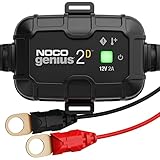
Overview: The NOCO GENIUS2D is a direct-mount, under-the-hood 12V smart charger designed for permanent installation on motorcycles, scooters, or small vehicles, combining charging, maintenance, and desulfation in a rugged package. What Makes It Stand Out: Its direct-mount design with a snap-fit bracket enables permanent, clean under-hood installation—ideal for tight spaces. The integrated thermal sensor adjusts charging based on ambient temperature, preventing damage in extreme climates. It also revives deeply discharged batteries (down to 1V) using Force Mode and includes automatic desulfation. Value for Money: Positioned as a premium product, its price reflects the specialized direct-mount convenience, temperature intelligence, and NOCO’s reputation for reliability. It’s cost-effective for users needing a permanent, set-and-forget solution compared to adapters for standard chargers. Strengths and Weaknesses: Strengths: Seamless direct-mount installation, critical temperature compensation, effective dead-battery recovery, compact and weather-resistant, robust build quality. Weaknesses: Higher cost than portable options, limited to 12V lead-acid (no 6V/lithium support), requires basic DIY installation. Bottom Line: The definitive choice for permanent onboard charging where space is limited. Its temperature-aware precision and ease of integration justify the investment for powersport enthusiasts prioritizing battery longevity.
9. MOTOPOWER MP00205A 12V 800mA Automatic Battery Charger, Maintainer, Trickle and Desulfator
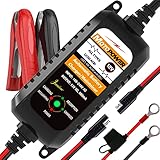
Overview: The MOTOPOWER MP00205A is an entry-level 12V smart charger targeting budget-conscious users for cars, motorcycles, and lawn equipment, emphasizing safety certifications and automatic desulfation. What Makes It Stand Out: ETL/UL certification provides strong safety assurance uncommon in this segment. Its automatic desulfation pulse technology works without user input, while zero-standby power drain and spark-proof operation enhance safety. The built-in 24-hour timer adds an extra layer of overcharge prevention. Value for Money: A high-value option under $30, offering certified safety and desulfation typically found in more expensive models. The inclusion of ETL certification and robust multi-protection (reverse polarity, short circuit) makes it a trustworthy budget pick for basic maintenance. Strengths and Weaknesses: Strengths: Top-tier safety certifications (ETL/UL), truly automatic desulfation, energy-efficient (zero standby drain), affordable price, simple plug-and-play operation. Weaknesses: Slow charge rate (800mA), no voltage display or diagnostics, basic build quality, limited to 12V lead-acid only. Bottom Line: An excellent, safety-focused budget charger for occasional use on standard 12V batteries. Ideal for beginners or as a secondary maintainer where cost is critical, though lacking advanced features for demanding applications.
10. NOCO GENIUS2X4: 8A 4-Bank Smart Battery Charger (2A/Bank) - 6V/12V Automatic Maintainer, Trickle Charger & Desulfator with Overcharge Protection & Temperature Compensation – for Lead-Acid & Lithium

Overview: The NOCO GENIUS2X4 is a high-end 4-bank charger capable of independently maintaining four 6V/12V batteries simultaneously—perfect for boats, RVs, or workshops with multiple vehicles. What Makes It Stand Out: Its four independent charging banks (2A each) support mixed battery types (lead-acid and lithium LiFePO4) in one unit. Temperature compensation, dead-battery recovery (down to 1V), and automatic desulfation per bank are industry-leading. The “set and forget indefinitely” promise is backed by superior monitoring. Value for Money: Premium-priced but unmatched for multi-battery setups. Paying separately for four quality smart chargers would cost significantly more. Lithium compatibility, bank independence, and NOCO’s reliability deliver strong ROI for professionals or serious enthusiasts managing complex battery systems. Strengths and Weaknesses: Strengths: Four independent smart banks, lithium support, best-in-class temperature compensation, robust dead-battery recovery, compact design for capacity. Weaknesses: Very high cost, overkill for single-battery users, no individual bank displays (rely on indicator LEDs). Bottom Line: The ultimate solution for maintaining multiple batteries of varying chemistries. Essential for marine/RV owners or workshops despite the price, offering unparalleled convenience, safety, and advanced tech across all four channels.
Understanding Classic Car Battery Challenges
Why Standard Chargers Fall Short
Standard automotive battery chargers designed for quick top-ups on daily drivers lack the precision needed for long-term classic car storage. They often deliver too much voltage or current for extended periods, leading to overcharging. This is particularly dangerous for older lead-acid batteries common in classics, as excessive gassing can cause electrolyte loss, plate warping, and even case damage. Modern maintenance chargers operate on a fundamentally different principle, focusing on gentle, sustained conditioning rather than rapid power delivery.
The Sulfation Threat Explained
Sulfation is the primary killer of idle car batteries. When a battery sits below a full state of charge, lead sulfate crystals form on the plates. Initially soft and reversible, these crystals harden over time (weeks or months), becoming insoluble. This process permanently reduces the battery’s ability to accept and deliver charge, robbing it of cranking power. A proper maintenance charger actively combats sulfation by keeping the battery at an optimal float voltage, preventing the deep discharge that triggers crystal formation.
Parasitic Drain: The Silent Battery Killer
Even when switched off, many classic cars (especially those with modern retrofits like alarms, radios, or fuel pumps) experience small, constant electrical draws known as parasitic drain. While negligible over a few days, this drain can completely deplete a battery in weeks. A quality trickle charger continuously offsets this drain, maintaining the battery at a healthy voltage without the need for frequent manual intervention, which is often forgotten until it’s too late.
Key Features to Prioritize in a Maintenance Charger
Smart Charging Technology Essentials
Look for chargers featuring multi-stage charging intelligence. This typically includes desulfation, bulk, absorption, and float stages. The critical phase for storage is the final float stage, where the charger delivers a precise, low voltage (usually around 13.2V - 13.8V for lead-acid) just sufficient to counteract self-discharge and parasitic drain without causing overcharge or gassing. True “smart” chargers automatically sense battery condition and adjust their output accordingly.
Compatibility with Battery Chemistry Types
Classic cars predominantly use traditional flooded lead-acid (FLA) batteries, but some may have upgraded to Absorbed Glass Mat (AGM) or even gel types. Each chemistry requires slightly different charging voltages. A versatile maintenance charger should offer selectable profiles or automatic detection to ensure it delivers the correct voltage for your specific battery type. Using a charger set for AGM on a standard FLA battery, for instance, can cause chronic undercharging.
Voltage Regulation Precision Matters
Consistent, accurate voltage output during the float stage is non-negotiable. Inconsistent voltage can swing between undercharging (allowing sulfation) and overcharging (causing damage). High-quality chargers utilize advanced circuitry to maintain voltage within a very tight tolerance (e.g., +/- 0.1V), providing stable, reliable maintenance. Cheaper units often have wider voltage fluctuations that are detrimental over time.
Output Amperage: Less is Often More
For pure long-term maintenance (not recharging a dead battery), lower amperage is generally better. Chargers in the 0.75A to 1.5A range are ideal for most classic car batteries during storage. Higher amperage chargers (2A+) might be useful for occasionally recharging a significantly depleted battery but can be too aggressive for indefinite float maintenance, potentially causing unnecessary stress. Prioritize the float stage capability over raw charging speed.
Selecting the Right Charger for Your Specific Needs
Assessing Your Classic’s Electrical System Age
The age and condition of your vehicle’s wiring harness significantly impact charger selection. Very early classics (pre-1960s) often have simpler, less robust wiring. While rare, overvoltage from a malfunctioning charger could pose a higher risk. Opt for chargers with robust safety certifications (like CE, ETL, RoHS) and multiple built-in protections. Modern retrofits in older cars might handle slightly higher tolerances, but caution is still key.
Considering Storage Environment Factors
Where your classic lives matters. Is it in a temperature-controlled garage, an unheated barn, or exposed to humidity? Some advanced chargers offer temperature compensation, automatically adjusting the float voltage based on ambient temperature (lower voltage when hot, slightly higher when cold). This is highly beneficial for environments with significant seasonal temperature swings, optimizing battery health year-round.
Evaluating Connector Types and Installation
Alligator clips are common but can be cumbersome and prone to accidental disconnection. Consider chargers with permanent mounting options like SAE plugs (requires installing a mating socket on the car) or Anderson Powerpole connectors. These provide a secure, weather-resistant connection point, making maintenance effortless – simply plug in the charger when parking for storage. Ensure the connector choice aligns with your planned usage and garage setup.
The Importance of Robust Safety Protections
Beyond basic overcharge protection, prioritize chargers with comprehensive safeguards: reverse polarity protection (prevents damage if leads are swapped), spark-proof technology (safe connection/disconnection), short-circuit protection, and over-temperature shutdown. These features are critical for peace of mind, especially in potentially dusty or cluttered garage environments where accidents can happen.
Proper Usage and Maintenance Best Practices
Preparing Your Battery for Long-Term Storage
Before connecting a maintenance charger, ensure the battery is as clean and fully charged as possible. Clean terminals with a baking soda solution to remove corrosion, check electrolyte levels in FLA batteries (top up with distilled water if plates are exposed), and give the battery a full charge using an appropriate charger if it’s below 12.6V. Connecting a maintenance charger to a significantly depleted or dirty battery reduces its effectiveness.
Correct Connection Sequence is Crucial
Always connect the charger to the battery before plugging it into the wall outlet. Connect the positive (red) clamp to the battery positive terminal, then the negative (black) clamp to the battery negative terminal or a solid, unpainted engine ground point (often safer for classics to avoid potential sparks near the battery). Reverse the sequence when disconnecting: unplug from the wall first, then remove clamps (negative first, then positive). This minimizes spark risk.
Monitoring During Initial Use
While modern smart chargers are largely “set and forget,” it’s wise to check the battery and charger periodically during the first few storage cycles. Verify the charger has transitioned to the float/maintenance mode (often indicated by a specific LED), feel for excessive heat on the charger or battery (a slight warmth is normal, hot is not), and ensure no unusual smells or signs of electrolyte leakage occur, especially with FLA batteries.
Seasonal Checks and Maintenance Routines
Even with a maintenance charger, perform a brief check every 4-6 weeks during long storage. Visually inspect terminals for corrosion, ensure connections are tight, and confirm the charger’s status indicators are correct. For FLA batteries, check electrolyte levels quarterly and top up with distilled water only if absolutely necessary (a good charger minimizes water loss). Never add acid.
Understanding Charger Status Indicators
Learn what the LED lights or display on your specific charger model signify. Common indicators include: Power On, Bulk Charge, Absorption, Float/Maintenance, Error (e.g., bad battery, reverse polarity). Knowing these allows you to quickly verify the charger is functioning correctly and identify potential issues early, preventing battery damage.
Safety Considerations for Classic Car Enthusiasts
Avoiding Fire Hazards in the Workshop
Never place a charger directly on the battery or atop flammable materials like cardboard, rags, or gasoline-soaked floors. Ensure adequate ventilation around the charger, especially in enclosed garages. Keep the charger away from direct water spray or excessive dust. Use chargers certified by recognized testing laboratories (UL, ETL, CE) which undergo rigorous safety testing for fire and electrical hazards.
Protecting Delicate Vintage Wiring
While modern smart chargers are generally safe, the age of classic car wiring necessitates caution. Avoid routing charger cables over sharp edges or near hot exhaust components. If using permanent connectors, ensure the wiring harness leading to the connector is appropriately sized and fused. A small in-line fuse (1-2A) on the negative lead near the battery adds an extra layer of protection for the vehicle’s wiring.
Safe Handling of Lead-Acid Batteries
Always wear safety glasses and gloves when handling batteries. Work in a well-ventilated area, especially when checking FLA batteries, as they can emit flammable hydrogen gas during charging. Keep sparks, flames, and cigarettes far away. Have baking soda and water nearby to neutralize any accidental acid spills. Remember, battery acid is corrosive and requires careful handling.
Frequently Asked Questions
Frequently Asked Questions
Can I leave a maintenance charger connected all winter? Yes, a modern smart maintenance charger designed for long-term use can and should be left connected throughout winter storage. Its primary function is to safely maintain the battery indefinitely by counteracting self-discharge and parasitic drain without overcharging, provided it’s the correct type for your battery chemistry.
Will a trickle charger prevent my battery from freezing? A fully charged battery has a much lower freezing point than a discharged one. By keeping the battery at a full state of charge, a maintenance charger significantly reduces the risk of the electrolyte freezing in cold temperatures, which can crack the battery case. However, it doesn’t generate heat to warm the battery itself.
Is it safe to use on a car with a classic points ignition system? Generally, yes. Modern smart maintenance chargers operate at very low currents during the float stage, posing minimal risk to sensitive points or condensers. However, ensure the charger is disconnected before starting the engine, as the charging system voltage will then take over. Avoid cheap, unregulated “dumb” trickle chargers, which can cause issues.
How do I know if my charger is actually working while connected? Check the charger’s status indicators (LEDs or display). Most will show a specific light (often green or labeled “Float” or “Maintain”) when correctly in maintenance mode. You can also carefully measure the voltage at the battery terminals with a multimeter; it should read between 13.2V and 13.8V for a lead-acid battery in float mode.
Can a maintenance charger revive a completely dead battery? Some advanced models have a dedicated “recovery” or “recondition” mode designed to safely attempt revival of moderately sulfated batteries. However, a severely dead or physically damaged battery (e.g., shorted cell) usually cannot be revived by any charger. For a truly dead battery, a standard charger might be needed first to bring it up to a minimal voltage before the maintenance charger can take over.
Do I need to disconnect the battery negative terminal before connecting the charger? Generally, no, and it’s often unnecessary and potentially problematic for classics with sensitive electronics or memory settings (though less common). Connecting directly to the battery terminals with the charger unplugged is standard and safe with modern smart chargers due to their spark-proof technology and reverse polarity protection. Always follow the specific sequence: connect to battery first, then plug in.
Are lithium battery chargers compatible with classic car lead-acid batteries? No. Chargers specifically designed for lithium iron phosphate (LiFePO4) batteries output a different, higher voltage profile (typically around 14.4V float) that is unsafe for traditional lead-acid (flooded, AGM, gel) batteries, causing severe overcharging and damage. Ensure your charger is explicitly compatible with your battery’s chemistry.
What’s the difference between a trickle charger and a float charger? “Trickle charger” is often used generically, but technically, a true trickle charger delivers a constant low current (e.g., 1-2A) regardless of battery state, risking overcharge. A float/maintenance/smart charger adjusts its output, delivering higher current only when needed and dropping to a safe, precise float voltage for indefinite storage. For classics, a smart float charger is essential.
Can I use a maintenance charger on a battery that’s already connected to the car? Yes, this is the standard and intended use case. These chargers are designed to be connected directly to the battery while it remains installed in the vehicle, counteracting parasitic drain and self-discharge without harming the vehicle’s electrical system when used correctly.
How often should I replace my maintenance charger? There’s no fixed timeline, but quality units can last 5-10 years or more. Signs it might need replacing include inconsistent charging (battery still dies in storage), physical damage to the casing or cables, excessive heat during normal float operation, flickering or incorrect status lights, or if it fails to initiate the charging cycle properly. Always prioritize safety and replace if in doubt.
See Also
- The Complete Guide to the 10 Best Battery Testers for Classic Cars
- 10 Affordable Trickle Chargers That Don’t Sacrifice Quality in 2026
- 10 Top-Rated Trickle Chargers According to Experts in 2026
- 10 Expert-Recommended Trickle Chargers for Seasonal Vehicle Use in 2026
- 10 Best Budget Trickle Chargers Under $60 for Everyday Car Owners in 2026