Table of Contents
Imagine this: you’re miles from the nearest town, surrounded by breathtaking canyon views at sunset, and your engine suddenly refuses to turn over. That sinking feeling as you realize your phone has one bar of signal and the temperature is dropping fast. For road trip adventurers, a dead car battery isn’t just an inconvenience—it’s a potential crisis that can derail days of meticulously planned exploration. The open road promises freedom, but it also demands self-reliance. Relying solely on passing strangers or distant tow trucks is a gamble no seasoned traveler should take, especially when venturing into remote areas where help might be hours away.
This is where the modern portable jump starter transforms from a simple car accessory into an indispensable piece of survival gear. Gone are the days of bulky, unreliable jumper cables requiring another vehicle. Today’s compact lithium-powered units fit neatly in your glove compartment or cargo box, offering peace of mind that you can resurrect your ride solo, anytime, anywhere. For the 2026 road tripper—whether navigating desert trails, mountain passes, or coastal highways—a reliable jump starter is as crucial as a first-aid kit or spare water. It’s not just about convenience; it’s about maintaining control over your adventure when the unexpected strikes far from civilization.
Top 10 Battery Jump Starters
Detailed Product Reviews
1. NOCO Boost GB40: 1000A UltraSafe Jump Starter – 12V Lithium Battery Booster Pack, Portable Jump Box, Power Bank & Jumper Cables - for 6.0L Gas and 3.0L Diesel Engines
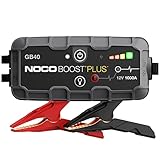
Overview: The NOCO Boost GB40 is a compact, specialized lithium jump starter designed for reliable dead-battery recovery in smaller vehicles. Weighing just 2.5 lbs, it fits effortlessly in glove compartments while delivering 1,000 amps of peak power to start gas engines up to 6.0L and diesel up to 3.0L.
What Makes It Stand Out: Its patented Ultrasafe Technology eliminates sparks and reverse-polarity risks, making it exceptionally beginner-friendly. The integrated 100-lumen LED flashlight (with 7 modes) and power bank functionality add practical emergency utility, while the rapid 3-hour recharge ensures readiness.
Value for Money: Priced mid-range, it excels as a pure jump starter. Though lacking an air compressor, its reliability, safety focus, and build quality justify the cost for those prioritizing core functionality over multi-tool features. It outperforms cheaper units in safety and longevity.
Strengths and Weaknesses: Strengths: Ultra-compact, foolproof safety, lightweight, excellent cold-weather performance, and reliable power bank. Weaknesses: Limited to smaller engines, no tire inflator, and lower max starts per charge (~20) compared to bulkier competitors.
Bottom Line: Ideal for compact cars, motorcycles, or as a minimalist emergency kit. Choose the GB40 for unmatched safety and portability if you don’t need air inflation—its specialization makes it a trustworthy, no-fuss solution.
2. GOOLOO A3 Jump Starter with Air Compressor, 3000A Portable Car Battery Booster (9.0 Gas/6.5L Diesel) with 150PSI Auto-Shutoff Tire Inflator, 12V Supersafe Lithium Jump Box Car Battery Jumper Starter

Overview: The GOOLOO A3 merges robust jump-starting (3,000A peak) with a high-speed cordless tire inflator, targeting drivers needing multi-functional emergency gear. It handles gas engines up to 9.0L and diesel up to 6.5L, operating reliably in extreme temperatures (-4°F to 140°F).
What Makes It Stand Out: The 150 PSI auto-shutoff inflator inflates tires exceptionally fast (e.g., Tesla tires in 1 minute) and supports 5 inflation modes. Its smart LED screen, 10-layer safety system, and 7-in-1 versatility (jumper, power bank, bike pump, etc.) deliver exceptional utility in one device.
Value for Money: Competitive pricing for its dual-core functionality. While pricier than basic jump starters, the integrated inflator eliminates needing a separate pump, saving cost and space. The 1,000+ charge cycles enhance long-term value for frequent travelers.
Strengths and Weaknesses: Strengths: Powerful inflator, intuitive pressure display, broad vehicle compatibility, extensive safety protections, and versatile nozzle kit. Weaknesses: Heavier than pure jump starters, inflator runtime limited to 45 minutes per charge, and slightly complex mode switching.
Bottom Line: A top pick for SUV, truck, or Tesla owners needing rapid tire inflation alongside jump-starting. Its speed, smart features, and reliability justify the investment for well-rounded roadside readiness.
3. Portable 10-in-1 Car Battery Jump Starter with Air Compressor 8000A 160PSI 45W Charger, Jump Starter Jump Box (All Gas 14L Diesel), Car Battery Jumper Starter Portable Jumper Cables, Gloves, Lights

Overview: This all-in-one unit aggressively targets max versatility with 10 functions, including class-leading 8,000A peak power for gas engines up to 14L and diesel equivalents. It combines jump-starting, a 160 PSI inflator, PD45W charging, and emergency gloves in a single rugged package.
What Makes It Stand Out: The FORCE START function revives completely dead (0V) batteries, while the 3.3" sunlight-readable display and auto-shutoff inflator (fills tires in 20 seconds) enhance usability. PD45W bi-directional charging powers laptops, and 800-lumen lights offer 400% brighter illumination than rivals.
Value for Money: High upfront cost is offset by its exceptional feature density. The inclusion of gloves, rapid charging, and industrial-grade inflation (160 PSI) provides unmatched scope for heavy-duty or commercial use, though overkill for small cars.
Strengths and Weaknesses: Strengths: Extreme engine compatibility, fastest inflator on test, PD45W laptop charging, superior lighting, and 24-month standby. Weaknesses: Bulky design, inflated “8000A” marketing (real-world amps lower), and complex interface for casual users.
Bottom Line: Opt for this if you drive large trucks/RVs or demand maximum emergency preparedness. Its power and features excel in professional scenarios, but size and complexity may deter daily commuters.
4. S ZEVZO ET03 Car Jump Starter 4000A Jump Starter Battery Pack for Up to 8.0L Gas and 7.0L Diesel Engines, 74Wh Portable 12V Jump Box with USB Ports, LCD Display, Storage Case, and LED Light

Overview: The S ZEVZO ET03 balances power (4,000A peak) and practicality for mid-to-large vehicles, supporting gas engines up to 8.0L and diesel up to 7.0L. Its 74Wh capacity acts as a substantial power bank, complemented by an LCD battery indicator and included storage case.
What Makes It Stand Out: The FORCE START function handles 0V dead batteries, while the 500-lumen LED light (3 modes) and 10 safety protections prioritize reliability. The 24-month standby time and broad temperature tolerance (-4°F to 140°F) suit seasonal storage in vehicles.
Value for Money: Solid mid-tier pricing for its engine capacity and battery bank size. The included case and 50 jump starts per charge offer good utility, though it lacks an inflator—making it less versatile than rivals at similar price points.
Strengths and Weaknesses: Strengths: Reliable 0V starts, long standby time, clear LCD display, dual USB ports, and comprehensive safety suite. Weaknesses: No tire inflator, slower charging than PD45W models, and slightly heavier than compact alternatives.
Bottom Line: A dependable, no-frills choice for sedans, SUVs, and light trucks where jump-starting is the priority. Skip if you need inflation; otherwise, it’s a robust, safety-focused performer.
5. Sharmeal Car Jump Starter 5000A, Jump Starter Battery Pack for 10.0L Gas and 9.0L Diesel, 12V Portable Jump Box with LED Light

Overview: Sharmeal’s 5000A jump starter targets larger vehicles (up to 10.0L gas/9.0L diesel) with a streamlined design emphasizing safety and portability. It includes smart clamps with traffic-light indicators for foolproof connections and doubles as a power bank for USB devices.
What Makes It Stand Out: The 14-layer safety system and insulated intelligent clamps prevent sparks/reverse polarity errors. Its standout feature is the 800-lumen LED light with 48-hour runtime (3 modes), significantly brighter than most competitors. The compact form factor enhances portability.
Value for Money: Aggressively priced for its engine capacity. While lacking an air compressor, the robust safety features, bright lighting, and included carrying case deliver strong value for budget-conscious buyers needing reliable large-engine support.
Strengths and Weaknesses: Strengths: Excellent safety suite, industry-leading light output/duration, intuitive clamp indicators, and lightweight. Weaknesses: No inflator, slower charging without PD tech, and limited to USB-C input (requires original cable).
Bottom Line: Best for owners of trucks, RVs, or farm equipment seeking an affordable, safety-first jump starter. Its lighting and clamp tech shine, but add a separate inflator if tire emergencies are a concern.
6. AstroAI S8 Car Battery Jump Starter, Car Jumper Starter Battery Pack for Up to 6.0L Gas & 3.0L Diesel Engines, 12V Portable Jump Box with 3 Modes Flashlight and Jumper Cable (Orange)

Overview:
The AstroAI S8 is a compact, ultra-lightweight (0.95 lbs) lithium jump starter designed for quick revivals of 12V vehicles with gas engines up to 6.0L or diesel up to 3.0L. Its pocket-friendly size (7.9 x 4.5 x 3.7 inches) and integrated safety features make it ideal for everyday car storage or travel emergencies.
What Makes It Stand Out:
Its standout feature is the “BOOST” mode, which intelligently detects critically low battery voltage (<9V) and safely jump-starts fully drained batteries—a rare capability in this size class. The durable metal clamps and comprehensive 8-layer safety protection (including reverse polarity and short-circuit shielding) enhance reliability without bulk.
Value for Money:
Priced competitively, the S8 delivers exceptional value for compact jump starters. It outperforms cheaper models with unreliable clamps while avoiding the premium cost of larger units. Its ability to handle lawnmowers and motorcycles adds versatility, though it’s less suited for heavy-duty diesel engines.
Strengths and Weaknesses:
Strengths: Unmatched portability; effective BOOST mode for dead batteries; robust safety suite; affordable.
Weaknesses: Limited to smaller engines (max 3.0L diesel); no power bank functionality; flashlight lacks advanced modes.
Bottom Line:
A top choice for sedan/SUV owners seeking a minimalist, reliable emergency solution. Its BOOST mode and featherweight design make it indispensable for daily drivers, though larger vehicle owners should consider higher-capacity alternatives.
7. TREKURE Portable Car Battery Jump Starter 4000A 16800mAh Jump Box, Car Battery Jumper Starter Portable Jumper Cables for car(8.0L Gas/6.5L Diesel), Fast Charge, Lights, Compact

Overview:
The TREKURE 4000A jump starter combines high power (supporting 8.0L gas/6.5L diesel engines) with rugged versatility. Its 16,800mAh capacity serves as a robust power bank, while military-grade durability ensures reliability in extreme temperatures (-4°F to 140°F) and harsh conditions.
What Makes It Stand Out:
The dual-angle, 4-mode LED light (including SOS and traffic-warning strobes) is uniquely practical for roadside safety. Coupled with waterproof/dustproof construction and 10 safety protections via a German smart chip, it excels as an all-in-one emergency tool for adventurers.
Value for Money:
Justifying its mid-range price, the TREKURE offers superior value through multi-functionality: 1,000+ jump cycles, device charging, and versatile lighting replace multiple gadgets. It’s more affordable than premium rivals while outperforming basic models in durability and features.
Strengths and Weaknesses:
Strengths: Exceptional weather resistance; bright multi-functional light; reliable in freezing temps; doubles as high-capacity power bank.
Weaknesses: Bulkier than ultra-compact rivals; charging speed slower than 65W-equipped competitors.
Bottom Line:
Highly recommended for outdoor enthusiasts and fleet vehicles. Its ruggedness, lighting, and consistent cold-weather performance make it a dependable companion, though frequent travelers may prefer faster-charging alternatives.
8. WOLFBOX 4000A Jump Starter,12V Car Battery Jumper Starter Portable with 65W Quick Charger,LED Display,88.8Wh Booster Jump Box Pack (10L Gas 10L Diesel Engine) with LED Light,Jumper Cables

Overview:
The WOLFBOX Megavolt24 is a high-capacity (88.8Wh) jump starter engineered for large vehicles (up to 10L gas/diesel engines). It integrates rapid charging, device powering, and clear diagnostics via an HD LCD screen, targeting users needing robust performance for trucks or boats.
What Makes It Stand Out:
Its 65W USB-C PD fast charging (0-100% in 1.3 hours) and dual-output ports for laptops/phones set it apart. The intuitive LCD display shows real-time battery status and voltage, eliminating guesswork during critical jumps—uncommon in this category.
Value for Money:
While pricier than entry models, the WOLFBOX delivers outstanding value for heavy-duty use. The speed of its 65W charging, laptop compatibility, and support for large engines justify the cost versus slower, less versatile competitors.
Strengths and Weaknesses:
Strengths: Industry-leading 65W fast charging; clear LCD diagnostics; handles large engines; efficient device charging.
Weaknesses: Slightly heavier (1.8 lbs); lacks advanced lighting modes like SOS strobes.
Bottom Line:
Essential for truck/boat owners prioritizing speed and clarity. The rapid recharge and precise display ensure readiness for major vehicles, though casual users might find its size excessive.
9. Jump Starter with Air Compressor, 5000A Battery Jumper Starter Portable (9L Gas/8L Diesel) with 160PSI Auto-Shutoff Tire Inflator, 12V Jump Box Car Battery Jump Starter with Jumper Cables, LED Light

Overview:
This innovative jump starter merges 5000A peak power (for 9L gas/8L diesel engines) with a built-in digital air compressor. Its auto-shutoff inflation up to 160 PSI and multi-nozzle system tackle flat tires alongside dead batteries, targeting comprehensive roadside readiness.
What Makes It Stand Out:
The integrated compressor is its game-changer—no separate pump needed. Real-time pressure monitoring (PSI/BAR/KPA), 25-minute runtime, and versatile nozzle attachments make tire maintenance effortless during emergencies, a rarity in jump starters.
Value for Money:
Priced at a slight premium, it offers exceptional value by replacing two tools. The compressor functionality saves money versus buying standalone units, while 5000A power and 3-mode LED lighting justify the cost for frequent travelers.
Strengths and Weaknesses:
Strengths: All-in-one jump/inflate solution; precise digital pressure control; compact despite dual functions; 10 safety protections.
Weaknesses: Heavier (2.12 lbs) than pure jump starters; compressor runtime limits sustained use.
Bottom Line:
A must-have for road trippers and RV owners. Combining jump-starting with reliable tire inflation streamlines emergencies, though minimalist drivers may prefer lighter single-purpose units.
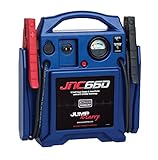
10. Clore Automotive Jump-N-Carry JNC660 1700 Peak Amp 12 Volt Jump Starter , Blue
Overview:
The Clore JNC660 is a traditional lead-acid jump starter with heavy-duty #2 AWG cables (46 inches) and 1700 peak amps, designed for reliable jump-starts on gas/diesel engines. Unlike lithium portables, it prioritizes raw power and simplicity for garages or commercial fleets.
What Makes It Stand Out:
Its integrated 22Ah Clore Proformer battery and ultra-thick cables deliver consistent cranking power for larger vehicles—unmatched by most portables. The built-in voltmeter provides instant charge status, and the DC outlet powers 12V accessories during use.
Value for Money:
Best suited for workshops or frequent professional use, it offers long-term value through durability and no battery degradation (unlike lithium). While heavier, it’s cost-effective for high-usage scenarios versus replacing compact units.
Strengths and Weaknesses:
Strengths: Exceptional cable durability; reliable for large engines; no lithium lifespan limits; simple operation.
Weaknesses: Bulky and heavy (not portable); requires periodic charging; no modern features like USB ports.
Bottom Line:
Ideal for mechanics or fleet managers needing a workshop staple. Sacrifices portability for brute-force reliability, but daily drivers should opt for lighter lithium alternatives.
Understanding Critical Safety Features
Safety must be your top priority when selecting a jump starter, especially in unpredictable road trip environments where mistakes can have serious consequences.
Built-In Reverse Polarity Protection
This essential safeguard instantly cuts power if the clamps are accidentally connected to the wrong battery terminals. It prevents dangerous sparks, potential battery explosions, and costly damage to your vehicle’s sensitive electronics—a non-negotiable feature for anyone who might be stressed or working in low-light conditions during an emergency.
Over-Current and Short-Circuit Safeguards
Quality units incorporate advanced circuitry that detects abnormal electrical flow. If a short circuit occurs or excessive current is drawn, the device automatically shuts down. This protects both your vehicle’s electrical system and the jump starter itself from catastrophic failure, ensuring the tool remains functional for future emergencies.
Spark-Proof Technology
The moment of connection is the most hazardous part of jump-starting. Advanced models feature spark-proof designs that only deliver power once a secure, correct connection is confirmed. This eliminates the terrifying (and dangerous) sparks common with older technology, making the process significantly safer for novice users and reducing fire risk near flammable battery gases.
Determining Your Power Requirements
Choosing the right power capacity is vital—it’s the difference between a successful jump start and a stranded vehicle. Don’t assume all compact units can handle your engine.
Engine Size and Battery Chemistry Considerations
Gasoline engines typically require 400-600 peak amps for reliable starting, while larger V8s or diesel engines often need 1000+ peak amps. Crucially, modern vehicles frequently use AGM (Absorbent Glass Mat) or EF (Enhanced Flooded) batteries, which demand higher cranking power than traditional lead-acid types. Always match the jump starter’s peak amp rating to your specific engine and battery type.
Cold Cranking Amps (CCA) vs. Peak Amps Explained
Understand the difference: CCA measures sustained power delivery in freezing temperatures (critical for mountain or winter trips), while peak amps indicate the maximum instantaneous burst. For reliable cold-weather performance, prioritize units with strong CCA ratings relevant to your engine size, not just high peak amp numbers which can be misleading marketing tactics.
Real-World Power Reserve for Multiple Attempts
A jump starter with just enough power for one perfect attempt is risky. Road conditions, weak batteries, or cold weather often require multiple tries. Opt for a unit with at least 25-50% more capacity than your engine’s minimum requirement. This reserve power ensures you won’t be left stranded if the first crank doesn’t catch.
Prioritizing Portability and Ease of Use
When space is precious in your adventure rig and stress levels are high during a breakdown, portability and user-friendliness become critical factors.
Compact Footprint vs. Necessary Power Balance
The smallest units might fit in your pocket, but they often lack the grunt for larger engines. Seek the optimal balance: a device robust enough for your vehicle that still slides easily into a center console, under a seat, or within your emergency kit. Measure your intended storage spot before purchasing—don’t sacrifice essential power for negligible size savings.
Intuitive Interface for High-Stress Situations
During a roadside emergency, complex menus or confusing indicator lights are your enemy. Look for models with clear, simple controls: large, easy-to-press buttons, unambiguous LED status displays (showing charge level and connection status), and straightforward clamp connections. Voice prompts guiding the process can be invaluable for first-time users in panic mode.
Integrated Handle and Secure Storage Design
A built-in, sturdy handle makes carrying the unit to the front or rear of your vehicle effortless. Equally important is a design that prevents accidental activation in storage—secure latches or recessed buttons stop the unit from draining or triggering when jostled in your gear. Consider units with dedicated, padded storage cases that protect against dust, moisture, and impacts.
Ensuring Durability for Harsh Environments
Road trips subject gear to extreme conditions. Your jump starter must withstand the rigors of adventure travel without failing when needed most.
Temperature Tolerance Range
Standard lithium units often fail below freezing or overheat in desert heat. For true all-season reliability, especially in 2026’s increasingly volatile climates, seek units rated for operation between -20°F (-29°C) and 140°F (60°C). This ensures functionality during frigid mountain mornings or scorching summer afternoons far from shade.
Ruggedized Exterior Construction
Plastic casings that crack on rocky trails are useless. Prioritize models with reinforced, impact-resistant shells (often rubberized or with military-grade drop-test certifications) and sealed ports to keep out dust, sand, and water splashes. IP65 or higher ingress protection ratings indicate solid resistance against the elements encountered on unpaved roads.
Vibration and Shock Resistance
Constant travel over rough terrain can damage internal components. Quality jump starters designed for adventurers feature internal shock absorption and securely mounted electronics to survive prolonged exposure to bumps, potholes, and off-road vibrations without losing calibration or failing.
Evaluating Essential Additional Functions
Modern jump starters often serve as multi-tools, adding significant value beyond just engine starts—especially useful when space is limited on extended trips.
High-Speed USB Power Delivery Ports
Beyond jump-starting, your unit should reliably recharge phones, tablets, GPS devices, action cameras, and satellite messengers. Prioritize models with USB-C Power Delivery (PD) ports offering 18W+ output, enabling significantly faster charging for modern devices compared to standard USB-A ports, keeping your communication lifelines powered.
Integrated Emergency Lighting System
A powerful, multi-mode LED work light is invaluable during nighttime breakdowns. Look for units with bright spotlights (500+ lumens), wide-beam floodlights for illuminating your workspace, and dedicated SOS/strobe modes for signaling help. Hands-free operation via a rotatable head or magnetic base is a major usability plus.
Air Compressor Compatibility
Some advanced 2026 models feature ports to connect compact, 12V tire inflators. While not replacing a dedicated compressor, this integration allows you to address low tire pressure—a common trailside issue—using the same power source, eliminating the need for a separate bulky air pump in your kit.
Understanding Battery Longevity and Maintenance
The jump starter is useless if its internal battery dies before you need it. Proper understanding of longevity ensures it’s ready when adventure calls.
Self-Discharge Rates and Long-Term Storage
All lithium batteries slowly lose charge when idle. Quality units exhibit low self-discharge (5-10% per month). For road trippers who might not use the device for weeks between trips, prioritize models with ultra-low discharge rates or built-in battery preservation modes to maintain readiness during storage.
Optimal Charging Practices for Maximum Lifespan
Avoid keeping the unit perpetually plugged in; charge it to 50-80% for long-term storage. Use only the manufacturer-specified charger. Extreme heat during charging (like leaving it in a hot car) drastically shortens battery life. A quick top-up charge every 3-4 months is ideal for maintaining health.
Clear Battery Health Indicators
Sophisticated units go beyond simple charge bars, offering percentage-based displays or predictive indicators showing remaining functional lifespan. This transparency prevents unpleasant surprises and helps you proactively replace the unit before its critical jump-starting capability degrades.
Navigating Connector and Cable Quality
The components making physical contact with your vehicle are where reliability is proven—or lost—in a critical moment.
Heavy-Duty Clamp Construction and Grip
Flimsy, plastic-jawed clamps that slip off corroded terminals are a recipe for frustration. Demand thick, copper-core cables with robust, spring-loaded metal clamps featuring deep teeth for biting through corrosion. Rubberized grips ensure secure handling even with cold or gloved hands.
Cable Length and Flexibility
Cables too short create dangerous stretching hazards; overly long ones tangle. Aim for 16-20 inch cables made from highly flexible, cold-resistant silicone—essential for easy maneuvering around engines with tight spaces or awkward battery placements common in modern vehicles.
Secure Connection Ports on the Unit
The ports where cables attach to the jump starter itself must be robust. Screw-terminal or magnetically locking connections are superior to simple plug-in ports, which can vibrate loose during transport or fail under high current draw during a jump start.
Verifying Real-World Reliability Through Testing
Marketing specs can be deceptive. Understanding how to assess genuine reliability prevents costly mistakes when stranded.
Independent Laboratory Certification Marks
Look beyond manufacturer claims. Valid certifications from recognized bodies like UL (Underwriters Laboratories), CE, or ETL on the specific model indicate rigorous safety and performance testing. Avoid units with only generic “CE” marks lacking a notified body number, which are often meaningless.
User Reviews Focused on Emergency Scenarios
Seek out reviews mentioning actual use during breakdowns, especially in challenging conditions (extreme cold, dusty environments, older vehicles). Pay attention to feedback about consistent success rates, ease of use under stress, and long-term durability—more valuable than specs alone.
Manufacturer Warranty and Support Reputation
A minimum 2-year warranty is standard for quality units. Investigate the brand’s reputation for honoring warranties and providing responsive customer support. A company that stands behind its product with accessible service centers or hassle-free replacements offers significant peace of mind for critical safety gear.
Integrating into Your Road Trip Emergency System
A jump starter shouldn’t be a lone island of functionality; it should synergize with your broader preparedness strategy.
Strategic Placement in Your Vehicle
Store it where it’s instantly accessible and protected: inside the passenger cabin (not the trunk), secured against movement, away from direct sunlight or heat sources. Ensure cables can reach both battery terminals without dangerous stretching—practice the setup at home first.
Complementing Other Critical Emergency Gear
Position it logically within your emergency kit alongside items like tire repair kits, first-aid supplies, and water. Consider how its lighting function aids nighttime medical care or how its USB ports recharge communication devices during extended waits. It’s a force multiplier for your entire safety ecosystem.
Pre-Trip Functional Check Protocol
Make checking your jump starter part of your pre-departure ritual. Verify charge level (ideally 80%+), clean any corrosion from clamp contacts, test the work light, and ensure cables move freely. A 30-second check prevents a 3-hour roadside delay.
Future-Proofing Your Investment for 2026 and Beyond
Technology evolves rapidly. Choosing a unit with forward compatibility ensures relevance as vehicle tech advances.
Compatibility with Emerging Vehicle Systems
As 12V systems coexist with higher-voltage architectures (like 48V mild hybrids becoming more common), ensure your jump starter explicitly supports modern vehicle electronics. Look for features like “smart” voltage regulation that prevents surges damaging sensitive ECUs during jumps.
Software Upgradability Potential
While not universal, some premium 2026 models offer firmware updates via USB-C to enhance safety protocols or compatibility with newer car models. This feature extends the usable life of your device as automotive technology progresses.
Sustainable Design and Repairability
Consider brands offering replaceable internal batteries or modular components. As environmental concerns grow, repairable units reduce e-waste. Look for clear end-of-life recycling programs—responsible disposal of lithium batteries is increasingly critical for conscientious adventurers.
Frequently Asked Questions
How often should I recharge my portable jump starter when not in use?
Recharge it every 3-4 months to maintain optimal battery health, even if unused. Lithium batteries degrade faster when stored completely full or completely empty. A 50-80% charge level is ideal for storage.
Can a single jump starter reliably start both gasoline and diesel engines?
It depends entirely on the unit’s power rating. Diesel engines typically require significantly higher cranking amps (often 1000+) than comparable gasoline engines. Verify the specific peak amp and CCA ratings match your diesel engine’s requirements before purchase.
What’s the absolute minimum peak amp rating needed for a standard sedan?
For most modern 4-cylinder gasoline sedans, a unit rated for at least 400-600 peak amps is generally sufficient. However, always consult your vehicle’s owner manual for its specific CCA requirement and add a 25% safety margin to your jump starter selection.
Are lithium jump starters safe to leave in a hot car?
Most quality units are designed to withstand high cabin temperatures (up to 140°F/60°C), but prolonged exposure to extreme heat accelerates battery degradation. Store it in a shaded, insulated area within the cabin if possible, never in direct sunlight on the dashboard.
How long does it take to fully recharge a typical modern jump starter?
Recharge times vary significantly, but most quality units with fast-charging capability (USB-C PD input) can go from empty to full in 1-2 hours using a compatible high-wattage adapter. Avoid slower charging methods that take 4+ hours for regular maintenance.
Can I accidentally overcharge or damage the jump starter by leaving it plugged in?
Reputable models include built-in battery management systems that automatically stop charging at 100%, preventing overcharging. However, keeping it perpetually at 100% charge while plugged in can slightly reduce long-term battery lifespan. Unplug it once fully charged.
Do I need special training to use a modern portable jump starter safely?
No formal training is needed thanks to intuitive designs and safety features like reverse polarity protection. However, always read the specific manufacturer’s instructions beforehand. The process is generally simpler and safer than using traditional jumper cables.
Why does my jump starter show a full charge but fail to start the car?
This often indicates insufficient cranking power (peak amps/CCA) for your engine, a weak vehicle battery beyond recovery, or poor clamp connections (corrosion, loose fit). Ensure clean, tight connections and verify the unit’s power rating matches your vehicle’s needs.
How many jump starts can I expect from a single charge?
This varies drastically based on engine size and conditions. A unit might deliver 20+ starts for a small car in warm weather but only 5-6 for a large truck in freezing temperatures. Always assume you’ll need multiple attempts and choose a unit with ample reserve capacity.
Are there significant differences between jump starters for cars versus motorcycles or boats?
Yes. Motorcycles and personal watercraft often have smaller batteries but may require specific connectors or lower power thresholds. Always confirm the jump starter’s minimum and maximum engine size compatibility matches your specific vehicle type to avoid damage.
See Also
- 10 Essential Compact Jump Starters Every Road Trip Traveler Needs in 2026
- 10 Essential Compact Jump Starters Every Commuter Needs in 2026
- 10 Essential Digital Jump Starters Every Modern Driver Needs in 2026
- 10 Essential Lithium Battery Chargers Every Off-Roader Needs in 2026
- 10 Essential Marine Battery Chargers Every Boat Owner Needs in 2026