Table of Contents
Finding elusive vacuum leaks in complex systems is like searching for a needle in a haystack – frustrating, time-consuming, and often requiring guesswork that leads to wasted parts and labor. Whether you’re a seasoned technician battling a stubborn check engine light on a modern vehicle or a DIY enthusiast trying to restore an older classic’s smooth idle, undetected vacuum leaks sabotage performance, fuel economy, and emissions. The old tricks – listening for hisses, spraying carb cleaner (dangerous!), or using propane (risky and messy) – are unreliable and potentially hazardous. The real game-changer? Utilizing purpose-built smoke leak detection technology designed specifically for pinpointing even the tiniest breaches invisible to the naked eye.
Smoke leak detection has evolved from a niche professional tool into an essential diagnostic method accessible to serious home mechanics, offering a safe, clean, and incredibly effective way to visualize leaks that evade traditional methods. Forget the days of frustrating trial-and-error; modern smoke machines flood the system with harmless, visible vapor, making leaks impossible to miss. This isn’t just about convenience; it’s about accuracy, safety, and saving significant time and money by diagnosing the actual problem on the first attempt. Understanding how to choose and use the right smoke leak detector transforms a daunting diagnostic challenge into a straightforward, almost satisfying process.
Top 10 Smoke Leak Detectors
Detailed Product Reviews
1. Solary Automotive Smoke Machine Leak Detector - 12V DC EVAP Vacuum Diagnostic Tester for Pipe System

Overview: This compact 12V smoke machine targets DIYers and technicians needing efficient leak diagnostics. It uses baby oil or glycerin to generate smoke for detecting EVAP, vacuum, turbo, and cooling system leaks in vehicles without external air sources.
What Makes It Stand Out: Its built-in air pump eliminates compressor dependency, enabling instant testing anywhere. Generating thick smoke in 10 seconds and weighing just 2.5 kg, it prioritizes portability and speed. The intuitive interface lowers the learning curve for beginners.
Value for Money: Priced mid-range, it outperforms budget models requiring external pumps while avoiding premium costs. The absence of included fluid slightly offsets value, but baby oil’s affordability keeps long-term costs low. Ideal for occasional users avoiding professional-priced tools.
Strengths and Weaknesses: Pros: True portability, rapid smoke output, versatile for multiple systems. Cons: No included fluid, lacks pressure adjustment (risking EVAP damage if misused), and limited thermal safeguards compared to premium units.
Bottom Line: A capable entry-level tool for basic diagnostics, but its inflexibility with pressure-sensitive systems warrants caution. Best for casual users prioritizing convenience over precision.
2. AutoLine Pro HyperSmoke™ Automotive Smoke Machine EVAP Vacuum Leak Tester – Adjustable Pressure – OEM Approved Smoke Fluid – Built-in Air Compressor Motor - Includes Smoke Fluid x2.

Overview: Engineered for professionals, this USA-designed smoke machine features adjustable pressure and OEM-approved fluid for comprehensive leak detection across EVAP, turbo, and exhaust systems. It includes two fluid bottles for extended use.
What Makes It Stand Out: HyperSmoke Technology delivers infinite smoke without overheating, while critical pressure adjustability (down to 1 PSI) prevents EVAP damage—a flaw in cheaper imports. The built-in compressor and 240-minute fluid runtime ensure readiness for complex diagnostics.
Value for Money: Premium pricing is justified by professional-grade engineering, included OEM fluid, and damage-prevention features. It outlasts non-adjustable competitors, offering long-term savings despite higher upfront cost. Essential for shops prioritizing accuracy and tool longevity.
Strengths and Weaknesses: Pros: Pressure adjustability, EVAP-safe operation, robust build, and generous fluid supply. Cons: Heavier than budget models, fluid included but no specialized adapters.
Bottom Line: The top choice for professionals needing precision and safety. Worth every dollar for serious diagnostics, especially on modern EVAP systems.
3. AutoLine Pro HyperSmoke™ Automotive Smoke Machine EVAP Vacuum Leak Tester – Adjustable Pressure – OEM Approved Smoke Fluid – Built-in Air Compressor Motor – Includes Cone and Gas Cap EVAP Adapter.

Overview: A variant of AutoLine Pro’s flagship HyperSmoke, this model swaps extra fluid for critical EVAP-specific accessories: a cone adapter and gas cap tool. It maintains all core features for professional leak testing on diverse vehicles.
What Makes It Stand Out: Retains the original’s pressure adjustability and built-in compressor but adds purpose-built EVAP adapters, streamlining access to service ports. This eliminates guesswork during EVAP diagnostics—a frequent pain point for technicians.
Value for Money: Slightly higher cost than the fluid-included version is offset by specialized hardware. The adapters save time and prevent damage during EVAP tests, making it more cost-effective for shops focused on emissions systems.
Strengths and Weaknesses: Pros: Pressure safety, EVAP-specific accessories, USA engineering. Cons: Less fluid runtime than Product 2, adapters may go unused by non-specialists.
Bottom Line: Best for emission-focused technicians. The targeted accessories justify the price, ensuring efficient, damage-free EVAP testing.
4. Automotive Smoke Machine Leak Detector,Evap Vacuum Smoke Diagnostic Tester,Pipeline Fuel Leakage Detector Compatible with 12V Cars, Trucks, Motorcycle, ATV, Boats, Snowmobiles

Overview: Marketed as a universal leak detector, this unit requires an external air source and targets users familiar with vehicle-specific EVAP procedures. It emphasizes leak consequences but lacks built-in convenience features.
What Makes It Stand Out: Its detailed “Why Need It” guide educates users on leak symptoms, and EVAP port instructions cater to American vehicles. However, it critically depends on shop air (2–15 bar), making it impractical for field use.
Value for Money: Low upfront cost is misleading. Mandatory external compressor access limits usability, while missing safety features risk system damage. Cheaper alternatives with built-in pumps offer better long-term value.
Strengths and Weaknesses: Pros: Clear diagnostic guidance, broad vehicle compatibility. Cons: No built-in pump (useless without compressed air), no pressure control, high risk of EVAP damage, and fragile design.
Bottom Line: Avoid despite the low price. Its dependency on external infrastructure and safety omissions make it unreliable for both novices and pros.
5. THIKPO Automotive Smoke Machine with Built-in Air Pump, Smoke Leak Detector for EVAP Vacuum, Pipe System, Fuel Leakage, 12V DC Vehicle Leakage Diagnostic Tester

Overview: A well-rounded DIY-focused smoke machine with a built-in pump, broad system compatibility, and robust safety features. It uses baby oil for smoke generation and includes extensive accessories for immediate use.
What Makes It Stand Out: Rapid 5-second smoke output, thermal cutoff (167°F), and extreme-temperature tolerance (-4°F to 122°F) ensure reliability. The lightweight 1.6 kg design and comprehensive kit—featuring bladders, hoses, and adapters—enhance usability.
Value for Money: Exceptional for the price. Includes critical accessories omitted by competitors (e.g., intake bladders), and 24/7 support reduces frustration. Outperforms similarly priced units lacking safety tech or portability.
Strengths and Weaknesses: Pros: All-in-one portability, safety protections, versatile accessories. Cons: Baby oil not included, pressure non-adjustable (caution with EVAP).
Bottom Line: The best budget-to-midrange option for home mechanics. Balances performance, safety, and convenience without professional pricing. Highly recommended for most users.
6. AUTOOL Automotive Smoke Machine Lead Detector DC 12V EVAP Vacuum Diagnostic Tester with Built-in Air Pump for Pipe System

Overview:
The AUTOOL Smoke Machine is a professional-grade diagnostic tool designed to pinpoint leaks in automotive vacuum and EVAP systems. It utilizes a built-in air pump and smoke generation to identify issues like ruptured hoses, blockages, or air leaks that cause performance problems such as rough idling, black smoke, or poor fuel economy. Compatible with most post-1996 American vehicles and versatile across multiple vehicle types.
What Makes It Stand Out:
Its integrated air pump eliminates the need for external equipment, streamlining setup. The device supports a broad testing range—including EVAP, intake, cooling, and crankcase systems—and uses standard baby oil (not included) for safe, non-toxic smoke generation. Clear operational steps simplify diagnostics for DIYers and pros alike.
Value for Money:
Competitively priced for its all-in-one functionality, it avoids extra costs for separate air pumps. While baby oil adds minor expense, it’s widely accessible and affordable. Outperforms basic leak testers but lacks premium features like adjustable pressure, positioning it as a solid mid-tier option.
Strengths and Weaknesses:
Strengths: Built-in pump saves time/costs; wide system compatibility; straightforward operation; durable construction.
Weaknesses: Requires user-supplied baby oil; no explicit safety certifications mentioned; EVAP port access varies by model, complicating setup.
Bottom Line:
A reliable, cost-effective diagnostic tool for common automotive leaks. Ideal for home mechanics seeking efficiency without advanced frills, though professionals may desire more precision controls.
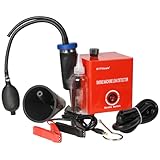
7. Smoke Leak Detector ,Automotive Smoke Machine, for Detecting leaks in Vacuum, Fuel, EVAP and Other Automotive Systems. (Red Strap Model)
Overview:
This compact, sheet-metal smoke machine delivers rapid leak detection for automotive systems using harmless baby oil smoke. Engineered for safety with automatic overheating protection, it targets vacuum, EVAP, turbo, and intake leaks across cars, motorcycles, and boats. Note: oil not included.
What Makes It Stand Out:
The lifetime warranty signals exceptional manufacturer confidence—a rarity in this category. Its red strap aids portability, while the built-in air pump and 10-second smoke generation ensure swift diagnostics. Intelligent overheating protection enhances user safety during prolonged use.
Value for Money:
Justifies its price with a lifetime warranty and all-in-one design that avoids external pump costs. The quick smoke output (10 seconds) boosts efficiency, making it a smarter long-term investment than cheaper units lacking warranty coverage.
Strengths and Weaknesses:
Strengths: Lifetime warranty; rapid 10-second smoke startup; overheat protection; versatile for multiple systems; portable strap design.
Weaknesses: Baby oil not included; sheet-metal build may dent; no pressure gauge for precise leak quantification.
Bottom Line:
Highly recommended for DIYers and pros prioritizing durability and peace of mind. The lifetime warranty sets it apart, though oil sourcing is a minor inconvenience.
8. TAOPOWER Smoke Machine Automotive Diagnostic Detector - 12V DC EVAP Smoke Leak Tester with Built-in Air Pump for Vehicle Pipe System

Overview:
TAOPOWER’s 1.9kg lightweight smoke machine offers rapid leak detection for EVAP, vacuum, and turbo systems. It generates dense smoke in 10 seconds and includes intelligent safety features like overheat and freeze protection, catering to both garage use and on-the-go diagnostics for cars and motorcycles.
What Makes It Stand Out:
Extreme portability (1.9kg) and dual thermal protection (-20°C to 75°C) make it ideal for fieldwork. The built-in air pump enables standalone operation, while quick smoke generation ensures efficient leak identification without external hardware.
Value for Money:
Budget-friendly for its robust safety suite and portability. It undercuts premium models while matching core functionality—ideal for cost-conscious users needing reliable, mobile diagnostics without sacrificing essential protections.
Strengths and Weaknesses:
Strengths: Ultra-portable; fast 10-second smoke output; overheat/freeze safeguards; broad vehicle compatibility; built-in pump.
Weaknesses: No pressure gauge; baby oil required (not included); lightweight build may feel less durable than metal alternatives.
Bottom Line:
An excellent choice for mobile technicians or DIYers needing a travel-ready tool. Compromises on durability for portability but delivers core performance reliably.
9. Solary Smoke Machine for Car - DC 12V EVAP Automotive Smoke Tester for Vacuum Leaks

Overview:
The Solary SD302 features dual-mode operation (air and smoke) for comprehensive leak diagnostics. It includes a pressure gauge to monitor system integrity and generates smoke in 20 seconds, targeting EVAP, fuel, and exhaust systems across diverse vehicles—from cars to speedboats.
What Makes It Stand Out:
The pressure gauge provides real-time leak verification, a feature missing in many competitors. Dual modes allow initial air-pressure checks followed by precise smoke localization, enhancing diagnostic accuracy. Overheating protection adds safety during extended use.
Value for Money:
Offers exceptional functionality at a mid-range price. The pressure gauge and dual modes justify costs by reducing guesswork, while the built-in pump avoids extra expenses. Outperforms single-mode testers in precision-focused scenarios.
Strengths and Weaknesses:
Strengths: Pressure gauge for accurate leak assessment; dual air/smoke modes; built-in pump; overheating alerts; non-toxic smoke.
Weaknesses: 20-second smoke warmup lags behind rivals (10 seconds); oil not included; gauge requires interpretation skill.
Bottom Line:
Best for users valuing precision diagnostics. The pressure gauge elevates it above basic models, though the slightly slower smoke output may frustrate urgency-focused tasks.
10. AutoLine Pro HyperSmoke™ Automotive Smoke Machine EVAP Vacuum Leak Tester – Adjustable Pressure – OEM Approved Smoke Fluid – Built-in Air Compressor Motor – Includes Cone for Vacuum and Exhaust Leaks.

Overview:
Engineered in the USA, the HyperSmoke™ is a premium diagnostic tool with adjustable pressure, OEM-approved fluid, and specialized modes (e.g., EVAP-safe mode). It includes 240 minutes of smoke fluid and targets leaks in turbo, exhaust, and EVAP systems across all vehicle types.
What Makes It Stand Out:
Adjustable pressure (critical for EVAP testing under 1 PSI) prevents system damage—a key differentiator. HyperSmoke™ technology ensures infinite smoke without overheating, while included OEM fluid guarantees sensor safety. USA engineering and comprehensive accessories elevate it above imports.
Value for Money:
Pricier but justifies cost with professional-grade reliability. Avoids EVAP damage risks from improper pressure, saving costly repairs. Included fluid and cone kit add immediate value, making it cost-effective for frequent commercial use.
Strengths and Weaknesses:
Strengths: Adjustable pressure for EVAP safety; OEM fluid included; infinite smoke output; durable build; USA-engineered precision.
Weaknesses: Higher upfront cost; overkill for occasional DIYers; bulkier than portable models.
Bottom Line:
The top recommendation for professionals. Its EVAP-safe pressure control and included fluid make it indispensable for workshops, though budget users may prefer simpler alternatives.
Understanding Vacuum Leaks and Why They’re Problematic
Vacuum leaks occur when unintended air enters the intake system downstream of the throttle body, disrupting the carefully calibrated air-fuel mixture essential for optimal engine operation. These leaks can be minuscule – hairline cracks in brittle hoses, microscopic pores in gaskets, or even faulty seals around sensors – yet cause disproportionately large performance issues. Symptoms often include rough idling, stalling, hesitation during acceleration, decreased fuel efficiency, and persistent check engine lights with codes related to lean conditions (like P0171 or P0174).
The Hidden Impact on Engine Management Systems
Modern engines rely heavily on precise sensor data and closed-loop fuel control. An unmetered air leak throws off the mass airflow (MAF) sensor readings and manifold absolute pressure (MAP) sensor data, forcing the engine control unit (ECU) to constantly overcompensate by adding more fuel. This constant correction strains the system, can lead to secondary issues like carbon buildup, and prevents the engine from operating within its designed efficiency parameters, ultimately affecting longevity and emissions compliance.
Common Culprits Behind Elusive Leaks
The complexity of modern intake manifolds, with their intricate runners, integrated EGR passages, and numerous vacuum-operated accessories (PCV valves, brake boosters, EVAP solenoids), creates a labyrinth where leaks easily hide. Common failure points include degraded rubber vacuum lines (especially near heat sources), cracked plastic intake manifolds (a notorious issue on certain engine designs), failed gaskets between components, and even leaks within the throttle body itself. Older vehicles suffer from dried-out, brittle hoses, while newer models often have complex, hard-to-access plastic assemblies prone to stress cracks.
How Smoke Leak Detection Technology Works
Smoke leak detectors operate on a brilliantly simple principle: introducing a safe, visible vapor under low pressure into the system to be tested, making any escaping air (and thus the leak path) instantly visible. Unlike pressure testing alone, which might only indicate that a leak exists but not where, smoke provides undeniable visual confirmation of the leak’s exact location, even for very slow leaks that wouldn’t cause a significant pressure drop.
The Science Behind the Safe Smoke
Modern professional-grade machines generate smoke using a specialized fluid, typically a refined mineral oil or a purpose-formulated, non-toxic, non-staining, and non-flammable smoke fluid. This fluid is vaporized at a controlled temperature, producing a dense, cold smoke that closely mimics the behavior of air. Crucially, this smoke is designed not to combust, eliminating the fire hazard associated with older methods like propane torches or carb cleaner sprays. The vapor is cold, so it won’t damage sensitive components like hot engine parts or sensors.
Pressure Control: The Key to Effective Testing
Simply pumping smoke isn’t enough. Effective machines feature precise, adjustable pressure regulation. Too much pressure can force smoke through seals that wouldn’t leak under normal operating vacuum, giving false positives or even damaging components. Too little pressure won’t adequately push smoke through tiny leaks or overcome system volume. The best units allow fine-tuning of the test pressure to match the specific system being diagnosed (e.g., intake manifold vs. EVAP system), ensuring realistic and accurate results without risk.
Essential Features to Evaluate When Choosing a Detector
Not all smoke leak detectors are created equal. Selecting the right tool requires careful consideration of features that directly impact diagnostic capability, safety, ease of use, and longevity. Prioritizing the right combination ensures you get a tool that delivers reliable results for years, justifying the investment whether you’re a professional shop or a dedicated home garage.
Smoke Generation Capacity and Speed
Look for machines that produce a consistently dense smoke output quickly. A robust vaporizer chamber and adequate heating element wattage are crucial. High-capacity units can fill larger systems (like diesel engine intakes or complex EVAP systems) faster and maintain smoke density longer during the inspection phase, reducing frustration and diagnostic time. Consider the typical size of the systems you’ll be testing.
Precision Adjustable Pressure Regulation
This is non-negotiable for serious diagnostics. A high-quality, easily adjustable pressure regulator with a clear, accurate gauge allows you to set the exact test pressure needed – typically between 0.5 and 5 PSI for most intake and EVAP testing. Fine control prevents over-pressurization damage and ensures leaks are found under conditions mimicking actual engine vacuum. Avoid units with fixed or poorly calibrated pressure settings.
Integrated Vacuum and Pressure Measurement
Advanced units incorporate a digital or high-quality analog pressure/vacuum gauge directly into the main unit. This provides real-time feedback on system integrity during the smoke test. You can monitor if pressure holds (indicating no major leaks) or drops (confirming a leak exists), and correlate the pressure reading with the visual smoke location, adding another layer of diagnostic confidence beyond just seeing the smoke.
Safety Considerations for Smoke Testing
While significantly safer than flammable alternatives, proper safety protocols are still essential when using smoke leak detectors. The primary risks involve potential over-pressurization and ensuring the smoke fluid used is truly non-flammable and non-toxic. Never bypass safety features or use inappropriate fluids.
Fluid Selection and Handling
Always use the smoke fluid specifically recommended by the detector manufacturer. Generic oils or incorrect fluids can produce excessive residue, stain components, generate unpleasant odors, or, in rare cases with unsuitable oils, pose a combustion risk if they contact extremely hot surfaces (though the smoke itself is cold). Store fluids properly and handle them with care, using the provided funnel to avoid spills. Check fluid levels regularly and top up only with the correct type.
System-Specific Pressure Limits
Every component in an intake or EVAP system has a maximum pressure tolerance. Exceeding this, even briefly, can crack plastic manifolds, rupture diaphragms in sensors or solenoids, or blow out seals. Always consult service information for the specific vehicle or system to determine the safe maximum test pressure. When in doubt, start testing at the lowest pressure possible (0.5 PSI) and only increase incrementally if no leak is found, stopping well before estimated component limits.
Optimizing Your Smoke Testing Technique
Achieving consistently accurate results depends not just on the tool, but on proper procedure. Rushing the setup or misapplying the smoke can lead to missed leaks or false positives. Mastering the technique is as important as owning the equipment.
Proper System Preparation and Sealing
Thorough preparation is half the battle. Before introducing smoke, the system must be completely sealed except for the smoke inlet point and the intended vent (like the throttle body or a removed MAF sensor). This often involves plugging vacuum lines leading to the brake booster, PCV valve, and EGR valve using specialized plugs or temporary solutions like golf tees (for immediate testing, but replace with proper plugs later). Remove the air intake tube and seal the throttle body opening securely with the machine’s adapter. Any unintended openings will prevent the system from pressurizing properly.
Conducting the Inspection Methodically
Once the system is pressurized with smoke and holding pressure (or showing a slow drop indicating a leak), begin a slow, systematic visual inspection. Start near the smoke inlet point and work your way through the entire system. Pay close attention to common failure points: hose connections, gasket seams, sensor ports, and areas exposed to heat or vibration. Use a bright inspection light; the smoke is often more visible against a dark background or in slightly dimmed conditions. Don’t forget to check under components and in shadowed areas. If smoke isn’t immediately visible, gently flex hoses and components – sometimes movement opens a hairline crack.
Interpreting Different Smoke Behaviors
The behavior of the smoke provides vital clues. A steady, concentrated stream indicates a larger, more obvious leak. A faint wisp or haze suggests a very small, slow leak – common in gaskets or fine cracks. Smoke that seems to “poof” out intermittently might indicate a leak only present under specific conditions (like heat expansion). If smoke flows into a component (like the crankcase breather), it points to a failed internal seal (e.g., a blown head gasket allowing intake vacuum into the oil system – a serious finding!). Understanding these patterns refines your diagnosis.
Beyond Basic Intake: Versatile Applications
While primarily known for engine vacuum leak diagnosis, a quality smoke leak detector is a remarkably versatile tool applicable across multiple vehicle systems, maximizing its value in your diagnostic arsenal.
Evaporative Emission (EVAP) System Diagnostics
Modern vehicles have complex sealed fuel vapor systems monitored by the ECU. Smoke testing is the gold standard for finding leaks in the EVAP system – from the gas cap and filler neck down to the charcoal canister and purge/vent solenoids. Testing requires plugging the system at the fuel tank and sometimes the purge line to the engine, then pressurizing with smoke to locate breaches as small as 0.020 inches, which trigger common EVAP leak codes (P0440-P0457 series).
Identifying Exhaust Leaks Pre-Catalyst
Small exhaust leaks before the catalytic converter can introduce false oxygen readings, causing erroneous lean codes and poor fuel trim. By introducing smoke into the tailpipe (with the exhaust sealed near the engine) while the engine is off, leaks in manifolds, downpipes, or gaskets become highly visible as smoke escapes, often in areas difficult to see with the engine running and hot.
HVAC and Cabin Air Leak Detection
Smoke can effectively trace leaks in a vehicle’s heating, ventilation, and air conditioning system. By introducing smoke into the cabin air intake or specific ducts, technicians can pinpoint where outside air (contaminants, water) is entering the passenger compartment or where conditioned air is escaping, aiding in diagnosing odd smells, poor climate control performance, or water leaks inside the cabin.
Integrating Smoke Testing into Your Diagnostic Workflow
Smoke detection shouldn’t be a standalone “magic bullet,” but rather a powerful step integrated within a logical diagnostic process. It excels at visualizing the physical leak but works best when combined with data from scan tools and basic mechanical knowledge.
Starting with the Data: Scan Tool First
Always begin diagnostics by retrieving and analyzing trouble codes and live data (fuel trims, MAF readings, STFT/LTFT, MAP sensor data). This identifies which system is affected (intake, EVAP, etc.) and the severity of the issue, guiding where to focus your smoke test. For example, consistently positive long-term fuel trims strongly suggest an unmetered air leak in the intake. Don’t smoke test blindly; let the data lead you.
Confirming Before Replacing Parts
The true value shines when replacing parts based solely on symptoms or codes leads to comebacks. If a technician replaces an O2 sensor for a lean code but the problem persists, smoke testing the intake before replacing more expensive components (like MAF sensors or injectors) can quickly reveal the actual culprit – a cracked hose or intake gasket – saving significant time and money on unnecessary parts. It provides undeniable physical proof.
Maintenance and Longevity of Your Smoke Machine
Treating your smoke leak detector as a precision instrument, not just a tool, ensures consistent performance and a long service life. Neglecting basic maintenance can lead to clogged vaporizers, weak smoke output, and inaccurate pressure readings.
Post-Use Cleaning Protocol
After every use, run clean, dry air through the vaporizer chamber and hoses for several minutes to purge residual smoke fluid. This prevents carbonization and buildup inside the heating element chamber, which is the primary cause of reduced performance and failure. Some units have specific cleaning cycles or require occasional disassembly of the vaporizer cup for thorough cleaning with isopropyl alcohol – consult your manual.
Fluid Management and Storage
Store smoke fluid in its original, tightly sealed container away from extreme heat or cold. Never leave fluid sitting in the machine’s reservoir for extended periods (weeks/months) when not in use; drain it according to the manufacturer’s instructions. Using old, contaminated, or incorrect fluid degrades performance and risks damaging the vaporizer. Keep spare fluid on hand, but ensure it’s the correct type for your specific unit.
Frequently Asked Questions
Can smoke leak detectors find all types of vacuum leaks?
While exceptionally effective for most air leaks in intake and EVAP systems, smoke might not reliably detect extremely high-frequency leaks (like some minute cracks only apparent under specific engine loads/vacuum levels) or leaks submerged in liquid (like a leaking fuel tank sending unit). However, it finds the vast majority of common vacuum and EVAP leaks far better than any other safe method.
Is the smoke produced by these machines dangerous or flammable?
No. Reputable professional smoke fluids are specifically formulated to be non-toxic, non-flammable, and non-staining when used correctly in the designated machine. The vapor is cold and poses no combustion risk, unlike propane or carb cleaner methods. Always use only the manufacturer-recommended fluid.
Can I use regular motor oil or other substitutes in the smoke machine?
Absolutely not. Using incorrect fluids (like motor oil, transmission fluid, or generic “smoke oil”) can cause severe damage to the vaporizer, create excessive, messy residue, produce unpleasant odors, and potentially create a fire hazard due to improper vaporization. Only use the fluid specified for your exact model.
How do I know what pressure to set for testing?
Always refer to vehicle-specific service information if available. As a general guideline: intake manifolds typically use 0.5 - 2 PSI; EVAP systems often require 0.25 - 0.5 PSI for small leak detection (some systems go up to 5 PSI for gross leak checks). Start very low (0.25 PSI) and only increase slightly if no leak is visible, staying well below any component’s estimated pressure limit.
Why do I need to seal the system before testing?
The system must be pressurized to force smoke out through the leak path. If there are other open ports (like the brake booster line or PCV valve), the smoke and pressure will simply escape there instead of highlighting the actual leak you’re trying to find, making the test ineffective.
Can smoke testing damage my engine or sensors?
When performed correctly using the proper low pressure (typically under 5 PSI) and the right fluid, smoke testing is completely safe for engines and sensors. The primary risk of damage comes from over-pressurization – using excessive pressure that can crack plastic manifolds or rupture diaphragms. Always use precise, adjustable pressure control.
Is smoke testing better than using propane or carb cleaner?
Yes, significantly. Propane and carb cleaner are flammable (major fire hazard), can damage sensors (O2 sensors, MAF sensors), leave residues, and only indicate a change in engine running (which can be misinterpreted), not the exact location of the leak. Smoke provides undeniable visual proof of the leak’s location safely and cleanly.
How long does a typical smoke test take?
Once the system is properly sealed (which takes practice), generating smoke and conducting a thorough visual inspection usually takes 5-15 minutes. This is vastly faster than hours of guesswork, component swapping, or listening for faint hisses, especially for intermittent or tiny leaks.
Can I use a smoke machine on a diesel engine?
Yes, smoke leak detectors are highly effective for diesel engines, which also suffer from vacuum leaks (affecting turbo actuators, EGR systems, and brake boosters) and complex EVAP systems. Ensure the machine has sufficient capacity for the typically larger diesel intake systems.
Why is my smoke machine producing weak or no smoke?
Common causes include: low or incorrect fluid level, clogged vaporizer chamber (needs cleaning), faulty heating element, insufficient warm-up time, or air leaks in the machine’s own hoses/adapters. Always check fluid level and connections first, and follow the manufacturer’s cleaning procedures for the vaporizer.
See Also
- 10 Game-Changing Smoke Leak Detectors for Finding Vacuum Leaks in 2026
- The 10 Ultimate Best Smoke Leak Detectors for Performance Vehicles in 2026
- 10 Best Smoke Leak Detectors for Classic Car Owners in 2026
- We Tested 50 Smoke Leak Detectors - Here are the 10 Best for Auto Shops
- 10 Game-Changing Battery-Powered Timing Lights for Mobile Mechanics in 2026