Table of Contents
We’ve all been there: that heart-sinking moment when you turn the key and hear nothing but silence. A dead battery isn’t just an inconvenience; it’s a major disruption to your day, potentially stranding you far from help or delaying critical tasks. In our increasingly connected world, where vehicles are packed with electronics and we rely on power tools, boats, and recreational vehicles more than ever, battery failure carries higher stakes. The frustration of preventable downtime is real, and the cost of emergency jumps or replacements adds up quickly. Thankfully, technology has evolved far beyond the simple trickle chargers of the past, offering intelligent solutions designed to keep your power sources healthy and ready.
The landscape of battery maintenance is transforming rapidly, moving towards smarter, more intuitive systems that anticipate problems before they leave you stranded. For 2026, the focus isn’t just on charging; it’s on comprehensive battery health management. Modern smart chargers act as vigilant guardians, constantly analyzing, optimizing, and protecting your investment in both your vehicle and its power source. They represent a shift from reactive fixes to proactive preservation, leveraging sophisticated electronics to understand battery chemistry, environmental conditions, and usage patterns. Understanding what truly defines a “smart” charger today – and where the technology is heading – is the key to eliminating dead battery anxiety for good. Let’s dive into the essential features and considerations that make these devices indispensable.
Top 10 Smart Battery Chargers
Detailed Product Reviews
1. YONHAN Battery Charger 10-Amp 12V and 24V Fully-Automatic Smart Car Battery Charger, Battery Maintainer Trickle Charger, and Battery Desulfator with Temperature Compensation

Overview:
This versatile 10-amp charger supports 12V/24V lead-acid batteries (AGM, GEL, SLA, Flooded) for cars, trucks, motorcycles, and marine use. It combines charging, maintenance, trickle charging, and desulfation in one compact unit, featuring temperature compensation for seasonal reliability and a backlit LCD for real-time monitoring of voltage, current, and mode status.
What Makes It Stand Out:
Its dual-voltage capability (12V/24V) is rare in this segment, alongside dedicated winter/summer modes that auto-adjust charging to prevent cold-weather drain. The advanced repair mode uses pulse technology to revive sulfated batteries, while safety features like reverse polarity and short-circuit protection enhance reliability. The memory function retains settings after power loss.
Value for Money:
Priced competitively for a dual-voltage unit, it outperforms single-voltage alternatives by serving both passenger vehicles and heavy-duty 24V systems. Though lacking lithium support, its comprehensive lead-acid coverage and desulfation justify the cost for users prioritizing battery longevity over multi-chemistry compatibility.
Strengths and Weaknesses:
Strengths: Dual-voltage flexibility; effective desulfation; robust safety suite; intuitive LCD display.
Weaknesses: No lithium support; repair mode fails on batteries below 0.3V; shorter output cables (65cm); requires clean terminals for optimal contact.
Bottom Line:
Ideal for owners of 12V/24V lead-acid systems needing seasonal resilience and battery revival, but avoid if you require lithium charging. A reliable, feature-rich choice for trucks, boats, and RVs.
2. NOCO GENIUS1: 1A 6V/12V Smart Battery Charger – Automatic Maintainer, Trickle Charger & Desulfator with Overcharge Protection & Temperature Compensation – for Lead-Acid & Lithium Batteries

Overview:
The compact GENIUS1 is a 1A smart charger for 6V/12V lead-acid (AGM, Gel, etc.) and lithium (LiFePO4) batteries, designed for motorcycles, ATVs, and small vehicles. It auto-switches between charging, maintenance, and desulfation modes while preventing overcharge via temperature compensation.
What Makes It Stand Out:
Its standout feature is lithium compatibility alongside lead-acid support—a rarity in sub-2A chargers. Force Mode revives batteries down to 0V, and the 35% smaller footprint (vs. G750) enhances portability. Thermal sensors ensure safe charging in extreme temperatures, and indefinite maintenance mode enables “set-and-forget” usability.
Value for Money:
Excellent for small-battery applications where lithium support is essential. Though pricier than basic lead-acid chargers, its chemistry versatility, dead-battery recovery, and durability justify the investment for powersport enthusiasts with mixed battery types.
Strengths and Weaknesses:
Strengths: Lithium (LiFePO4) compatibility; Force Mode for 0V batteries; ultra-compact; maintenance-safe for indefinite use.
Weaknesses: Low 1A output too slow for large car batteries; no 24V support; limited to smaller vehicles.
Bottom Line:
The top pick for motorcycle, scooter, or small battery users needing lithium support and dead-battery recovery. Avoid for standard cars—opt for higher-amp models instead.
3. NOCO GENIUS10: 10A 6V/12V Smart Battery Charger – Automatic Maintainer, Trickle Charger & Desulfator with Overcharge Protection & Temperature Compensation – for Lead-Acid & Lithium Batteries

Overview:
This 10A charger handles 6V/12V lead-acid and lithium (LiFePO4) batteries for cars, boats, and RVs. It auto-manages charging, maintenance, and desulfation, featuring temperature compensation and NOCO’s signature “Force Mode” for reviving dead batteries.
What Makes It Stand Out:
Delivering 115% more power than its predecessor (G7200) in a 17% smaller chassis, it combines high-speed charging with chemistry agnosticism. Force Mode charges batteries at 0V—a lifesaver for neglected vehicles—while thermal sensors prevent seasonal under/overcharging. Indefinite maintenance mode ensures zero battery drain during storage.
Value for Money:
A premium but justifiable price for its dual-chemistry support and robust recovery features. Outperforms similarly priced single-chemistry units, especially for users with lithium or frequently discharged batteries. The 10A rate balances speed and safety for most 12V systems.
Strengths and Weaknesses:
Strengths: 0V Force Mode; lithium compatibility; rapid 10A charging; compact yet powerful; maintenance-safe.
Weaknesses: No 24V support; higher cost than lead-acid-only alternatives; shorter cables may require extenders.
Bottom Line:
A near-perfect all-rounder for car, boat, or RV owners with lead-acid or lithium batteries. Worth the splurge for its reliability, speed, and dead-battery rescue capabilities.
4. TowerTop 2/10/25 Amp 12V Smart Car Battery Charger, Fully Automatic Battery Maintainer with Engine Start, Auto Desulfator, Battery Repair, Winter Mode, for AGM, STD, Gel, Deep Cycle Batteries

Overview:
This 12V-only charger offers adjustable 2A/10A/25A output for fast charging of AGM, Gel, and flooded batteries in cars, boats, and RVs. Its 8-stage charging cycle includes desulfation, repair modes, and an HD LCD for real-time diagnostics.
What Makes It Stand Out:
The 25A max output charges a 100Ah battery in ~3.5 hours—16x faster than 2A chargers. Unique manual desulfation/repair buttons let users actively restore batteries, and the “AUTO” mode intelligently selects optimal current. Winter mode and 85% energy efficiency further enhance its utility for large-battery owners.
Value for Money:
Exceptional for heavy-duty 12V applications (e.g., RVs, boats) needing rapid charging. The 25A capability at this price beats many competitors, though the lack of 6V/24V or lithium support limits versatility. Best for lead-acid users prioritizing speed over chemistry flexibility.
Strengths and Weaknesses:
Strengths: Blazing 25A speed; manual repair/desulfation controls; 8-stage charging; energy-efficient; winter mode.
Weaknesses: 12V-only; no lithium support; repair mode ineffective on fully dead batteries; complex interface for beginners.
Bottom Line:
A powerhouse for lead-acid battery owners needing speed and active repair features. Avoid if you require multi-voltage or lithium compatibility—otherwise, unmatched for large 12V systems.
5. NOCO GENIUS5: 5A 6V/12V Smart Battery Charger – Automatic Maintainer, Trickle Charger & Desulfator with Overcharge Protection & Temperature Compensation – for Lead-Acid & Lithium Batteries

Overview:
The GENIUS5 is a 5A smart charger for 6V/12V lead-acid and lithium (LiFePO4) batteries, targeting cars, motorcycles, and marine use. It auto-manages charging stages, includes desulfation, and features temperature compensation for all-season reliability.
What Makes It Stand Out:
Striking a balance between portability and power, it delivers 65% more output than its predecessor (G3500) in a 34% smaller body. Force Mode revives batteries at 0V, while lithium compatibility and indefinite maintenance mode make it versatile for mixed fleets. Thermal sensors prevent seasonal charging issues.
Value for Money:
Superb mid-range value: cheaper than the GENIUS10 but more capable than the GENIUS1. Ideal for standard car batteries where 5A offers optimal speed without overwhelming smaller systems. Lithium support adds future-proofing at a reasonable premium over lead-acid-only units.
Strengths and Weaknesses:
Strengths: Lithium compatibility; 0V Force Mode; compact; energy-efficient; safe for indefinite maintenance.
Weaknesses: 5A too slow for large RVs/boats; no 24V support; higher cost than basic chargers.
Bottom Line:
The sweet spot for everyday car and powersport users needing lithium support and dead-battery recovery. Skip if you own large vehicles—opt for GENIUS10 instead—but perfect for most passenger vehicles.
6. YONHAN Battery Charger 20A 12V/24V LiFePO4 Lead Acid Fully Automatic Battery Maintainer, Car Battery Trickle Charger Automotive w/Repair, Winter Mode, for AGM, STD, Gel, Deep Cycle Batteries

Overview:
The YONHAN 20A charger is a versatile 12V/24V solution designed for rapid charging and maintenance of lead-acid, LiFePO4, and deep-cycle batteries across vehicles and equipment. Its 7-stage charging process targets automotive, marine, and recreational batteries, emphasizing speed and repair capabilities.
What Makes It Stand Out:
Its standout features include 20A (12V) rapid charging—significantly faster than 6A/10A models—and dedicated Winter Mode for temperature-adaptive charging in cold climates. The high-efficiency pulse repair function revives sulfated batteries, while the extra-large LCD provides clear real-time data on voltage, current, and modes, even in sunlight.
Value for Money:
Priced competitively for its 20A capacity, it outperforms slower chargers in time-sensitive scenarios. The inclusion of LiFePO4 support, repair mode, and robust safety features (reverse protection, fireproof materials) justifies its cost versus basic 10A alternatives, especially for users needing quick, reliable charging for larger batteries.
Strengths and Weaknesses:
Strengths: Exceptional charging speed; comprehensive battery compatibility; intuitive LCD; effective pulse repair; essential winter/summer modes.
Weaknesses: Not a jump starter; cannot revive 0V batteries; requires manual mode selection per battery type; 24V capacity limited to 10A.
Bottom Line:
Ideal for professionals or frequent users needing fast, adaptable charging for diverse batteries. Its repair mode and weather resilience make it a top-tier choice despite minor limitations, offering excellent long-term value for automotive and marine applications.
7. NEXPEAK NC201 10-Amp Battery Charger, Smart Trickle Charger 12V 24V Car Battery Charger Fully Automatic Maintainer Desulfator w/Temp Compensation for Car Truck Lawn Mower Boat Marine Batteries

Overview:
The NEXPEAK NC201 is a 10A smart charger for 12V/24V lead-acid batteries, combining rapid charging, maintenance, and desulfation. It targets everyday users with plug-and-play simplicity for cars, boats, and lawn equipment, featuring 7-stage charging and robust safety protocols.
What Makes It Stand Out:
Its pulse repair technology actively combats sulfation to extend battery life, while temperature compensation ensures safe operation in extreme climates. The large LCD clearly displays charging metrics, and 8-layer protections (including overcurrent and short-circuit) provide peace of mind during extended trickle-charging sessions.
Value for Money:
At a mid-range price, it delivers superior speed over 5A chargers without compromising battery health. The 2-year warranty and all-in-one functionality (charger, maintainer, desulfator) offer strong value for casual users maintaining seasonal vehicles or backup batteries.
Strengths and Weaknesses:
Strengths: User-friendly operation; effective desulfation; reliable temp compensation; bright LCD; comprehensive safety suite.
Weaknesses: Max 10A limits speed for large batteries; no LiFePO4 support; repair mode ineffective on dead (0V) batteries.
Bottom Line:
A reliable, hassle-free option for homeowners and hobbyists. Its focus on battery longevity and safety makes it a smart investment for routine maintenance, though heavy-duty users may prefer higher-amp models.
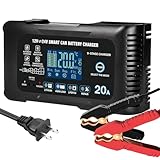
8. YHCHKJ 20Amp: 12/24V Smart Car Battery Charger – Automatic Maintainer, Trickle Charger & Desulfator with Overcharge Protection & Temperature Compensation – for Lead-Acid & Lithium & LiFePO4 Batteries
Overview:
YHCHKJ’s 20A charger supports lead-acid, lithium, and LiFePO4 batteries with adjustable current modes. It targets users needing fast charging for trucks, boats, or RVs, blending high power with safety features like temperature compensation and pulse repair.
What Makes It Stand Out:
Triple current options (5A/10A/20A for 12V) allow tailored charging, while explicit lithium/LiFePO4 compatibility sets it apart. The 3-level smart charging adapts voltage curves to battery chemistry, and the pulse repair mode rejuvenates degraded lead-acid batteries effectively.
Value for Money:
Competitively priced for a 20A dual-chemistry charger, it replaces multiple single-purpose devices. The speed advantage for large batteries (e.g., RVs) and lithium support justify costs versus lead-acid-only rivals, though lithium charging requires precise voltage control.
Strengths and Weaknesses:
Strengths: High 20A speed; versatile battery compatibility; intuitive LCD; robust safety protections; compact design.
Weaknesses: Lithium mode risks if misconfigured; minimum 2V starting voltage; complex mode selection for beginners.
Bottom Line:
Best for tech-savvy users with mixed battery types. Its power and flexibility excel in demanding scenarios, but lithium compatibility demands careful handling—prioritize reading the manual.
9. 2-Pack Smart Fully Automatic 6V 12V Battery Charger Maintainer for Car, Marine, Motorcycle, Lawn Mower

Overview:
This compact 2-pack offers dual 6V/12V charging for lead-acid batteries, emphasizing portability and maintenance. Ideal for small vehicles or backup use, it integrates charging, desulfation, and trickle maintenance in a space-efficient design.
What Makes It Stand Out:
The twin-pack value proposition is unique, allowing simultaneous charging of two batteries. Its 7-stage program includes desulfation and auto-switching to trickle mode (13.6V), while the 6.6ft cord and detachable connectors enhance versatility for motorcycles or mowers.
Value for Money:
Exceptional value as a duo—perfect for households with multiple small vehicles. At this price, few competitors offer two chargers with LCD displays, 8-layer protection, and desulfation, making it ideal for budget-conscious users.
Strengths and Weaknesses:
Strengths: Cost-effective 2-pack; true 6V/12V flexibility; plug-and-forget safety; strong desulfation; long warranty.
Weaknesses: Low 6A max current; slow for large batteries; LCD lacks detailed metrics; manual 12V override needed for weak batteries.
Bottom Line:
A stellar choice for maintaining small batteries across multiple devices. Its affordability and dual-unit convenience outweigh slower speeds, especially for seasonal equipment like lawn mowers or ATVs.
10. TowerTop Smart Car Battery Charger: 10A Battery Chargers 6V/12V Boat Battery Chargers with Auto Repair, Desulfator, Maintainer, Winter Mode, Suitable for AGM, Lithium (LiFePO4), Deep-Cycle Batteries

Overview:
TowerTop’s 10A charger delivers energy-efficient charging for 6V/12V lead-acid and LiFePO4 batteries. Using SMPS technology, it emphasizes speed (647% faster than 2A models) and smart diagnostics for cars, boats, and RVs.
What Makes It Stand Out:
Its 85% efficiency (vs. industry 75%) reduces heat and energy waste, while 6 dedicated battery modes (including LiFePO4) optimize charging curves. The true 8-stage process and HD LCD with real-time stage tracking provide unmatched precision for battery health.
Value for Money:
Priced above basic models, but SMPS efficiency, lithium support, and memory function justify costs. The 647% speed claim saves significant time for 25Ah batteries, offering long-term savings versus older transformer-based chargers it replaces.
Strengths and Weaknesses:
Strengths: Industry-leading efficiency; extensive battery compatibility; intuitive plug-and-play; detailed LCD; compact build.
Weaknesses: 10A max limits large-battery speed; LiFePO4 mode requires correct selection; no winter-specific mode.
Bottom Line:
A future-proof charger for eco-conscious users with diverse batteries. Its blend of speed, intelligence, and safety makes it a premium pick for boats or RVs, though occasional users may prefer simpler models.
Understanding the Core Technology Behind Modern Smart Charging
The Evolution from Dumb to Smart: Why Basic Chargers Fall Short
Gone are the days when a simple constant-voltage charger sufficed. Older “dumb” chargers often overcharge batteries, leading to gassing, electrolyte loss, and shortened lifespan, or undercharge them, leaving them perpetually sulfated and weak. Smart chargers, however, utilize multi-stage charging algorithms that adapt the voltage and current based on the battery’s real-time state of charge and chemistry. This precision prevents damage and ensures the battery reaches its maximum potential capacity safely.
Decoding Multi-Stage Charging Algorithms
The true intelligence lies in the charging profile. A robust smart charger typically employs at least four distinct stages: Bulk (delivering maximum safe current until ~80% charge), Absorption (holding voltage constant while current tapers as the battery accepts less), Float (reducing voltage to a maintenance level to prevent overcharging while compensating for natural discharge), and often a specialized Recondition or Desulfation stage. This final stage applies controlled voltage pulses to break down sulfate crystals that form on lead-acid plates during discharge, significantly extending battery life.
Advanced Voltage and Current Sensing Capabilities
Precision measurement is non-negotiable. Top-tier smart chargers feature highly accurate internal sensors that continuously monitor the battery’s voltage, the current flowing in and out, and crucially, the internal resistance. This real-time data feeds the microprocessor, allowing it to make micro-adjustments throughout the charging cycle. This level of granular control ensures optimal charging regardless of ambient temperature fluctuations or the battery’s specific age and condition.
Critical Features That Define a Truly Smart Charger for 2026
Comprehensive Chemistry Recognition and Adaptation
Your charger must automatically identify the battery type – whether it’s traditional flooded lead-acid, AGM (Absorbent Glass Mat), Gel, or even advanced lithium-ion variants becoming more common in vehicles and marine applications. Each chemistry has vastly different voltage and current requirements. A charger that misidentifies or lacks support for your specific battery type can cause catastrophic damage. Look for models explicitly listing support for all major chemistries you might encounter.
Intelligent Temperature Compensation
Battery charging efficiency and safety are heavily influenced by ambient temperature. A smart charger with a built-in temperature sensor (or a remote probe option) dynamically adjusts the charging voltage. In cold weather, it increases voltage slightly to overcome increased electrolyte resistance; in hot weather, it decreases voltage to prevent accelerated corrosion and water loss. This feature is vital for maintaining battery health year-round, especially in extreme climates.
Robust Safety Mechanisms Beyond Basic Overcharge Protection
While overcharge protection is standard, advanced safety is multi-layered. Expect features like reverse polarity protection (preventing damage if clamps are hooked up wrong), short-circuit protection, spark-proof connection, and thermal overload shutdown. For 2026, enhanced safety protocols that detect internal battery faults (like a shorted cell) and halt charging to prevent fire risk are becoming essential differentiators, offering crucial peace of mind.
Real-Time Diagnostic Feedback and User Interface
A smart charger should be a diagnostic tool, not just a power source. Clear, intuitive displays (backlit LCDs are ideal) should show critical data: current stage of charge, real-time voltage, charging current, estimated time remaining, and crucially, a battery health assessment. Advanced models might even provide a specific “State of Health” percentage or flag potential issues like high internal resistance indicating imminent failure, allowing for proactive replacement.
Optimizing Performance and Longevity for Diverse Applications
Matching Charger Capacity to Your Battery Needs
Selecting the right amperage is critical. A charger significantly underpowered for your battery (e.g., a 1A charger on a large truck battery) will take impractically long and may not complete the absorption stage effectively. Conversely, an overly powerful charger on a small battery can cause stress. As a general rule, the charger’s output should be roughly 10-25% of the battery’s cold cranking amps (CCA) or amp-hour (Ah) rating for optimal charging without strain. Consider your largest potential battery when choosing.
The Importance of Maintaining Trickle Power for Sensitive Electronics
Modern vehicles are rolling computers, constantly drawing small amounts of power (“parasitic drain”) for systems like alarms, clocks, and memory settings, even when off. A basic charger disconnected after a full charge won’t prevent slow discharge from this drain. Smart chargers with a true maintenance or “float” mode provide just enough power to counteract this drain indefinitely, keeping the battery at 100% without overcharging. This is essential for vehicles stored for weeks or months.
Specialized Considerations for Marine and RV Applications
Boats and RVs present unique challenges: harsh saltwater environments, extended storage periods, and complex multi-battery systems (starting, house, generator). Chargers designed for these applications often feature higher levels of corrosion resistance, compatibility with sophisticated battery combiners or isolators, and the ability to manage multiple battery banks simultaneously with independent charging profiles. Waterproofing (IP ratings) is also a significant factor for marine use.
Handling Seasonal Storage with Precision
Putting a vehicle or equipment away for winter or summer requires specific charging protocols. A smart charger with a dedicated storage mode is invaluable. This mode typically performs a full charge cycle, then switches to a very low, optimized float voltage specifically designed to maintain the battery at peak capacity for months without causing grid corrosion (common in lead-acid during long storage) or risking under-voltage damage. It’s far superior to simply disconnecting the battery.
Future-Proofing Your Investment: Trends Shaping 2026 Chargers
Enhanced Connectivity and Remote Monitoring Capabilities
The trend towards IoT integration is accelerating. Expect wider adoption of Bluetooth and Wi-Fi connectivity in 2026, allowing you to monitor charging progress, receive completion alerts, view battery health reports, and even initiate charging cycles remotely via a smartphone app. This is particularly useful for checking on stored vehicles or equipment from anywhere. Some systems may integrate with smart home platforms for broader energy management.
Predictive Analytics for Battery Health Management
Moving beyond simple diagnostics, the next frontier involves predictive algorithms. By analyzing long-term charging patterns, voltage stability, and internal resistance trends over multiple cycles, advanced chargers could soon provide more accurate forecasts of remaining battery lifespan and issue warnings well before a failure occurs. This transforms the charger from a maintenance tool into a proactive battery lifecycle manager.
Integration with Renewable Energy Sources
As solar charging for vehicles, boats, and storage systems becomes more common, smart chargers are evolving to seamlessly integrate with these setups. Look for models with dedicated solar input modes or compatibility with solar charge controllers, allowing them to intelligently manage power from both the grid and renewable sources for optimal, eco-friendly battery maintenance.
Improved Efficiency and Reduced Environmental Impact
Energy efficiency is gaining prominence. Newer chargers are focusing on higher conversion efficiency (less wasted energy as heat), lower standby power consumption, and the use of more sustainable materials in manufacturing. This not only saves you money on electricity but also aligns with broader environmental goals, making smart charging a greener choice.
Practical Implementation: Getting the Most from Your Smart Charger
Correct Connection Procedures for Safety and Effectiveness
Even the smartest charger requires proper setup. Always connect the charger to the battery before plugging it into the wall (or turning on power). Connect positive (red) clamp to the battery positive terminal, then negative (black) clamp to a solid, unpainted metal point on the vehicle chassis or engine block, not directly to the battery negative terminal if possible (reduces spark risk near the battery). Reverse the order when disconnecting. Double-check polarity!
Interpreting Diagnostic Feedback Accurately
Don’t just glance at the display; learn what the readings mean. A charger indicating “Complete” but also showing “Poor Health” or high internal resistance is telling you the battery itself is failing, regardless of the charge state. Understanding the difference between a successful charge cycle and an actual assessment of the battery’s underlying condition is crucial for making informed decisions about replacement.
Establishing a Proactive Maintenance Schedule
Smart chargers excel when used preventatively, not just as a rescue tool. For vehicles driven infrequently or subjected to short trips (which never fully recharge the battery), connect the charger weekly or bi-weekly. For seasonal storage, connect it before the battery discharges significantly and leave it on maintenance mode. Consistent, gentle topping off is far better for battery longevity than deep discharges followed by emergency charging.
Troubleshooting Common Charging Scenarios
If the charger doesn’t start, check connections, fuses (on charger and vehicle), and battery voltage (a severely depleted battery might need a “wake-up” mode). If charging takes excessively long, verify the charger amperage matches the battery size and check for parasitic drains. If the charger repeatedly shuts down, it could indicate a faulty battery (internal short, cell failure) or a poor connection. Consult the manual for specific error code meanings.
Frequently Asked Questions
Frequently Asked Questions
How much more should I expect to spend on a truly smart charger compared to a basic model? Investing in a quality smart charger typically costs 2-3 times more than a basic trickle charger, but this is easily justified by the extended battery lifespan (often doubling it), prevention of costly jump-starts or replacements, and the convenience of maintenance-free storage. It’s an investment that pays for itself.
Can a smart charger revive a completely dead battery that won’t accept any charge? While advanced reconditioning modes can often recover batteries suffering from mild sulfation or slight discharge, a battery that is physically damaged (e.g., shorted cell, broken plate) or completely sulfated beyond recovery generally cannot be revived by any charger. Smart chargers are preventative and maintenance tools, not resurrection devices for dead cells.
Is it safe to leave a smart charger connected indefinitely on maintenance mode? Yes, this is a primary function of a true smart charger with a proper float/maintenance mode. It continuously monitors the battery and provides only the tiny amount of current needed to counteract self-discharge and parasitic drain, keeping the battery at 100% without overcharging or causing damage. Always verify your specific model has this capability.
Do I still need to check electrolyte levels in flooded lead-acid batteries if using a smart charger? Yes. While smart chargers significantly reduce gassing and water loss compared to old chargers, flooded batteries still require periodic physical inspection of electrolyte levels, especially in hot climates or after deep discharges. Smart charging minimizes the need but doesn’t eliminate the requirement for basic flooded battery maintenance.
Can one smart charger effectively maintain multiple batteries of different types simultaneously? Standard single-output smart chargers cannot safely manage multiple different battery types at once, as each requires specific charging profiles. You need either a multi-bank charger (with independent outputs and processors for each bank) or separate chargers. Attempting to charge different chemistries (like AGM and Gel) together on one output risks damage.
Are smart chargers necessary for modern vehicles with efficient charging systems? Absolutely. While modern vehicle alternators are efficient for daily driving, they often don’t fully recharge the battery after short trips, idling with accessories on, or during cold starts. They also don’t counteract parasitic drain during storage. A smart charger ensures the battery remains at peak health, preventing the “parasitic drain death spiral” common in newer cars with complex electronics.
What’s the single most overlooked feature that causes problems for users? Many users overlook the critical importance of temperature compensation. Charging a battery in freezing cold or extreme heat with a charger lacking this feature leads to chronic undercharging (in cold) or accelerated corrosion/water loss (in heat), drastically shortening battery life regardless of how “smart” the other features are.
Can using an incompatible smart charger damage a lithium (LiFePO4) battery? Yes, potentially catastrophically. Lithium batteries, especially popular LiFePO4 types for accessories or starting, have very different charging requirements (strict voltage limits, no equalization) compared to lead-acid. Using a charger not explicitly designed and certified for your specific lithium chemistry can cause thermal runaway, fire, or explosion. Always verify lithium compatibility.
How do I know if my battery health reading from the charger is accurate? Charger health assessments (like “Good,” “Weak,” “Replace”) are generally reliable indicators but are based on voltage response and internal resistance during charging. For absolute confirmation, especially if the charger flags an issue, a professional load test at an auto parts store provides the definitive assessment of a battery’s ability to deliver cranking amps.
Is there any scenario where a basic charger is still preferable to a smart charger? The only common scenario is for very simple, infrequent charging of basic flooded batteries where the user is present to monitor the process and disconnect immediately upon full charge (e.g., an old lawn tractor used weekly). For virtually all automotive, marine, RV, and modern applications involving storage, multiple batteries, or sensitive electronics, a smart charger is overwhelmingly the better, safer, and more economical choice.
See Also
- 10 Must-Have Smart Battery Chargers for Modern Vehicles in 2026
- 10 Must-Have Battery Tenders for Winter Storage to Keep Your Car Running Smoothly in 2026
- We Tested 50 Smart Battery Chargers - Here are the 10 Best for Home Use in 2026
- The 10 Ultimate Best Smart Battery Chargers for Modern Vehicles in 2026
- 2026’s Top 10 Jump Starter Chargers for Dead Battery Recovery