Table of Contents
Ever woken up to a silent engine when you know you turned off the headlights? Or returned to your classic car after a long winter only to face the dreaded click of a dead battery? That sinking feeling when your vehicle won’t cooperate – despite your best intentions – is incredibly frustrating. It’s not just an inconvenience; it disrupts your plans, costs you time, and can even lead to expensive replacements if the battery isn’t cared for properly. The culprit is often slow, relentless self-discharge, especially when vehicles sit idle for days or weeks, a problem modern electronics make even worse.
The good news? You don’t need to live in fear of a flat battery. The solution lies in smart, proactive maintenance, and trickle chargers are the unsung heroes of battery longevity. Forget the hassle of jump-starts or the expense of premature battery failures. A quality trickle charger works silently in the background, gently replenishing your battery’s charge at the exact rate it loses power, keeping it perpetually ready to go. Understanding how to choose and use one correctly transforms battery anxiety into effortless reliability, whether you’re dealing with a daily driver, a prized classic, a seasonal boat, or even essential backup power systems. Let’s dive into the world of intelligent battery care.
Top 10 Trickle Chargers
Detailed Product Reviews
1. NOCO GENIUS1: 1A 6V/12V Smart Battery Charger – Automatic Maintainer, Trickle Charger & Desulfator with Overcharge Protection & Temperature Compensation – for Lead-Acid & Lithium Batteries

Overview: The NOCO GENIUS1 is a compact, intelligent charger designed for 6V/12V lead-acid and lithium (LiFePO4) batteries, serving as a charger, maintainer, trickle charger, and desulfator in one unit. It targets automotive, marine, and powersport users needing reliable, hands-off battery care.
What Makes It Stand Out: Its standout features include charging dead batteries as low as 1 volt (with Force Mode for zero-volt recovery), precise temperature-compensated charging to prevent over/under-charging, and universal compatibility with nearly all battery types. The 35% smaller footprint and higher power density versus predecessors enhance portability.
Value for Money: Priced premium, it justifies cost through durability, advanced safety, and lithium support—rare in entry-tier chargers. While cheaper alternatives exist, its desulfation capability and indefinite maintenance mode offer long-term savings by extending battery life.
Strengths and Weaknesses: Strengths: Exceptional safety (overcharge/temp protection), effortless maintenance mode, robust build. Weaknesses: 1A output slower for large batteries, no LCD display for real-time metrics, higher price than basic models.
Bottom Line: Ideal for users prioritizing reliability and battery longevity over speed; a top-tier choice for critical applications despite the cost. Highly recommended for lithium or neglected battery recovery.
2. 2-Pack Smart Fully Automatic 6V 12V Battery Charger Maintainer for Car, Marine, Motorcycle, Lawn Mower

Overview: This NEXPEAK 2-pack offers dual 4-in-1 chargers (charger/maintainer/trickle/desulfator) for 6V/12V lead-acid batteries, targeting car, marine, and powersport owners needing affordable, multi-battery solutions. It emphasizes plug-and-forget simplicity.
What Makes It Stand Out: The clear LCD screen displaying voltage, current, and charge percentage provides unmatched transparency. Its 7-stage charging cycle (including desulfation) and dual-mode operation (STD cutoff vs. trickle maintenance at 13.6V) cater to varied needs. The detachable connectors and 2-year warranty add versatility.
Value for Money: Excellent for budget-conscious buyers—the 2-pack allows simultaneous charging of two batteries at a lower per-unit cost than premium brands. While lacking lithium support, it covers most lead-acid use cases effectively.
Strengths and Weaknesses: Strengths: Real-time LCD feedback, solid safety suite (reverse polarity/over-temp protection), easy 12V force mode. Weaknesses: Trickle voltage (13.6V) may be high for long-term AGM storage, no lithium compatibility, build quality less robust than NOCO.
Bottom Line: A practical, feature-rich option for lead-acid battery owners needing visibility and dual-unit convenience. Best for casual users; skip if using lithium batteries.
3. MOTOPOWER MP00205A 12V 800mA Automatic Battery Charger, Maintainer, Trickle and Desulfator
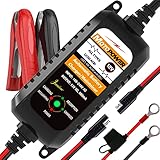
Overview: The MOTOPOWER MP00205A is a streamlined 12V charger/maintainer/desulfator for lead-acid batteries (flooded, AGM, gel), focusing on safety and simplicity. It suits motorcycle, lawn mower, and small-vehicle owners seeking an ETL-certified, no-fuss solution.
What Makes It Stand Out: Its ETL/UL safety certification and spark-free connection enhance trustworthiness. The automatic 24-hour timer terminates charging at 14.4V (preventing gassing) and switches to a gentle 13.6V maintenance mode—ideal for sensitive batteries. Zero-standby drain also protects vehicle electronics.
Value for Money: Competitively priced for certified safety and desulfation. While slower (800mA) than 1A+ rivals, it’s cost-effective for small batteries where speed isn’t critical, outperforming uncertified budget models.
Strengths and Weaknesses: Strengths: Certified safety, optimal maintenance voltage, energy-efficient, fully automatic. Weaknesses: No 6V support, lacks LCD display, slower charge rate, limited to 12V lead-acid (no lithium).
Bottom Line: A reliable, safety-focused pick for 12V maintenance on smaller vehicles. Recommended for users prioritizing certification over speed or multi-voltage flexibility.
4. NOCO GENIUS2: 2A 6V/12V Smart Battery Charger – Automatic Maintainer, Trickle Charger & Desulfator with Overcharge Protection & Temperature Compensation – for Lead-Acid & Lithium Batteries

Overview: The NOCO GENIUS2 upgrades its predecessor with 2A output, targeting users needing faster charging for 6V/12V lead-acid and lithium batteries without sacrificing NOCO’s signature smart features. It’s engineered for efficiency and resilience.
What Makes It Stand Out: Force Mode enables charging from zero volts—critical for fully depleted batteries. Temperature-compensated charging adapts dynamically to climate, while 24-hour reconditioning cycles maintain peak performance. The compact, high-power design outperforms bulkier rivals.
Value for Money: Commands a premium but delivers with doubled amperage, broader lithium compatibility, and military-grade durability. Faster charging justifies cost for frequent users, though occasional users may prefer the GENIUS1.
Strengths and Weaknesses: Strengths: Zero-volt recovery, rapid 2A charging, climate optimization, silent operation. Weaknesses: No display (relying on LED indicators), expensive, slightly larger than GENIUS1.
Bottom Line: The best NOCO for demanding applications—worth the investment for professionals or those with chronically drained batteries. Top recommendation for speed and versatility.
5. [4-Pack]1.75-Amp Car Battery Charger, 6V and 12V Smart Fully Automatic Battery Charger Maintainer, Trickle Charger, Battery Desulfator for Car, Lawn Mower, Motorcycle, Boat, Marine Lead Acid Batteries
![[4-Pack]1.75-Amp Car Battery Charger, 6V and 12V Smart Fully Automatic Battery Charger Maintainer, Trickle Charger, Battery Desulfator for Car, Lawn Mower, Motorcycle, Boat, Marine Lead Acid Batteries](https://m.media-amazon.com/images/I/51rc2qpU9VL._SL160_.jpg)
Overview: This NEXPEAK 4-pack delivers quadruple 1.75A chargers for 6V/12V lead-acid batteries, emphasizing multi-device convenience for fleet managers or households with numerous vehicles. It mirrors Product 2’s core tech but in a larger bundle.
What Makes It Stand Out: The 1.75A output strikes a balance between speed and safety, while the LCD screen provides real-time metrics (voltage, charge %). Its 7-stage program and 12.5V maintenance voltage suit long-term storage better than higher-voltage rivals. The 4-pack is ideal for scaling battery care.
Value for Money: Unbeatable for bulk needs—the per-unit cost is exceptionally low. However, the 12.5V maintenance level may undercharge some AGM batteries, and lithium incompatibility limits flexibility.
Strengths and Weaknesses: Strengths: Cost-efficient 4-pack, LCD clarity, robust protection suite, decent amperage. Weaknesses: Questionable 12.5V maintenance voltage, no lithium support, build quality feels lightweight.
Bottom Line: A smart buy for lead-acid fleet maintenance where budget and quantity matter most, but verify if 12.5V suits your batteries. Avoid for lithium or precision-sensitive setups.
6. NOCO GENIUS5: 5A 6V/12V Smart Battery Charger – Automatic Maintainer, Trickle Charger & Desulfator with Overcharge Protection & Temperature Compensation – for Lead-Acid & Lithium Batteries

Overview: The NOCO GENIUS5 is a premium smart charger designed for comprehensive battery care across 6V/12V lead-acid (AGM, Gel, flooded) and lithium (LiFePO4) batteries. It combines charging, maintenance, desulfation, and recovery in a compact unit.
What Makes It Stand Out: Its standout features include 65% more power than predecessors in a 34% smaller chassis, temperature-compensated charging to prevent over/under-charging, and “Force Mode” for reviving dead batteries (down to 0V). Seamless compatibility with both lead-acid and lithium chemistries sets it apart.
Value for Money: Priced higher than budget options, it justifies cost through durability, advanced lithium support, and dead-battery recovery—eliminating frequent replacements. Cheaper alternatives often lack lithium compatibility or robust desulfation.
Strengths and Weaknesses: Strengths: Exceptional versatility, ultra-compact design, reliable long-term maintenance, and military-grade safety. Weaknesses: Premium price; no LCD display for real-time metrics; 5A output may be slow for large marine/RV batteries.
Bottom Line: Ideal for enthusiasts needing reliable, chemistry-agnostic charging. Despite the cost, its dead-battery recovery and lithium support make it a top-tier investment for critical applications—highly recommended for discerning users.
7. Battery Tender Plus 12V 1.25 AMP Car & Motorcycle Battery Charger and Maintainer, Float Charge for Automotive, and ATVs - Smarter Than a Trickle Charger

Overview: The Battery Tender Plus is a trusted 1.25A smart charger/maintainer for 12V lead-acid batteries (cars, motorcycles, ATVs). It emphasizes simplicity and safety with a 4-step charging program and long-term float maintenance.
What Makes It Stand Out: Its 10-year warranty and lifetime support are unmatched in the segment. The quick-disconnect harness streamlines connection, while the dual-color LED clearly signals charge status and auto-resumes charging if voltage drops under load.
Value for Money: Competitively priced for its reliability. Though slower (1.25A) than higher-amp rivals, it excels as a pure maintainer. Budget chargers often lack robust warranties or auto-resume features, making this a cost-effective long-term solution.
Strengths and Weaknesses: Strengths: Exceptional warranty, user-friendly quick-disconnect, reliable float mode, and solid safety protections. Weaknesses: Limited to 12V lead-acid; slow charging for larger batteries; no desulfation mode; basic LED-only feedback.
Bottom Line: A dependable, hassle-free maintainer for casual users with standard automotive/motorcycle batteries. Its warranty and simplicity justify the price—best for those prioritizing set-and-forget reliability over advanced features.
8. Foval Automatic Trickle Battery Charger 12V 1000mA Smart Battery Charger
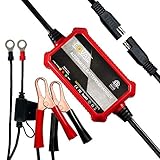
Overview: This ultra-compact 1A charger serves as a maintainer, trickle charger, and desulfator for 12V lead-acid batteries (AGM, Gel, flooded). It targets users needing portability and broad vehicle compatibility without complex features.
What Makes It Stand Out: Its phone-sized profile (3.9 x 2.4 x 1.25 inches) and dual cable options (ring/alligator clips) enhance convenience. The 4-step charging program and intuitive 3-color LED (power/charging/fully charged) simplify monitoring.
Value for Money: An excellent budget pick. At this price, it delivers essential smart charging, safety protections, and compatibility with boats, ATVs, and classics—outperforming basic trickle chargers that risk overcharging.
Strengths and Weaknesses: Strengths: Remarkably compact, affordable, robust safety suite (reverse polarity, over-voltage), and versatile cable setup. Weaknesses: No LCD display; limited to 12V lead-acid (no lithium); 1A output suits small batteries only; desulfation effectiveness is modest.
Bottom Line: Perfect for cost-conscious owners of motorcycles, lawn mowers, or classic cars needing reliable, space-saving maintenance. Lacks premium features but excels as a no-frills, safe daily maintainer—highly recommended for light-duty use.
9. 1.75-Amp Car Battery Charger, 6V and 12V Smart Fully Automatic Battery Charger Maintainer, Trickle Charger, Battery Desulfator for Car, Lawn Mower, Motorcycle, Boat, Marine Lead Acid Batteries

Overview: This 1.75A dual-voltage (6V/12V) smart charger offers automatic maintenance, desulfation, and a digital LCD display for lead-acid batteries across automotive, marine, and powersport applications.
What Makes It Stand Out: The real-time LCD showing voltage, current, and charge percentage is rare in this tier. Its 7-stage charging includes dedicated “pulse repair” for battery restoration, and a forced 12V mode revives severely depleted batteries.
Value for Money: Mid-priced but feature-rich. The LCD and pulse repair add tangible value over LED-only rivals, while dual-voltage support avoids buying separate chargers. Outperforms cheaper models with limited diagnostics.
Strengths and Weaknesses: Strengths: Clear LCD interface, effective desulfation, versatile 6V/12V use, and comprehensive safety suite. Weaknesses: Build quality feels less premium; “pulse repair” results vary; no lithium support; forced 12V mode requires manual intervention.
Bottom Line: A smart choice for users wanting detailed charging insights and battery revival without lithium needs. The LCD and dual-voltage flexibility make it worth the slight premium—recommended for hands-on maintainers.
10. [4-Pack] FOVAL Fully Automatic Trickle Battery Charger, 1000mA 12V Smart Car Battery Charger, Battery Maintainer, Float Charger for Motorcycle Car Lawn Mower Boat ATV Cell Lead Acid Batteries
![[4-Pack] FOVAL Fully Automatic Trickle Battery Charger, 1000mA 12V Smart Car Battery Charger, Battery Maintainer, Float Charger for Motorcycle Car Lawn Mower Boat ATV Cell Lead Acid Batteries](https://m.media-amazon.com/images/I/51z7cL3OlrL._SL160_.jpg)
Overview: This 4-pack of 1A 12V smart chargers delivers identical functionality to Product 8 but multiplies value for users managing multiple vehicles. It covers maintenance, desulfation, and float charging for lead-acid batteries.
What Makes It Stand Out: Bulk savings and identical compact design (phone-sized) with dual cables per unit. The 4-step program and color-coded LEDs ensure consistent, safe charging across all four units—ideal for fleets of bikes, boats, or seasonal vehicles.
Value for Money: Exceptional for multi-battery households. Buying four standalone units would cost 2–3x more. Each charger matches budget single units in features but scales value exponentially for RV/marine owners or collectors.
Strengths and Weaknesses: Strengths: Unbeatable per-unit cost; space-efficient; reliable maintenance; robust safety features. Weaknesses: Still limited to 12V lead-acid; no displays; desulfation is basic; 1A output unsuitable for large batteries.
Bottom Line: The ultimate solution for maintaining multiple small-to-medium lead-acid batteries affordably. Sacrifices advanced features for sheer practicality—highly recommended for garages with motorcycles, lawn equipment, or storage-bound vehicles.
Understanding Battery Drain and Why Trickle Charging is Essential
The Silent Killer: How Batteries Self-Discharge
All lead-acid and AGM batteries naturally lose charge over time, even when disconnected from your vehicle. This self-discharge happens due to internal chemical reactions and can accelerate with higher temperatures or older batteries. Modern vehicles, packed with computers and sensors constantly drawing small amounts of power (“parasitic drain”), drain batteries much faster than older models. Left unchecked for weeks, this drain pushes the battery into a deeply discharged state, causing irreversible sulfation – the formation of hard lead sulfate crystals on the plates that permanently reduce capacity and lifespan.
Beyond Jump-Starting: The Limitations of Quick Fixes
While jump-starting gets you moving immediately, it’s merely a temporary band-aid. A deeply discharged battery requires a slow, controlled recharge to reverse sulfation safely. Standard chargers or alternators aren’t designed for this prolonged, low-current task. Using them risks overheating the battery, causing internal damage, or simply failing to fully restore the charge. Relying solely on your alternator after a jump-start puts excessive strain on it and rarely brings the battery back to 100% capacity, leaving it vulnerable to the next drain cycle.
The Trickle Charger Advantage: Gentle, Continuous Care
Trickle chargers deliver a very low, constant amperage (typically 0.5A to 2A) specifically designed to counteract self-discharge and parasitic drain. Unlike fast chargers, they operate safely for extended periods – weeks, months, or even indefinitely – without overcharging or damaging the battery. This “float” stage maintains the battery at its optimal full charge voltage, preventing sulfation and significantly extending its usable life. It’s preventative maintenance that pays off in reliability and cost savings.
Key Features to Evaluate When Choosing a Trickle Charger
Amperage and Charging Stages: Matching the Charger to Your Needs
The right amperage depends on your battery size and usage pattern. Smaller batteries (like motorcycles or lawn tractors) often need only 0.5A-1A, while larger automotive or marine batteries might benefit from 1.5A-2A for slightly faster topping off. Crucially, look for multi-stage chargers: Bulk (fast initial charge), Absorption (reaches full voltage), and Float (maintenance mode). Avoid simple “trickle” chargers that only offer a constant low charge; without automatic float mode, they risk overcharging over time. Smart chargers with these stages are essential for modern battery health.
Battery Type Compatibility: One Charger for Multiple Applications?
Modern vehicles use various battery chemistries: traditional flooded lead-acid (FLA), Absorbed Glass Mat (AGM), and Gel Cell. Each requires slightly different charging voltages. A versatile charger should explicitly state compatibility with all three types, often with a selector switch. Using a charger set for FLA on an AGM battery, for instance, can undercharge it, while the reverse can overcharge and damage a Gel battery. Universal compatibility ensures you can use one charger safely across cars, boats, motorcycles, and RVs.
Safety and Protection Mechanisms: Non-Negotiable Safeguards
Safety is paramount. Look for essential built-in protections: Spark-proof technology (prevents sparks during connection), reverse polarity protection (won’t operate if leads are crossed, preventing damage), short-circuit protection, and overcharge/over-temperature shutdown. Overheating is a major risk with poorly designed units, especially in enclosed spaces like engine bays. Robust thermal management and automatic shutdown features are critical for worry-free, unattended operation. Never compromise on these safety aspects.
Optimizing Trickle Charger Performance for Your Specific Use Case
Garage vs. On-Vehicle: Connection Strategies
Where and how you connect matters. For vehicles stored long-term in a garage, connecting directly to the battery terminals is ideal for consistent charging. If leaving the charger connected while the vehicle is in regular (but infrequent) use, ensure the charger is securely mounted away from moving parts and moisture, with leads routed safely. For hard-to-reach batteries (like some modern cars), consider using a dedicated SAE pigtail connector permanently wired to the battery, allowing easy plug-in without opening the hood each time.
Climate Considerations: Charging in Extreme Temperatures
Battery chemistry and charging requirements change with temperature. Extreme cold slows chemical reactions, requiring slightly higher voltage to charge effectively, while extreme heat increases the risk of overcharging and water loss. Advanced “temperature-compensated” chargers automatically adjust their output voltage based on ambient temperature, optimizing the charge profile and maximizing battery life in all conditions. This feature is highly valuable if your vehicle is stored in an unheated garage, outdoors, or in very hot climates.
Long-Term Storage Protocols: Beyond Just Plugging In
For vehicles stored for months (like seasonal boats or classic cars), preparation is key. Before storage, ensure the battery is fully charged using a standard charger. Then, connect the trickle charger. Clean battery terminals to prevent corrosion, which can create resistance and hinder charging. If possible, store the vehicle in a cool, dry place. Check the charger’s status indicators periodically (if accessible) to confirm it’s functioning correctly in float mode. This proactive approach ensures your vehicle starts reliably when you’re ready to use it.
Advanced Considerations for Modern Vehicles and Complex Systems
Managing Onboard Electronics: The Parasitic Drain Challenge
Modern cars are essentially computers on wheels. Even when off, systems like the alarm, radio presets, clock, and engine control modules draw small amounts of current – sometimes enough to drain a battery in 2-4 weeks. A trickle charger specifically designed to handle this constant, low-level drain is essential. Ensure the charger’s float voltage is stable and sufficient to counteract this parasitic load without causing ripple voltage that could confuse sensitive electronics. Look for chargers marketed as “maintenance chargers” optimized for modern vehicles.
Dealing with Stop-Start and Enhanced Electrical Systems
Vehicles equipped with start-stop technology or numerous high-draw accessories (like premium audio or advanced driver aids) often use sophisticated AGM or EFB (Enhanced Flooded Battery) types. These batteries have different charging requirements and are more sensitive to improper charging than traditional batteries. Using a charger explicitly designed and certified for AGM/EFB is non-negotiable. Standard chargers may not recognize the battery type correctly or deliver the precise voltage profile needed, leading to undercharging and reduced battery life.
Integrating with Solar Power: Sustainable Maintenance Solutions
For vehicles stored remotely (boats on moorings, RVs in fields, or solar-powered backup systems), combining a trickle charger with a small solar panel creates a self-sustaining maintenance system. You’ll need a solar charge controller specifically designed to work with your trickle charger’s input requirements or a dedicated solar maintainer. This setup harnesses sunlight to keep the battery topped off indefinitely without any grid connection, perfect for off-grid scenarios where plugging in isn’t feasible.
Maximizing Battery Lifespan Through Proper Charging Practices
The Sulfation Reversal Myth: Realistic Expectations
Be wary of chargers claiming to “recondition” or “desulfate” severely degraded batteries. While a mild state of sulfation can sometimes be reversed with a controlled, slow charge before crystals harden, deep sulfation is usually permanent damage. A quality trickle charger’s primary role is prevention – keeping the battery fully charged to avoid sulfation in the first place. Don’t expect miracles from a charger on a battery that’s been deeply discharged for months; prevention is always cheaper and more effective than attempted cure.
Monitoring and Maintenance: It’s Not Truly “Set and Forget”
Even the smartest charger benefits from occasional checks. Familiarize yourself with the charger’s indicator lights – what does “Float” or “Maintain” look like? Periodically inspect battery terminals for corrosion and ensure connections are tight. If your charger has a display, note the voltage during float mode (typically around 13.2V-13.8V for a healthy 12V system, depending on type/temp). If the charger constantly shows “Charging” and never reaches float, it could indicate a failing battery with excessive self-discharge or a parasitic drain exceeding the charger’s capacity.
Knowing When to Replace the Battery, Not Just the Charger
A trickle charger maintains a healthy battery; it doesn’t fix a fundamentally dead one. If a battery consistently fails to hold a charge even when properly maintained by a known-good charger, or if it’s more than 3-5 years old and shows signs of weakness (slow cranking, needing frequent recharges), the battery itself is likely the problem. Continuing to rely on a charger with a failing battery wastes effort and risks being stranded. Recognize when battery replacement is the necessary next step.
Frequently Asked Questions
Frequently Asked Questions
Can I leave a trickle charger connected to my battery all winter? Yes, a modern smart trickle charger with automatic float mode is designed for continuous, unattended connection. Ensure it’s compatible with your battery type and has all necessary safety protections (reverse polarity, spark-proof, overcharge).
Will a trickle charger drain my car battery if it’s not plugged in? No. A trickle charger requires an external power source (wall outlet). When unplugged, it’s just inert wiring. However, ensure the charger itself doesn’t have any internal circuitry that could theoretically draw a minuscule amount (unlikely in quality units).
What’s the difference between a trickle charger and a battery maintainer? The terms are often used interchangeably. Technically, a “trickle charger” historically meant a simple constant low-current charger (risk of overcharge), while a “battery maintainer” implies a smart charger with automatic float mode. Today, “trickle charger” usually refers to the smart, safe type.
Can I use a trickle charger on a lithium-ion battery? Generally, no. Most standard trickle chargers are designed for lead-acid chemistries (FLA, AGM, Gel). Lithium-ion batteries require completely different charging profiles and voltage controls. Using a standard charger can be dangerous. Only use a charger explicitly designed and certified for your specific lithium battery type.
Why does my battery still go dead even with a trickle charger connected? This usually indicates a problem: 1) The charger might be undersized (amperage too low to counteract a high parasitic drain), 2) The charger isn’t compatible with your battery type, 3) There’s an excessive parasitic drain in the vehicle exceeding the charger’s capacity, or 4) The battery itself is failing and cannot hold a charge.
How do I know if my trickle charger is working correctly? Check the status lights per the manual (e.g., solid green for float/maintain). Use a multimeter: a fully charged 12V battery on float should read 13.2V - 13.8V. If it’s constantly showing “charging” or the voltage is very high (>14.4V) or very low (<12.6V) for extended periods, investigate.
Is it safe to use a trickle charger in the rain or snow? Generally, no. While many chargers have some weather resistance, they are not designed for direct exposure to rain, snow, or standing water. Moisture can cause short circuits, damage the charger, or create electrical hazards. Always use in a dry, well-ventilated location.
Do I need to disconnect the battery before connecting a trickle charger? Usually not with modern smart chargers designed for on-vehicle use. Connect the charger directly to the battery terminals (red to positive, black to negative) following the charger’s instructions. Disconnecting isn’t necessary and can reset vehicle electronics; ensure the vehicle is off.
Can a trickle charger start a completely dead battery? No. Trickle chargers provide low amperage for maintenance, not the high current needed to crank an engine. If the battery is fully dead (0V), use a standard battery charger first to bring it up to a minimal charge level before connecting the trickle charger for maintenance.
How often should I check the battery when using a trickle charger? For peace of mind, a quick visual check of the charger’s status indicator every few weeks is sufficient. Physically inspect terminals for corrosion and tightness every 3-6 months. If the charger shows abnormal behavior (frequent charging cycles, overheating), investigate immediately.
See Also
- How to Solve Winter Battery Failure with the 10 Best Trickle Chargers in 2026
- How to Solve Winter Battery Failures with the 10 Best Trickle Chargers in 2026
- 10 Must-Have Smart Battery Chargers for Preventing Dead Batteries in 2026
- How to Solve Dead Battery Anxiety with the 10 Best Digital Jump Starters in 2026
- 2026’s Top 10 Jump Starter Chargers for Dead Battery Recovery