Table of Contents
There’s a special kind of panic that sets in when you turn the key on your vintage cruiser or beloved older sedan, only to be met with a sickening silence or that dreaded rapid-clicking sound. It’s not just inconvenient—it’s a potential trap, leaving you stranded far from help, especially if you’re cruising backroads or attending a weekend car show. Older vehicles, with their unique electrical characteristics and sometimes finicky components, present specific challenges that modern jump starters aren’t always designed to handle gracefully. Relying on the wrong device can mean wasted time, damaged electronics, or worse—adding insult to injury when you’re already frustrated. The peace of mind that comes from having the right tool in your trunk isn’t just about convenience; it’s about preserving the joy of driving a classic without the constant shadow of electrical gremlins.
Choosing a jump starter for an older vehicle isn’t as simple as grabbing the latest high-amp model off the shelf. Vintage and classic cars often operate on different electrical principles compared to their modern counterparts. They might have weaker grounding, sensitive points-based ignition systems, or even the rare 6-volt system lurking under the hood. Using a device designed purely for today’s computer-laden cars can sometimes overwhelm delicate vintage circuitry or simply fail to deliver the necessary cranking power effectively. This guide cuts through the marketing hype to focus solely on the critical features and considerations you must evaluate to ensure your jump starter is a reliable guardian angel for your older automobile, not just another piece of gear that lets you down when the battery dies.
Top 10 Jump Starters for Older Vehicles
Detailed Product Reviews
1. GOOLOO A3 Jump Starter with Air Compressor, 3000A Portable Car Battery Booster (9.0 Gas/6.5L Diesel) with 150PSI Auto-Shutoff Tire Inflator, 12V Supersafe Lithium Jump Box Car Battery Jumper Starter

Overview: The GOOLOO A3 is a versatile 3000A portable jump starter and tire inflator combo designed for 12V vehicles up to 9.0L gas or 6.5L diesel engines. It integrates jump-starting, tire inflation, power banking, and emergency lighting into a single rugged unit rated for extreme temperatures (-4°F to 140°F). What Makes It Stand Out: Its standout feature is the dual functionality as both a reliable jump starter (with a force-start mode for severely depleted batteries) and a smart cordless tire inflator. The inflator offers five preset modes, auto-shutoff at target pressure, and rapid inflation (e.g., Tesla tires in 1 minute), all displayed on a sunlight-readable LED screen. The robust 10-layer safety protection system also ensures reliable operation. Value for Money: Priced competitively in the mid-range, the A3 delivers exceptional value by replacing multiple tools—a dedicated jump starter, tire pump, and power bank. Its 1000+ charge cycles and comprehensive nozzle kit (for cars, bikes, balls) justify the cost versus single-function alternatives. Strengths and Weaknesses: Strengths: Reliable jump performance, intuitive inflation with auto-shutoff, durable weather resistance, and genuine multi-tool utility. Weaknesses: Lower peak amps (3000A) than some rivals limit use on larger diesel engines, and the inflator runtime (45 mins) may fall short for extensive use. Bottom Line: An excellent all-in-one emergency kit for most drivers, offering reliable jump starts and highly practical tire inflation. Ideal for everyday drivers prioritizing versatility and ease of use over extreme high-amperage needs.
2. Sharmeal Car Jump Starter 5000A, Jump Starter Battery Pack for 10.0L Gas and 9.0L Diesel, 12V Portable Jump Box with LED Light

Overview: The Sharmeal 5000A jump starter targets larger vehicles (up to 10.0L gas/9.0L diesel) with high peak amperage in a compact 12V lithium unit. It emphasizes safety and portability, featuring integrated smart clamps, dual USB outputs, and an 800-lumen emergency light. What Makes It Stand Out: Its 5000A peak power handles demanding engines like RVs and heavy-duty trucks, while the 14-layer safety system (including spark-proof and reverse-polarity protection) minimizes user error risks. The standout 800-lumen LED light with 48-hour runtime (SOS/strobe modes) significantly exceeds competitors’ basic flashlights. Value for Money: Positioned as a budget-friendly high-power option, it offers strong value for owners of larger vehicles needing robust starting power without premium pricing. The included carrying case, cables, and 24-month warranty enhance its cost-effectiveness versus pricier brands. Strengths and Weaknesses: Strengths: Exceptional power for large engines, superior lighting for emergencies, user-friendly smart clamps with clear status indicators, and lightweight portability. Weaknesses: Lacks an integrated air compressor, and the power bank output (5V/2A) is slower than modern PD standards. Bottom Line: A top choice for RV, truck, or SUV owners needing maximum starting power in a safe, portable package. Its lack of inflation functionality is offset by strong core performance and emergency lighting, making it a reliable specialist tool.
3. Portable 10-in-1 Car Battery Jump Starter with Air Compressor 8000A 160PSI 45W Charger, Jump Starter Jump Box (All Gas 14L Diesel), Car Battery Jumper Starter Portable Jumper Cables, Gloves, Lights

Overview: This powerhouse 8000A jump starter boasts a “10-in-1” design, supporting massive engines (all gas/14L diesel) and integrating a 160PSI air compressor, PD45W charging, emergency gloves, and multi-mode lighting into one unit. What Makes It Stand Out: Unmatched versatility defines this model: the FORCE START function revives completely dead batteries even in freezing temps (-20°C), while the ultra-fast compressor inflates tires to 25 PSI in 2 minutes. PD45W bi-directional charging (0-80% in 1 hour) and 45W laptop charging are rare highlights, alongside included safety gloves. Value for Money: Despite a likely premium price, it delivers exceptional value through sheer functionality. Replacing a jump starter, high-speed power bank, professional-grade inflator, and safety kit justifies the cost for frequent travelers or commercial users needing comprehensive roadside readiness. Strengths and Weaknesses: Strengths: Industry-leading 8000A power, rapid PD45W charging, versatile inflation with auto-shutoff, bright 800-lumen lights, and included safety accessories. Weaknesses: Bulkier than minimalist models, and the high feature count may overwhelm casual users. Bottom Line: A premium, feature-packed solution ideal for professionals or adventure seekers. Its unparalleled power, charging speed, and all-in-one design make it worth the investment for those demanding maximum capability in emergencies.
4. Jump Starter with Air Compressor, 8000A Car Battery Jump Starter (9.0 Gas/8.0L Diesel), 180PSI Car Battery Jumper Starter Portable 12V Jump Box with Jumper Cables, LED Light, Power Bank, LCD Display
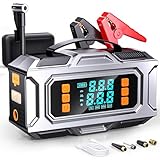
Overview: This 8000A jump starter combines high starting power (for 9.0L gas/8.0L diesel engines) with an 180PSI smart air compressor, a 20,000mAh power bank, and emergency lighting in a single portable unit built for daily drivers and road trips. What Makes It Stand Out: The intelligent wireless inflation system is key: preset modes, real-time pressure monitoring via a large LCD screen, and auto-shutoff prevent over-inflation. The 180PSI max pressure and 35L/min airflow enable quick tire fills (30→36 PSI in 1 minute), while 10 safety protections ensure secure operation. Value for Money: Offering a balanced feature set at a mid-to-high price point, it provides excellent value by merging essential functions—jump starting, reliable inflation, and device charging—without the complexity of ultra-premium models. The 20,000mAh capacity outperforms many rivals as a power bank. Strengths and Weaknesses: Strengths: Powerful jump capability, accurate and fast tire inflation, comprehensive safety suite, bright backlight LCD, and robust power bank. Weaknesses: Slightly lower diesel support (8.0L vs. some 9.0L+ models), and the compressor hose isn’t detachable. Bottom Line: A highly practical, well-rounded choice for most drivers. Its seamless integration of jump starting, precise inflation, and charging makes it a dependable daily companion for commuters and travelers alike.
5. NOCO Boost GB40: 1000A UltraSafe Jump Starter – 12V Lithium Battery Booster Pack, Portable Jump Box, Power Bank & Jumper Cables - for 6.0L Gas and 3.0L Diesel Engines
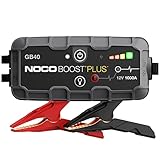
Overview: The NOCO GB40 is a compact, ultralight (2.5 lb) jump starter focused on safety and simplicity for smaller vehicles (up to 6.0L gas/3.0L diesel). It prioritizes user-friendliness with patented safety tech and essential emergency features. What Makes It Stand Out: NOCO’s UltraSafe Technology—spark-proof and reverse-polarity protection—is its hallmark, making it nearly impossible to cause damage during use. Its glovebox-friendly size, 100-lumen 7-mode LED light, and rapid 3-hour recharge cater to everyday drivers prioritizing convenience and safety over raw power. Value for Money: While priced higher per amp than bulkier models, the GB40 excels in value for compact-car owners. Its legendary reliability, 20-starts-per-charge efficiency, and 4+ year lifespan (with proper storage) offset the cost, especially as a low-profile emergency staple. Strengths and Weaknesses: Strengths: Unbeatable safety features, ultra-portable design, intuitive operation, fast recharge, and exceptional build quality. Weaknesses: Limited power for larger engines (unsuitable for trucks/RVs), and lacks an air compressor. Bottom Line: The definitive minimalist choice for sedan/hatchback drivers. If you prioritize safety, portability, and foolproof reliability for smaller vehicles, the GB40 is an unmatched investment for peace of mind.
6. S ZEVZO ET03 Car Jump Starter 4000A Jump Starter Battery Pack for Up to 8.0L Gas and 7.0L Diesel Engines, 74Wh Portable 12V Jump Box with USB Ports, LCD Display, Storage Case, and LED Light

Overview: The S ZEVZO ET03 is a compact 4000A peak jump starter designed for 12V vehicles up to 8.0L gas or 7.0L diesel engines. It integrates essential emergency features like jump-starting, power banking, and lighting in a portable 74Wh unit.
What Makes It Stand Out: Its standout feature is the “force start” function for reviving 0V dead batteries, a rarity in this price tier. The 500-lumen LED light with SOS/strobe modes, LCD battery status display, and 10 safety protections (including reverse polarity prevention) enhance reliability. The 24-month standby time is also impressive.
Value for Money: Priced mid-range, it offers excellent value by supporting lawnmowers, motorcycles, and boats beyond standard cars. While competitors like the ANFLAG include air compressors, the ET03’s focus on core jump-starting performance and safety justifies its cost for drivers prioritizing simplicity.
Strengths and Weaknesses: Strengths: Reliable 0V jump capability, robust safety suite, long standby time, and dual USB ports. Weaknesses: Lacks an air compressor, USB-C charging, and the power bank capacity (74Wh) is modest compared to newer models.
Bottom Line: Ideal for drivers seeking a dependable, safety-focused jump starter without extra frills. It’s a cost-effective solution for common emergencies but skip if you need tire inflation or faster device charging.
7. WOLFBOX 4000A Jump Starter,12V Car Battery Jumper Starter Portable with 65W Quick Charger,LED Display,88.8Wh Booster Jump Box Pack (10L Gas 10L Diesel Engine) with LED Light,Jumper Cables

Overview: The WOLFBOX Megavolt24 delivers 4000A peak power from an 88.8Wh battery, supporting vehicles up to 10L gas/diesel engines. It emphasizes fast charging and device compatibility alongside core jump-starting.
What Makes It Stand Out: The standout feature is its 65W USB-C PD port, enabling laptop charging and ultra-fast recharging (1.3 hours with the included PD65W charger). The HD LCD clearly displays voltage and status, while the IP64 rating ensures durability in dust/moisture. UL/FCC/CE certifications add trust.
Value for Money: Justifies its premium price with rapid charging capabilities and broad device support. The 88.8Wh capacity outperforms many rivals as a power bank, making it ideal for road-trippers. However, it lacks an air compressor, which some similarly priced models include.
Strengths and Weaknesses: Strengths: Industry-leading 65W USB-C charging, quick recharge time, reliable cold-weather operation (-4°F), and strong safety credentials. Weaknesses: No integrated air compressor, and the LED light lacks versatility (fewer modes than competitors).
Bottom Line: Best for tech-savvy users needing a powerful power bank and swift jump starts. Choose this over basic models if fast device charging is critical, but consider alternatives if tire inflation is essential.
8. Jump Starter with Air Compressor, 5000A Peak Car Battery Jump Starter(9.0 Gas/8.0L Diesel), 160PSI 12V Jump Box Car Battery Jumper Starter Portable with Smart Jumper Cables, LED Lights, LCD Display

Overview: This 5-in-1 unit combines a 5000A jump starter (for up to 9.0L gas/8.0L diesel engines), a 160 PSI tire inflator, 20,000mAh power bank, LED light, and SOS signal. It targets drivers wanting an all-in-one roadside emergency tool.
What Makes It Stand Out: The integrated 160 PSI air compressor is the highlight, featuring preset modes for cars/bikes/balls and auto shut-off at target pressure. The smart LCD with backlit display provides real-time pressure readings, and the 30L/min airflow inflates tires rapidly (29→36 PSI in ~1 min).
Value for Money: Excellent value as a comprehensive kit. It replaces multiple tools (jumper cables, separate inflator, power bank), saving space and cost. The compressor alone justifies the price for frequent travelers, though pure jump-starters may be cheaper.
Strengths and Weaknesses: Strengths: Highly versatile air compressor, intuitive pressure control, robust 10-safety system, and wide temperature tolerance. Weaknesses: Power bank capacity (20,000mAh) lags behind newer models, and USB-C charging is absent.
Bottom Line: A top pick for road-trippers needing tire inflation and jump-starting in one device. Its compressor efficiency makes it worth the investment, but opt for WOLFBOX if device charging speed is paramount.
9. Clore Automotive Jump-N-Carry JNC660 1700 Peak Amp 12 Volt Jump Starter , Blue
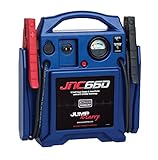
Overview: The Clore JNC660 is a professional-grade, industrial jump starter with heavy-duty cables and a 22Ah battery. Designed for mechanics or fleet use, it focuses on raw power for 12V vehicles without modern extras.
What Makes It Stand Out: Its standout trait is the ultra-durable #2 AWG 46" cables and robust 1700-amp output, ideal for commercial vehicles or repeated shop use. The built-in voltmeter provides clear charge status, and the 22Ah Clore Proformer battery ensures longevity in high-demand settings.
Value for Money: Priced higher than consumer portables, it’s cost-effective for professionals due to its ruggedness and reliability. However, it lacks USB ports, LED lights, or portability—making it poor value for casual drivers seeking multifunctional tools.
Strengths and Weaknesses: Strengths: Exceptional cable durability, reliable jump performance for trucks/SUVs, and simple, repairable design. Weaknesses: Bulky (not portable), no safety extras like reverse polarity protection, and no device charging capabilities.
Bottom Line: A specialist tool for garages or worksites needing dependable, high-amperage jumps. Avoid for personal car use—modern portables offer far more features for everyday emergencies.
10. ANFLAG Car Jump Starter with Air Compressor 160PSI, 7000A Car Battery Jumper Starter Portable 12V Jump Box(All Gas/12L Diesel), Cordless Tire Inlfator, 26800mAh Powerbank, Led Lights, Safety Hammer

Overview: The ANFLAG is an 8-in-1 powerhouse featuring a 7000A jump starter, 160 PSI inflator, 26,800mAh power bank, 600-lumen light, and safety hammer. It targets adventure seekers needing maximum versatility in extreme conditions.
What Makes It Stand Out: Its 7000A peak current (for “all gas” engines) and FORCE START function for dead batteries are exceptional. The turbo 45L/min air compressor inflates tires in 2 minutes (0→30 PSI), while the 99.16Wh battery supports 18W device charging and 1,000+ cycles. V-0 fire resistance and IP65 rating enhance safety.
Value for Money: Premium-priced but justified by unmatched specs: highest amperage here, fastest inflator, largest power bank, and comprehensive toolset. Beats competitors on raw capability, though overkill for city commuters.
Strengths and Weaknesses: Strengths: Blazing-fast jump/inflation, massive capacity, spark-free safety, and 600-lumen light with hammer. Weaknesses: Bulkiest unit here, complex interface may overwhelm beginners, and high price.
Bottom Line: The ultimate all-terrain emergency kit for off-roaders or frequent travelers. If budget allows and you need every feature, it’s unmatched—but consider WOLFBOX or S ZEVZO for simpler, cheaper daily use.
Understanding Older Vehicle Electrical Systems
The Voltage Variable: 6V vs. 12V Systems
Many classic cars produced before the mid-1950s utilized 6-volt electrical systems, a critical factor often overlooked. Modern jump starters are almost exclusively built for 12-volt systems. Attempting to jump-start a 6-volt vehicle with a standard 12-volt device can cause severe damage to lights, the generator, ignition coil, and other components. Always confirm your vehicle’s system voltage before purchasing or using any jump starter; specialized 6-volt capable models or traditional jumper cables with another 6-volt vehicle are the only safe options here.
Sensitivity of Vintage Ignition Components
Older vehicles frequently rely on points-and-condenser ignition systems or early electronic ignitions that are far more sensitive to voltage spikes and electrical noise than modern computer-controlled systems. A jump starter with poor voltage regulation or excessive ripple can easily fry these delicate components, turning a simple jump-start into a costly ignition repair job. Prioritize devices explicitly mentioning compatibility with vintage electronics and stable power delivery.
Weaker Grounding and Corrosion Issues
Decades of exposure take their toll on wiring harnesses, battery terminals, and grounding points. Older vehicles often suffer from increased electrical resistance due to corrosion, loose connections, or degraded wiring. This means the jump starter needs sufficient cranking amps not just to turn the engine, but to overcome this inherent resistance. Features like robust clamps designed to bite through minor corrosion and maintain a solid connection become essential for reliable performance.
Essential Jump Starter Features for Classic Cars
Amperage Requirements vs. Cranking Reality
While peak amperage numbers are heavily marketed, the sustained cranking amps (CA) or marine cranking amps (MCA) rating is far more relevant for older engines, especially those with larger displacements or in cold weather. These engines often require a longer duration of solid cranking power. Look for devices specifying a healthy CA/MCA rating (often 400+ for many classics) rather than being swayed solely by a massive, short-burst peak amp figure that might not translate to real-world starting ability.
Voltage Regulation and Surge Protection
This is non-negotiable for vintage vehicles. A quality jump starter must incorporate advanced voltage regulation circuitry to deliver a stable, clean 12 volts (or 6V if applicable) without dangerous spikes or drops. Built-in reverse polarity protection is also crucial, as it prevents damage if the clamps are accidentally connected backwards – a common stress point when working with older, less clearly marked terminals. Surge protection safeguards the vehicle’s sensitive electronics during the critical connection phase.
Clamp Design and Cable Quality
Flimsy, thin cables and small, weak clamps are a recipe for failure on older vehicles. Thick, flexible copper cables minimize resistance and maximize power transfer. Look for heavy-duty, insulated clamps with strong springs and teeth designed to penetrate terminal corrosion – a frequent issue on batteries that sit for periods. Angled clamps can also be a significant advantage when accessing tight or awkwardly positioned battery terminals common in classic engine bays.
Power Source and Capacity Considerations
Lithium-Ion Versatility vs. Lead-Acid Reliability
Lithium-ion (Li-ion) jump starters dominate the market due to their compact size, lightweight nature, and ability to hold a charge for extended periods. However, traditional lead-acid jump starters, while bulkier and heavier, often provide exceptionally stable voltage delivery and can sometimes offer higher sustained cranking power, which some vintage car enthusiasts prefer for critical reliability. Consider your storage space, weight tolerance, and whether ultimate stability trumps portability for your specific needs.
Capacity (mAh) and Recharge Cycles
Milliamp-hour (mAh) capacity indicates how much total energy the unit stores, influencing how many jump starts it can deliver on a single charge and how long it holds a charge during storage. For older vehicles that might sit unused for weeks, a higher mAh capacity (e.g., 15,000mAh+) ensures the unit remains ready when needed. Also, check the rated number of full recharge cycles; higher-quality Li-ion units often exceed 1000 cycles, providing long-term value.
Cold Cranking Performance
Battery chemistry, especially in Li-ion units, suffers in cold temperatures, reducing available power when you need it most. If you drive your classic in colder climates, prioritize jump starters explicitly rated for cold-cranking performance (e.g., down to 0°F or lower). Some units incorporate thermal management systems to maintain output in the cold, a vital feature for reliable winter starts in an older vehicle.
Safety and Usability Factors
Reverse Polarity Alarms and Protection
A loud, unmistakable alarm that sounds before you attempt to crank the engine is a critical safety net. This immediate feedback prevents the catastrophic damage that reverse connection can cause to vintage electrical systems. Ensure the device has both the alarm and robust circuitry that physically blocks power flow if polarity is reversed, offering double protection against user error.
Spark-Proof Technology
Connecting jump starter clamps to a discharged battery can cause dangerous sparks, posing a fire risk near battery off-gassing (hydrogen) – a more pronounced issue with older lead-acid batteries. Spark-proof technology safely equalizes the voltage between the jump starter and the dead battery before full connection, significantly reducing the chance of a hazardous spark. This feature is particularly important for safety around vintage battery compartments.
Clear Status Indicators and Simplicity
When you’re stranded and stressed, complex interfaces are the enemy. Opt for a jump starter with large, easy-to-read LED indicators showing precise remaining charge levels (not just “low/medium/full”) and clear connection status lights. Simple, intuitive operation – ideally a single button for activation after clamps are connected – minimizes confusion during a stressful situation. Avoid units buried under unnecessary digital displays for core jump-starting functionality.
Practical Usage and Maintenance Tips
Proper Connection Sequence is Paramount
Always connect the jump starter clamps in the correct order: Red (+) clamp to the dead battery’s positive terminal first, then the black (-) clamp to a solid, unpainted metal ground point on the engine block or chassis, away from the battery itself and the fuel system. Never connect the black clamp directly to the dead battery’s negative terminal if possible, as this reduces spark risk near the battery. Reverse the sequence when disconnecting. This procedure is even more critical for older vehicles with potentially compromised battery vents.
Managing Expectations for Weak Batteries
An older battery that is deeply discharged or near the end of its life may not accept a charge effectively from a jump starter. While the jump starter might provide enough power to crank the engine, the weak battery could drain the jump starter too quickly during cranking, preventing a successful start. If the engine cranks slowly or not at all after the first attempt, allow a minute or two for the jump starter to partially recharge the dead battery before trying again. Persistent failure likely indicates a battery needing replacement.
Storage and Charging Protocol
Lithium-ion jump starters should be stored with a partial charge (around 50-70%) in a cool, dry place, not fully depleted or fully saturated. Check the charge level every 3-6 months and top it up if necessary. Avoid leaving them in extreme temperatures, like a hot car trunk in summer. For lead-acid jump starters, maintaining a full charge via a smart maintainer is usually recommended during storage to prevent sulfation. Always follow the manufacturer’s specific storage guidelines for optimal longevity.
Compatibility with Aftermarket Upgrades
Many older vehicles have undergone upgrades, such as alternator conversions (from generator), electronic ignition retrofits, or added modern accessories (radios, fuel pumps). While generally beneficial, these modifications can sometimes alter electrical demands or sensitivities. Ensure your chosen jump starter has sufficient capacity and clean power delivery to handle the actual electrical load of your specific modified vintage setup, not just the original factory specs.
Frequently Asked Questions
How do I know if my classic car has a 6-volt or 12-volt system?
Check the original owner’s manual, the battery itself (6V batteries are typically smaller with 3 cell caps), or the voltage rating on the headlight bulbs. When the engine is off, a 6V system will read approximately 6 volts at the battery terminals, while a 12V system reads around 12 volts. If unsure, consult a specialist familiar with your vehicle’s year and model.
Can a modern 12V jump starter damage my vintage car’s electronics?
Yes, it absolutely can if the jump starter lacks proper voltage regulation and surge protection. Voltage spikes or unstable power delivery can fry sensitive points ignition systems, early electronic ignitions, or even delicate gauges. Always choose a jump starter explicitly designed or certified for use with vintage/classic vehicles.
Why won’t my jump starter crank my older engine even though it has high peak amps?
Peak amps are a very short burst, often less than a second. Older engines, especially larger displacements or those in cold weather, need sustained cranking power (measured in Cranking Amps - CA). Check the CA rating, not just peak amps. Also, weak battery terminals, corrosion, or a failing battery in the car can prevent adequate power transfer.
Are lithium jump starters reliable for long-term storage in a classic car?
Generally, yes, if stored correctly. Store them at around 50-70% charge in a cool, dry place (not a hot trunk). Check the charge level every 3-6 months and recharge if it drops below 20-30%. Quality lithium units hold their charge much better over months than lead-acid units. Avoid storing them fully depleted.
What’s the safest ground point to connect the negative clamp on an old car?
Connect the black (-) clamp to a solid, unpainted metal part of the engine block or chassis, away from the battery itself, the fuel system, and moving parts. Good spots include a clean bolt on the intake manifold or cylinder head. Avoid the carburetor, fuel lines, or painted surfaces. This minimizes spark risk near the battery.
Do I need a special jump starter for a car with electronic ignition?
Not necessarily “special,” but you do need one with excellent voltage regulation and clean power output. Many modern electronic ignition retrofits (like Pertronix) are more robust than points, but poor quality power from a jump starter can still cause issues. Prioritize units known for stable voltage delivery.
Can jump starters recharge an old, dead battery effectively?
Jump starters are designed to provide cranking power, not to fully recharge a deeply discharged battery. They can put enough charge into a weak battery to allow starting, but a dedicated battery charger is required for a full, proper recharge, especially for older batteries that degrade faster.
Why do I get sparks when connecting the jump starter clamps?
Sparks often occur due to a small electrical load (like interior lights) still being active or the jump starter equalizing voltage with the dead battery. Using spark-proof technology minimizes this. Always connect the black clamp to a chassis ground last and away from the battery to direct any potential spark away from hydrogen gas emitted by the battery.
How often should I recharge my stored jump starter?
For lithium-ion units: Check every 3-6 months; recharge if the indicator shows below 20-30%. For lead-acid units: They self-discharge faster; check monthly and keep fully charged using a maintainer if possible. Refer to your specific unit’s manual for optimal storage charging intervals.
Can a jump starter be used on a vehicle with a severely corroded battery?
It’s challenging. Heavy corrosion creates high resistance, blocking power flow. Safely clean the battery terminals and cable ends with a wire brush before attempting a jump start. Jump starter clamps need clean metal contact. Never try to force clamps onto heavily corroded terminals; clean first or seek professional help.
See Also
- Stop Getting Stranded: 10 Best Jump Starters That Solve Dead Battery Emergencies in 2026
- Stop Stranded Starts with the 10 Best Heavy Duty Jump Starters This Year
- Stop Stranded Starts: 10 Best All-in-One Jump Starters This Year
- 10 Best Jump Starters for Older Vehicles with Weak Batteries in 2026
- Stop Stranding Yourself with the 10 Best Jump Starters This Year