Table of Contents
Ever felt that sinking feeling—not from waves, but from your boat’s engine stubbornly refusing to turn over? You’re not alone. For boaters, a dead battery isn’t just an inconvenience; it’s a stranded adventure, a ruined weekend, or worse, a safety hazard miles from shore. The culprit often isn’t the battery itself, but the unsung hero (or villain) we rarely think about until it’s too late: the marine battery charger. Choosing the wrong one can silently degrade your investment, while the right charger acts like a 24/7 guardian, ensuring your power system thrives through salt spray, temperature swings, and seasonal storage. It’s the invisible backbone of reliable time on the water.
Forget the flashy gadgets—true boating confidence starts below deck. A quality marine charger does far more than just “refill” power; it intelligently communicates with your specific battery chemistry, adapts to environmental stressors, and prevents the slow, costly demise of one of your vessel’s most expensive components. Yet, with confusing terminology, misleading specs, and marine-specific dangers lurking in generic products, selecting the perfect match feels overwhelming. This guide cuts through the noise, focusing purely on the principles and features that matter for your unique boating life. We’ll explore how to decode technical jargon, match chargers to real-world demands, and avoid critical pitfalls—so you can focus on the horizon, not a dead battery alert.
Top 10 Marine Battery Chargers
Detailed Product Reviews
1. NOCO Genius GEN5X2: 2-Bank, 10A Onboard Battery Charger - 5A Per Bank, 12V Waterproof Marine Charger with Overcharge Protection & Temperature Compensation – for Lead-Acid & Lithium Batteries
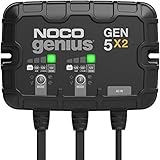
Overview: The NOCO Genius GEN5X2 is a compact, high-performance 2-bank marine battery charger designed for demanding marine environments. It delivers 10A total (5A per bank) to maintain and charge 12V lead-acid (including AGM, Gel) and lithium (LiFePO4) batteries independently. Its rugged, waterproof construction ensures reliable operation onboard vessels. What Makes It Stand Out: Engineered 37% smaller and 43% more powerful than its predecessor, it excels with selectable modes per bank (12V, AGM, Lithium, Repair), precision temperature compensation, and the unique ability to charge batteries as low as 1V—or even from 0V using Force Mode. Its advanced diagnostics and marine-grade sealing are key differentiators. Value for Money: Positioned at a premium price, it justifies cost through superior engineering, NOCO’s trusted reliability, and comprehensive battery support. While cheaper alternatives exist, its compact size, robust build, and deep-discharge recovery offer significant long-term value for serious boaters needing dependable, maintenance-free charging. Strengths and Weaknesses: Strengths: Exceptional build quality; precise multi-chemistry charging; Force Mode for dead batteries; compact size; reliable temperature compensation. Weaknesses: Higher initial cost than generic brands; 5A per bank may be slow for large deep-cycle banks; limited to 2 banks. Bottom Line: An elite 2-bank charger for discerning marine users. Its compact power, versatility across battery types, and dead-battery recovery make it a top investment for boat owners prioritizing reliability and advanced features over budget pricing.
2. Upgraded 3 Bank Marine Battery Charger 10X3, 30A (10A/Bank) - 12V Waterproof Onboard Battery Charger, Battery Maintainer & Desulfator for SLA/AGM, Lithium (LiFePO4), Calcium & Deep-Cycle Battery

Overview: This robust 3-bank charger delivers 30A total (10A per bank) for simultaneous charging of three 12V batteries across lead-acid (SLA/AGM, Calcium) and lithium (LiFePO4) chemistries. Fully IP68 waterproof, it’s designed for permanent marine installation with 24/7 operation capability. What Makes It Stand Out: Its standout feature is high per-bank output (10A), significantly faster than many competitors. Independent mode selection (SLA/AGM, Lithium, Calcium) per bank, combined with auto repair mode, Force Mode for sub-1V batteries, and comprehensive diagnostics (reverse connection, over-temp), provides versatile, hands-off maintenance. Value for Money: Offers exceptional capacity per dollar. The 10A/bank output is ideal for larger marine or RV systems needing rapid charging, surpassing similarly priced units. While lacking NOCO’s brand pedigree, its feature set and robust waterproofing deliver strong value for cost-conscious buyers with multi-battery setups. Strengths and Weaknesses: Strengths: High 10A/bank output; true 3-bank independence; excellent waterproofing; clear diagnostics; Force Mode for dead batteries. Weaknesses: Build quality/longevity may not match premium brands; mode selection less granular than some (e.g., no dedicated “standard lead-acid”); fewer user reviews for validation. Bottom Line: A high-capacity, budget-friendly 3-bank workhorse. Ideal for boats or RVs with three batteries needing fast, reliable charging, especially where cost efficiency and high amperage per bank are critical priorities over brand-name assurance.
3. 2 Bank Marine Battery Charger 5X2, 10A (5A/Bank) - 12V Waterproof Onboard Battery Charger, Battery Maintainer & Desulfator for SLA/AGM, Lithium (LiFePO4), Calcium & Deep-Cycle Battery- Charged 24/7

Overview: This IP68-rated 2-bank charger provides 10A total (5A per bank) for maintaining and charging diverse 12V marine batteries (SLA/AGM, Lithium, Calcium, deep-cycle) continuously onboard. It emphasizes simplicity and all-weather reliability for dual-battery boat systems. What Makes It Stand Out: It features three independent charging modes per bank (SLA/AGM, Lithium, Calcium), automatic repair mode for sulfated batteries, and Force Mode to revive batteries below 1V. Integrated temperature compensation and advanced diagnostics (reverse polarity, over-temp) ensure safe, optimized charging without user intervention. Value for Money: Represents a solid mid-range option. It matches core features of premium chargers (temperature compensation, multi-chemistry support, diagnostics) at a significantly lower price point than NOCO equivalents. The 5A/bank output suits typical starter/deep-cycle marine pairs, offering good value for budget-focused boaters. Strengths and Weaknesses: Strengths: Affordable price; true independent bank control; essential diagnostics; waterproof design; auto repair function. Weaknesses: Lower 5A/bank output may prolong charging for large banks; build quality feels less premium; limited brand recognition/support compared to NOCO. Bottom Line: A capable and economical choice for standard dual-battery marine setups. Delivers essential smart-charging features reliably at an accessible price, making it a sensible pick where budget constraints outweigh the need for ultra-compact design or maximum amperage.
4. NOCO Genius GEN5X3: 3-Bank, 15A Onboard Battery Charger - 5A Per Bank, 12V Waterproof Marine Charger with Overcharge Protection & Temperature Compensation – for Lead-Acid & Lithium Batteries
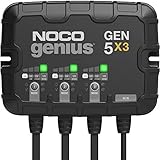
Overview: The NOCO GEN5X3 is a premium 3-bank marine charger delivering 15A total (5A per bank). Engineered for harsh conditions, it charges and maintains 12V lead-acid and lithium batteries independently with advanced safety and precision, building on NOCO’s trusted Genius platform. What Makes It Stand Out: Combining NOCO’s signature compactness (37% smaller than GENM3) with 3-bank versatility, it offers selectable modes per bank (12V, AGM, Lithium, Repair), precise temperature compensation, and industry-leading dead-battery recovery—from 1V or 0V via Force Mode. Its integrated diagnostics and marine sealing are exceptional. Value for Money: Commands a premium price, but justifies it through NOCO’s proven reliability, compact engineering, and comprehensive feature set. For boats with three critical batteries (e.g., starter, house, thruster), the peace of mind, precise charging, and longevity often outweigh the higher cost versus generic 3-bank units. Strengths and Weaknesses: Strengths: Top-tier build and reliability; versatile per-bank mode selection; excellent dead-battery recovery; compact for 3 banks; robust marine certification. Weaknesses: Higher cost than alternatives; 5A/bank output slower than some high-amp competitors; not ideal for very large deep-cycle banks needing >5A. Bottom Line: The definitive premium 3-bank solution for marine applications. If ultimate reliability, brand trust, and precise multi-chemistry charging for three batteries are paramount, the GEN5X3 is a worthy investment despite its price.
5. NOCO GENIUS1: 1A 6V/12V Smart Battery Charger – Automatic Maintainer, Trickle Charger & Desulfator with Overcharge Protection & Temperature Compensation – for Lead-Acid & Lithium Batteries

Overview: The NOCO GENIUS1 is a compact, single-bank smart charger/maintainer designed for 6V or 12V batteries. It serves as a trickle charger, maintainer, and desulfator for lead-acid (flooded, AGM, Gel) and lithium (LiFePO4) batteries, ideal for seasonal storage or infrequently used vehicles. What Makes It Stand Out: Despite its small size (35% smaller than G750), it uniquely handles both 6V and 12V systems with automatic voltage detection. Its genius lies in true “set-and-forget” operation: temperature compensation, desulfation, and the ability to safely remain connected indefinitely while recovering batteries as low as 1V (or 0V via Force Mode). Value for Money: Excellent value for solo battery maintenance. At its price point, it outperforms basic trickle chargers with comprehensive chemistry support, desulfation, and critical safety features. It’s significantly more capable than ultra-cheap float chargers, offering long-term battery health benefits that justify the cost. Strengths and Weaknesses: Strengths: Handles 6V/12V automatically; safe for indefinite connection; effective desulfation; compact and portable; recovers dead batteries. Weaknesses: Only 1A output, too slow for regular charging of larger batteries; single-bank only; not suitable for primary marine charging systems. Bottom Line: The perfect dedicated battery maintainer for motorcycles, classic cars, lawn equipment, or backup batteries. Its safety, versatility across voltages/chemistries, and desulfation make it indispensable for preserving battery life during storage.
6. NOCO Genius GEN5X1: 1-Bank, 5A Onboard Battery Charger - 5A Per Bank, 12V Waterproof Marine Charger with Overcharge Protection & Temperature Compensation – for Lead-Acid & Lithium Batteries
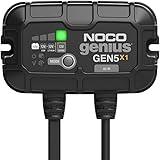
Overview: The NOCO Genius GEN5X1 is a compact, single-bank 5A marine battery charger engineered for harsh environments. It supports 12V lead-acid (flooded, AGM, gel) and lithium-ion batteries, featuring temperature compensation and robust waterproofing (IP65). Its small footprint suits tight marine installations while delivering reliable maintenance. What Makes It Stand Out: Its standout features include 37% reduced size and 43% more power than prior models, selectable charging modes per bank (including lithium and repair), and the ability to revive batteries as low as 0V via Force Mode. The integrated thermal sensor optimizes charging in extreme temperatures, preventing damage from over/under-charging. Value for Money: Priced mid-to-high for a single-bank unit, it justifies cost through durability, advanced lithium compatibility, and NOCO’s proven reliability. While cheaper alternatives lack lithium support or temperature compensation, the GEN5X1’s longevity and precision charging reduce long-term battery replacement costs. Strengths and Weaknesses: Strengths: Exceptional compactness, true 5A output, waterproof design, versatile battery compatibility, and Force Mode for dead batteries. Weaknesses: Single-bank limits multi-battery setups, no LCD display for real-time metrics, and higher cost than basic lead-acid chargers. Bottom Line: Ideal for boaters needing a compact, high-performance single-battery charger with lithium support. Its rugged design and dead-battery recovery make it a top-tier choice despite the premium price, especially for critical marine applications.
7. 3 Bank Marine Battery Charger 5X3, 15A (5A/Bank) - 15A Onboard Charger, 12V Waterproof Boat Battery Charger, Battery Maintainer for SLA/AGM, Lithium, Calcium - Charged 24/7

Overview: This 3-bank 15A charger (5A per bank) offers fully independent charging for three 12V batteries simultaneously. IP68 waterproof and designed for permanent marine installation, it supports lead-acid (SLA/AGM/calcium) and lithium batteries with 24/7 maintenance capability and comprehensive diagnostics. What Makes It Stand Out: Key innovations include triple independent banks with selectable modes (SLA/AGM, Lithium, Calcium), Auto Repair Mode for sulfated batteries, and Force Mode for sub-1V batteries. Its advanced diagnostics (reverse connection, over-temperature alerts) and IP68 submersion rating exceed most competitors in resilience. Value for Money: Positioned as a budget-friendly multi-bank solution, it delivers exceptional value with full lithium support and industrial-grade waterproofing at a lower cost than premium brands like NOCO or ProMariner. The 24/7 charging capability eliminates manual monitoring, saving time and preventing battery degradation. Strengths and Weaknesses: Strengths: True independent bank control, robust IP68 rating, intuitive mode selection, and strong dead-battery recovery. Weaknesses: Basic LED indicators lack detailed data (vs. LCD screens), plastic housing feels less premium, and repair mode effectiveness varies with severe battery damage. Bottom Line: A highly reliable, cost-effective solution for multi-battery boats. Its waterproofing, diagnostics, and lithium compatibility make it perfect for sailors prioritizing durability and versatility without overspending on luxury features.
8. YONHAN Battery Charger 20A 12V/24V LiFePO4 Lead Acid Fully Automatic Battery Maintainer, Car Battery Trickle Charger Automotive w/Repair, Winter Mode, for AGM, STD, Gel, Deep Cycle Batteries

Overview: The YONHAN 20A charger is a versatile 12V/24V automatic maintainer for automotive, marine, and recreational vehicles. It supports LiFePO4, AGM, gel, and flooded batteries with a 7-stage charging process, winter/summer modes, and repair functions for neglected batteries. What Makes It Stand Out: Its dual-voltage capability (12V/24V), large sunlight-readable LCD displaying real-time metrics (voltage, temp, charge %), and specialized winter mode set it apart. The high-efficiency pulse repair technology actively combats sulfation, while smart temperature adaptation prevents winter undercharging. Value for Money: Offers outstanding value as a multi-vehicle solution—competitors rarely combine 20A output, LiFePO4 support, dual voltage, and a detailed LCD at this price. The winter mode justifies cost for seasonal boaters, though its non-permanent connection limits 24/7 marine use. Strengths and Weaknesses: Strengths: Bright LCD interface, effective winter mode, broad battery compatibility, and strong repair functionality. Weaknesses: Not permanently installable (must disconnect post-charge), can’t revive batteries below 0.3V, and lacks true marine waterproofing (IP65 max). Bottom Line: Best for land/vehicle users needing a smart, repair-focused charger with dual-voltage support. Avoid for permanent marine use, but ideal for cars, RVs, and seasonal boat storage where its LCD and winter mode shine.
9. ProMariner 44020 ProSport HD Waterproof Marine Battery Charger, 20 Amp, 2 Bank

Overview: The ProMariner ProSport HD is a heavy-duty 20A dual-bank marine charger with distributed-on-demand technology. Engineered for demanding environments, it delivers 10A per bank (20A total) with microprocessor-controlled charging and an IP67 waterproof rating for permanent onboard installation. What Makes It Stand Out: Its Distributed-On-Demand Technology dynamically allocates unused amps between banks, ensuring optimal charging speed. The tri-surface heat sink prevents overheating during sustained use, while the color-coded LED fuel gauge provides intuitive charge status—superior to basic indicator lights. Value for Money: Premium-priced but justified by ProMariner’s marine-specific engineering. Competitors like NOCO charge more for similar amperage but lack distributed amp allocation. Long-term reliability reduces replacement costs, making it cost-effective for serious boaters despite the higher upfront investment. Strengths and Weaknesses: Strengths: Efficient amp distribution, exceptional thermal management, clear LED diagnostics, and rugged build. Weaknesses: No LCD for detailed data, limited to lead-acid (no native lithium support), and slightly bulkier than compact alternatives. Bottom Line: A top recommendation for dual-battery powerboats needing maximum charging efficiency and durability. Its amp-sharing tech and heat dissipation excel in high-demand scenarios, though lithium users should consider alternatives.
10. 2 Bank Marine Battery Charger, 20A (10A/Bank) 12V IP68 Waterproof LCD Onboard Battery Charger with Overcharge Protection, Battery Maintainer for Lead-Acid, AGM, Gel, LiFePO4, Lithium, Boat, Car, RV

Overview: This 20A dual-bank charger (10A per bank) combines IP68 waterproofing with a full-color LCD screen for real-time monitoring. It supports lead-acid, AGM, gel, and LiFePO4 batteries, featuring 9-stage smart charging and Force Mode for deeply discharged units. What Makes It Stand Out: The vivid LCD display (rare in this segment) shows voltage, current, and battery health dynamically. Its 9-stage charging process includes desulfation for aging batteries, while IP68 submersion capability and Force Mode (for <1V batteries) enhance marine readiness beyond typical chargers. Value for Money: Competitively priced for its feature set—IP68 rating, LCD interface, and LiFePO4 support undercut premium brands. The repair functionality extends battery life, offering long-term savings. Cheaper models lack the screen or true waterproofing, justifying its mid-range cost. Strengths and Weaknesses: Strengths: Excellent LCD visibility, true IP68 rating, versatile battery modes, and effective repair cycle. Weaknesses: LCD may drain power slightly faster than LED-only units, and Force Mode requires manual activation (vs. automatic on some rivals). Bottom Line: The best LCD-equipped option for boaters wanting real-time data and robust waterproofing. Its balance of tech, repair features, and value makes it a standout for dual-battery marine systems.
Understanding Your Marine Power Ecosystem
Before diving into chargers, grasp the foundation: your battery type and usage pattern dictates everything. Marine environments are uniquely harsh, demanding components engineered beyond standard automotive equivalents. Salt air, vibration, moisture, and deep discharges create a perfect storm that generic chargers can’t handle. Choosing a charger isn’t about horsepower; it’s about precision medicine for your specific energy storage.
Why Marine Batteries Differ Radically from Car Batteries
Marine batteries endure deep cycling (draining significantly) during trolling or onboard electronics use, unlike car starters needing short, high bursts. They’re built with thicker plates to resist corrosion and physical damage from constant movement. Crucially, marine batteries often combine starting power (cranking amps) with deep-cycle capability in dual-purpose designs, requiring chargers that accommodate both functions without damage. Automotive chargers lack the nuanced charging profiles needed, often overcharging or undercharging, drastically shortening marine battery life.
Decoding Common Marine Battery Chemistries
Flooded lead-acid batteries are traditional and cost-effective but require regular water level checks and ventilation. Absorbed Glass Mat (AGM) batteries are sealed, vibration-resistant, and charge faster but demand precise voltage limits to avoid damage. Gel batteries, also sealed, are highly sensitive to overcharging and require even stricter voltage control. Lithium-ion (LiFePO4) options are gaining popularity for their lightweight, long cycle life, and rapid charging—but they absolutely require chargers explicitly designed for lithium chemistry. Using a charger not matched to your battery type is a fast track to failure.
Assessing Your Real Power Consumption Needs
How you use your boat defines charger requirements. A weekend cruiser with basic electronics needs less charging capacity than a fishing vessel running multiple large-screen chartplotters, livewells, and trolling motors daily. Calculate your typical daily amp-hour (Ah) draw: add up the current draw (in amps) of all devices multiplied by hours used. This reveals how much capacity your charger must replenish overnight or during generator runtime. Underestimating leads to chronic undercharging; overestimating wastes money and complicates installation.
Critical Charger Specifications Demystified
Moving beyond basic “12V” labels, the devil is in the technical details. These specifications directly impact battery health, charging speed, and system reliability. Ignoring them risks poor performance or dangerous situations. Focus on these non-negotiables before considering brand or price.
Amp Output: Matching Capacity to Demand
A charger’s amp rating (e.g., 10A, 20A, 50A) determines how quickly it can replenish battery capacity. A rough rule: charger amps should be 10-25% of your total battery bank’s amp-hour (Ah) capacity. For a 200Ah bank, a 20A-50A charger is appropriate. Too low (e.g., 5A for 200Ah) means painfully slow recharging, especially after heavy use, leading to sulfation. Too high risks overheating batteries if not properly managed by the charger’s intelligence—more amps aren’t always better without the right control system.
The Non-Negotiable: Multi-Stage Charging Intelligence
Single-stage “trickle” chargers are marine battery killers. True marine chargers use 3-4 distinct stages: Bulk (high current, fast refill), Absorption (holds voltage, maximizes capacity), Float (maintenance voltage, prevents overcharge), and sometimes Equalization (controlled overcharge for flooded batteries only). Advanced chargers add a desulfation stage. This progression ensures batteries reach 100% capacity safely without gassing, overheating, or sulfation—the silent killer of lead-acid batteries. Lithium chargers have entirely different, precise stage requirements.
Voltage Precision and Chemistry Matching
Chargers must deliver exact voltage levels specific to your battery type. AGM typically requires ~14.4V absorption, gel ~14.1V, flooded ~14.4-14.8V, and lithium ~14.2-14.6V (varies by brand). Even 0.2V deviation can cause undercharging (sulfation) or overcharging (dry-out, thermal runaway). The best chargers let you select the battery type or automatically detect chemistry, ensuring voltage profiles are perfectly tailored. Never assume “marine” means universally compatible.
Essential Safety and Durability Features for Marine Use
Your charger lives in a hostile environment. Safety isn’t a feature—it’s a requirement. Saltwater corrosion, flammable hydrogen gas from batteries, and constant vibration demand robust engineering far beyond household chargers. Cutting corners here risks fire, explosion, or catastrophic system failure.
Ignition Protection: Non-Negotiable for Engine Compartments
ABYC (American Boat & Yacht Council) standards mandate ignition-protected chargers for installation within engine rooms or any space where explosive fumes could accumulate. These chargers are sealed to prevent internal sparks from igniting battery gases. Even if mounted elsewhere, ignition protection is a wise safety buffer. Look for explicit “Ignition Protected” or “ABYC A-28” certification—never skip this for below-deck installations.
Waterproofing and Corrosion Resistance
Marine chargers face splashes, humidity, and salt spray. IP65 (splash-proof) or IP67 (temporary immersion) ratings are ideal. Aluminum housings dissipate heat better than plastic and resist corrosion. Internal circuitry should have conformal coating to protect against salt-laden air. Avoid chargers designed solely for “marine use” without explicit waterproofing specs—they often fail quickly in real-world conditions.
Thermal Management and Overload Protection
Continuous operation in hot engine rooms demands excellent thermal design. Look for chargers with temperature sensors that automatically reduce output if overheating occurs. Robust overload, short-circuit, and reverse polarity protection are essential safeguards against wiring errors or component failure. These features prevent fires and protect your entire electrical system.
Installation and Integration Considerations
A perfect charger fails if installed incorrectly. Placement, wiring, and system compatibility are as critical as the unit itself. Poor installation negates even the most advanced technology and creates hazards.
Optimal Mounting Location and Ventilation
Install chargers in well-ventilated, dry areas away from direct engine heat sources but accessible for monitoring. Avoid sealed compartments where heat builds up. Ensure adequate airflow around the unit—check the manufacturer’s minimum clearance specs. Never mount directly above batteries where acid fumes or potential leaks could damage it. Vertical mounting is often preferred for convection cooling.
Correct Wiring Gauge and Circuit Protection
Undersized wiring causes voltage drop, overheating, and fire hazards. Use the charger manufacturer’s specified wire gauge (AWG) based on amperage and cable run length—often thicker than you’d expect. Always include an appropriately sized marine-rated circuit breaker or fuse at the battery source, not just at the charger. This protects the wiring in case of a short. Tinned marine wire resists corrosion far better than standard automotive wire.
Compatibility with Onboard Systems (Inverters, Solar, Generators)
Modern boats often have complex power ecosystems. Ensure your charger integrates seamlessly: Does it automatically switch to float when shore power is lost? Can it communicate with an inverter/charger combo? Will it coexist with solar charge controllers without conflict? Some advanced chargers offer communication ports (like NMEA 2000) for system monitoring. Consider future upgrades—choose a charger that won’t become obsolete with new tech.
Maximizing Battery Life Through Smart Charging Habits
The charger is a tool; your habits determine its effectiveness. Understanding charging cycles, storage protocols, and monitoring techniques transforms your charger from a simple device into a battery longevity powerhouse.
The Dangers of Chronic Undercharging
Failing to fully recharge batteries after each use causes sulfation—hard sulfate crystals form on plates, permanently reducing capacity and lifespan. This is the #1 killer of lead-acid batteries. Ensure your charger’s daily runtime (shore power or generator) is sufficient to complete all charging stages, especially Absorption. Never rely solely on engine alternators for full recharging; they rarely reach the required voltage or duration.
Proper Storage Charging Protocols
Batteries degrade rapidly when stored discharged. For seasonal storage, use a charger with a dedicated “storage” or “maintenance” mode that provides a safe, low float voltage (typically 13.2V-13.6V for lead-acid) to counteract self-discharge without overcharging. Lithium batteries often require storage at 50% charge. Disconnecting batteries isn’t enough—voltage slowly drops, inviting damage. A smart storage charger is essential for offseason preservation.
Monitoring and Diagnostics: Beyond the Green Light
Basic “power/charge/float” LEDs offer minimal insight. Advanced chargers provide detailed status via displays or apps: real-time voltage, current, stage, error codes, and even estimated time to full. This diagnostic capability helps catch developing issues early—like a failing battery cell or poor connections—before they strand you. View diagnostics as preventive maintenance, not just a convenience.
Future-Proofing Your Marine Charging System
Boating technology evolves rapidly. Investing in a charger with scalability and modern features protects your purchase and simplifies future upgrades, avoiding costly replacements down the line.
Scalability for Battery Bank Expansion
Planning to add a second house bank or switch to lithium? Choose a charger with modular capacity (e.g., stackable units) or one rated significantly higher than your current needs (within the 10-25% Ah guideline). Some models allow adding remote battery temperature sensors for multi-bank setups. Avoid being locked into a system that can’t grow with your changing power demands.
Smart Connectivity and Remote Monitoring
Wi-Fi or Bluetooth-enabled chargers let you monitor status and receive alerts via smartphone—critical for checking systems before a weekend trip or diagnosing issues while away from the boat. Integration with broader vessel monitoring systems (VMS) provides a holistic view of your electrical health. While not essential today, connectivity is becoming standard for proactive boat management.
Preparing for Lithium Adoption
Even if you use lead-acid now, lithium adoption is accelerating. Chargers explicitly labeled “lithium-ready” or with selectable lithium profiles offer a smoother transition later. They handle the unique communication (often via CAN bus) and precise voltage requirements lithium batteries demand. This avoids needing a whole new charger when you eventually upgrade your energy storage.
Frequently Asked Questions
Frequently Asked Questions
What’s the biggest mistake boaters make with marine battery chargers?
Assuming any “marine-labeled” charger is suitable. Many lack ignition protection, precise chemistry matching, or adequate waterproofing. Always verify certifications and specs against your specific battery type and installation location.
Can I safely use a regular automotive battery charger on my boat?
Generally, no. Automotive chargers lack marine-specific safety features (ignition protection), often have incorrect voltage profiles for deep-cycle marine batteries, and aren’t built to withstand saltwater corrosion or vibration, posing safety and reliability risks.
How do I know if my charger is properly sized for my battery bank?
Calculate your total battery bank capacity in amp-hours (Ah). Your charger’s amp output should be 10-25% of this Ah rating. For a 300Ah bank, a 30A-75A charger is appropriate. Too small leads to chronic undercharging; too large requires sophisticated control to avoid damage.
Why does my charger stay in “Float” mode and never seem to finish charging?
Float mode is normal maintenance charging after the battery is full. If it never leaves Float after a significant discharge, the charger may be undersized, faulty, or your battery bank is damaged/sulfated and can’t accept a full charge. Check voltage during Bulk stage.
Is it safe to leave a smart marine charger connected indefinitely?
Yes, high-quality multi-stage marine chargers with proper float/maintenance modes are designed for continuous connection. They automatically switch to safe voltage levels to maintain charge without overcharging, which is ideal for seasonal storage or docked boats.
What causes a marine battery charger to overheat?
Common causes include inadequate ventilation around the unit, undersized wiring causing resistance/heat, installation in excessively hot locations (like near engines), attempting to charge a severely sulfated or shorted battery, or a charger operating beyond its duty cycle rating.
Do I need a separate charger for each battery bank on my boat?
Not necessarily. Many modern chargers support multi-bank operation (e.g., 3 banks: engine, house 1, house 2) with independent charging control per bank. Alternatively, use a single-output charger with an external battery management system (BMS) or isolator combiner.
How often should I replace my marine battery charger?
There’s no fixed timeline, but expect 5-10+ years from quality units. Replace if you notice inconsistent charging, excessive heat, error codes you can’t resolve, physical corrosion/damage, or if it lacks critical features needed for new battery tech (like lithium).
Can a marine charger work while the boat’s engine is running?
Yes, but it’s usually unnecessary and inefficient. Engine alternators provide primary charging underway. Shore-power chargers typically activate only when AC power is connected and the engine is off. Some advanced systems intelligently combine sources, but standard chargers don’t run off the engine’s DC system.
What’s the role of a battery temperature sensor, and do I need one?
Temperature sensors adjust charging voltage based on battery heat (voltage needs lower when hot, higher when cold). They’re highly recommended, especially for sealed batteries (AGM/Gel) in varying climates, to maximize lifespan and prevent damage. Most quality chargers support them.
See Also
- We Tested 50 Smart Battery Chargers - Here are the 10 Best for Home Use in 2026
- We Tested 50 Portable Battery Chargers - Here are the 10 Best for Winter Emergencies in 2026
- We Tested 50 Dual Bank Battery Chargers - Here are the 10 Best for RV and Boat Owners in 2026
- We Tested 50 Portable Battery Chargers - Here are the 10 Best for Winter Emergencies
- 10 Essential Marine Battery Chargers Every Boat Owner Needs in 2026