Table of Contents
Ever found yourself stranded with a dead battery after your vehicle sat idle for just a week? You’re not alone. Modern vehicles—packed with complex electronics, infotainment systems, and energy-hungry sensors—drain batteries at an alarming rate, even when parked. This isn’t just an inconvenience; it’s a costly headache that can lead to corrupted computer systems, shortened battery life, and unexpected roadside emergencies. The silent hero in this scenario? A reliable battery maintainer. Forget the old-school “trickle chargers” of yesteryear; today’s smart maintainers are intelligent guardians that preserve your power source through seasonal storage, daily neglect, or even extreme climates.
Think of your battery as the heart of your machine—without consistent, gentle care, it weakens prematurely. A quality maintainer doesn’t just top up charge; it actively monitors voltage, adjusts for temperature fluctuations, and prevents dangerous sulfation buildup that kills batteries. Yet with a flood of options boasting confusing jargon like “pulse technology” or “desulfation modes,” choosing the right one feels overwhelming. This guide cuts through the noise, focusing on what truly matters for your specific needs. Whether you’re reviving a vintage motorcycle, safeguarding a boat through winter, or keeping your daily driver ready for emergencies, we’ll help you invest in a solution that delivers peace of mind for years—not just a quick fix.
Top 10 Battery Maintainers
Detailed Product Reviews
1. NOCO GENIUS1: 1A 6V/12V Smart Battery Charger – Automatic Maintainer, Trickle Charger & Desulfator with Overcharge Protection & Temperature Compensation – for Lead-Acid & Lithium Batteries

Overview:
The NOCO GENIUS1 is a premium compact smart charger designed for 6V/12V lead-acid and lithium (LiFePO4) batteries. It replaces older models like the G750 with 35% more power in a smaller footprint, serving as a charger, maintainer, trickle charger, and desulfator in one unit. Ideal for automotive, marine, and powersport applications, it emphasizes safety and battery longevity.
What Makes It Stand Out:
Its universal compatibility (including lithium) and advanced temperature compensation stand out, adjusting charge rates based on ambient conditions to prevent damage. The ability to revive dead batteries (down to 0V via Force Mode) and indefinite maintenance without overcharging are key differentiators. The rugged build and NOCO’s reputation for reliability further elevate it.
Value for Money:
Priced higher than budget options, it justifies cost through durability, lithium support, and precision engineering. Cheaper alternatives often lack temperature compensation or lithium compatibility, making the GENIUS1 a cost-effective long-term investment for frequent users or critical applications.
Strengths and Weaknesses:
Strengths: Compact yet powerful; exceptional safety features; works with all major battery types; excellent dead-battery recovery; maintenance mode is foolproof. Weaknesses: No display for real-time metrics; premium price may deter casual users; 1A output suits smaller batteries only.
Bottom Line:
A top-tier choice for enthusiasts and professionals needing a versatile, reliable charger. Its lithium support and temperature intelligence make it worth the investment for critical or diverse battery needs, despite the higher cost.
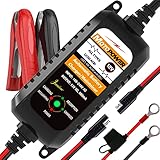
2. MOTOPOWER MP00205A 12V 800mA Automatic Battery Charger, Maintainer, Trickle and Desulfator
Overview:
This budget-friendly 12V charger targets lead-acid batteries (AGM, gel, flooded) as a maintainer, trickle charger, and desulfator. With ETL/UL certification and automatic operation, it’s designed for simplicity and safety in all-weather conditions, suiting cars, motorcycles, or lawn equipment.
What Makes It Stand Out:
ETL safety certification and multi-level protection (reverse polarity, short circuit) provide peace of mind. Its automatic desulfation via pulse technology and 24-hour timer that switches to maintenance mode at 13.6V prevent gassing and extend battery life without user input.
Value for Money:
An affordable entry point for basic maintenance. While less powerful (800mA) and limited to 12V lead-acid, it outperforms ultra-cheap chargers with certified safety and desulfation. Ideal for occasional users prioritizing reliability over advanced features.
Strengths and Weaknesses:
Strengths: Excellent safety certifications; spark-proof connections; zero standby drain; effective desulfation; simple plug-and-play use. Weaknesses: No voltage display; slow 800mA rate; timer limits extended charging; no lithium or 6V support.
Bottom Line:
A solid, safety-focused option for maintaining standard 12V lead-acid batteries. Best for budget-conscious users with infrequently used vehicles, though it lacks versatility for complex needs.
3. [4-Pack]1.75-Amp Car Battery Charger, 6V and 12V Smart Fully Automatic Battery Charger Maintainer, Trickle Charger, Battery Desulfator for Car, Lawn Mower, Motorcycle, Boat, Marine Lead Acid Batteries
![[4-Pack]1.75-Amp Car Battery Charger, 6V and 12V Smart Fully Automatic Battery Charger Maintainer, Trickle Charger, Battery Desulfator for Car, Lawn Mower, Motorcycle, Boat, Marine Lead Acid Batteries](https://m.media-amazon.com/images/I/51rc2qpU9VL._SL160_.jpg)
Overview:
This 4-pack offers compact 1.75A chargers for 6V/12V lead-acid batteries, featuring LCD displays and 7-stage charging. Targeted at multi-vehicle households, it supports cars, boats, and lawn equipment with desulfation, maintenance, and repair modes.
What Makes It Stand Out:
The real-time LCD screen (showing voltage, current, and charge %) and forced 12V mode for low-voltage batteries are rare at this price. Its 7-stage charging program includes specialized desulfation and repair cycles, while dual maintenance modes (STD cutoff or trickle at 12.5V) enhance flexibility.
Value for Money:
The 4-pack delivers exceptional value for multi-battery setups. Though limited to lead-acid (no lithium), the LCD screen and repair tech surpass comparable single-unit chargers. Great for families managing multiple seasonal vehicles.
Strengths and Weaknesses:
Strengths: Clear LCD interface; versatile 7-stage charging; forced 12V mode; comprehensive safety protections; 4-pack convenience. Weaknesses: Trickle voltage (12.5V) may be low for some AGM batteries; no lithium support; repair mode effectiveness varies.
Bottom Line:
A practical, feature-rich solution for households with several lead-acid batteries. The LCD display and multi-pack value make it a smart buy, though lithium users should look elsewhere.
4. 2-Pack Smart Fully Automatic 6V 12V Battery Charger Maintainer for Car, Marine, Motorcycle, Lawn Mower

Overview:
Identical to Product 3 but sold as a 2-pack, this charger shares the same 1.75A output, LCD screen, and 7-stage charging for 6V/12V lead-acid batteries. It’s optimized for cars, boats, and powersports, with identical repair technology and safety features.
What Makes It Stand Out:
Like Product 3, its standout features are the real-time LCD metrics and pulse-based battery repair. The maintenance mode holds at 13.6V (vs. Product 3’s 12.5V), better preserving AGM/gel batteries. The forced 12V mode and detachable connectors add versatility.
Value for Money:
Slightly better value per unit than Product 3 for those needing two chargers. The 13.6V maintenance voltage is more battery-friendly than Product 3’s 12.5V setting, justifying a preference for AGM users. Still unmatched for multi-vehicle budgets.
Strengths and Weaknesses:
Strengths: Informative LCD display; optimized 13.6V maintenance; robust 7-stage charging; dual-mode operation; strong safety suite. Weaknesses: Lead-acid only; repair mode not guaranteed; identical build quality concerns as Product 3.
Bottom Line:
The ideal pick for AGM/gel battery owners needing two units. The higher maintenance voltage and LCD clarity make it a slight upgrade over Product 3 for modern batteries.
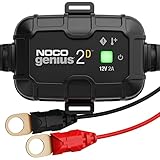
5. NOCO GENIUS2D: 2A 12V Smart Onboard Battery Charger - Direct-Mount Automatic Maintainer, Trickle Charger & Desulfator with Overcharge Protection & Temperature Compensation – for Lead-Acid Batteries
Overview:
The GENIUS2D is a direct-mount charger designed for permanent under-hood installation on 12V lead-acid batteries (AGM, gel, flooded). It functions as a maintainer and desulfator with NOCO’s signature precision, targeting marine, RV, and classic car applications.
What Makes It Stand Out:
Its snap-fit direct-mount design eliminates portable hassles, while temperature compensation ensures optimal charging in varying climates. The 2A output (vs. GENIUS1’s 1A) speeds up recovery for larger batteries, and Force Mode revives dead cells down to 0V.
Value for Money:
Pricier than portable options but invaluable for vehicles stored long-term. The permanent installation saves effort versus reattaching clamps, and NOCO’s reliability reduces replacement costs. Justifies expense for RV/marine users prioritizing convenience.
Strengths and Weaknesses:
Strengths: Seamless permanent installation; robust 2A output; excellent temperature compensation; strong dead-battery recovery; compact for under-hood use. Weaknesses: Lead-acid only (no lithium); no display; single-battery focus; installation required.
Bottom Line:
A must-have for RV or boat owners seeking hassle-free, continuous battery care. Its direct-mount convenience and NOCO’s engineering make it a premium solution for dedicated applications.
6. 12v 2A Battery Charger, Trickle Charger for Lawn Mower Battery, Motorcycle, car, Boat, ATVs, Riding andMore -2000mA Battery Maintainer and Desulfator withIntelligent Interface

Overview:
This 12V 2A charger targets riders and outdoor equipment owners needing reliable battery maintenance. It handles lead-acid batteries across motorcycles, lawn mowers, boats, and ATVs, emphasizing safety and basic restoration for sulfated batteries. Designed purely as a maintainer (not a jump starter), it suits seasonal or infrequent vehicle use.
What Makes It Stand Out:
Its broad compatibility with flooded, AGM, and gel batteries stands out, alongside robust safety features like reverse polarity and over-voltage protection. The ABS flame-retardant casing adds durability, while LED indicators simplify monitoring. The integrated desulfation mode helps revive weakened batteries, a feature often missing in budget models.
Value for Money:
Positioned affordably, it delivers essential trickle-charging and desulfation at a lower cost than premium brands. While lacking advanced tech like temperature compensation, it covers core needs for casual users maintaining smaller batteries (e.g., lawn equipment), making it a practical entry-level choice.
Strengths and Weaknesses:
Strengths: Wide battery compatibility; comprehensive safety protections; effective desulfation; clear LED status. Weaknesses: Limited to 2A (slower for larger batteries); no lithium support; basic interface without smart features like automatic climate adjustment; no warranty details specified.
Bottom Line:
Ideal for budget-conscious users with small 12V lead-acid batteries, this charger offers solid safety and desulfation at a fair price. Avoid for large vehicles or lithium batteries, but it’s a reliable maintainer for mowers or motorcycles.
7. MOTOPOWER MP00205A 12V 800mA Automatic Battery Charger, Battery Maintainer, Trickle Charger, and Battery Desulfator, 2 Pack

Overview:
This dual-pack 12V 800mA charger combo serves as a maintainer, trickle charger, and desulfator for lead-acid batteries. Certified to ETL/UL standards, it prioritizes safety and automation, targeting riders, boaters, and car owners needing hassle-free maintenance for AGM, gel, or flooded batteries.
What Makes It Stand Out:
The 2-pack value and automatic desulfation via pulse technology are key highlights. ETL certification ensures rigorous safety compliance, while spark-proof connections and a 24-hour timer enhance reliability. Zero standby drain prevents battery drain when idle, a rare efficiency feature in this segment.
Value for Money:
Offering two units at a mid-range price, it’s exceptional value for multi-vehicle households. The ETL certification and automated desulfation justify the cost versus uncertified single units, though the 800mA rate limits speed for larger batteries compared to 1.5A+ models.
Strengths and Weaknesses:
Strengths: Dual-pack convenience; ETL safety certification; true “set-and-forget” desulfation; zero standby drain; spark-proof operation. Weaknesses: Lower 800mA output (slower charging); no lithium support; timer may interrupt desulfation prematurely; limited voltage range (12V only).
Bottom Line:
A top pick for owners with multiple vehicles seeking certified safety and effortless maintenance. The dual-pack saves long-term costs, though high-amperage needs may require supplementation.
8. Schumacher Electric 1.5A Car Battery Charger and Maintainer, 3-in-1 Solution, for 6V/12V Power Sport, Automotive, and Marine Batteries, SC1355

Overview:
Schumacher’s SC1355 is a versatile 1.5A charger/maintainer/reconditioner for 6V and 12V lead-acid batteries. Targeting automotive, marine, and powersport users, it combines immediate charging with smart maintenance to extend battery life across diverse vehicle types.
What Makes It Stand Out:
The true 3-in-1 functionality (charge/maintain/recondition) is rare at this price. Its broad compatibility—covering standard, AGM, and deep-cycle batteries for gas/diesel vehicles—sets it apart. The dedicated desulfation mode actively restores battery health, unlike basic trickle chargers.
Value for Money:
Competitively priced for a multi-voltage (6V/12V) unit with reconditioning, it outperforms single-mode chargers. While not the cheapest, its durability and versatility offer strong ROI for users with varied battery needs, undercutting premium smart chargers.
Strengths and Weaknesses:
Strengths: Genuine 3-in-1 capability; 6V/12V flexibility; robust desulfation; handles deep-cycle batteries; compact design. Weaknesses: No lithium support; lacks advanced safety certifications (e.g., ETL); basic LED indicators; slower than 2A+ chargers.
Bottom Line:
An excellent all-rounder for garage owners with mixed battery types. Its reconditioning focus and voltage versatility deliver standout utility for the price, though lithium users should look elsewhere.
9. NOCO GENIUS2: 2A 6V/12V Smart Battery Charger – Automatic Maintainer, Trickle Charger & Desulfator with Overcharge Protection & Temperature Compensation – for Lead-Acid & Lithium Batteries

Overview:
NOCO’s GENIUS2 is a premium 2A smart charger supporting both lead-acid and lithium-ion batteries. Engineered for precision, it features climate-aware charging and zero-volt recovery, targeting enthusiasts with high-end vehicles, marine, or off-road applications.
What Makes It Stand Out:
Lithium compatibility and “Force Mode” (recharging dead 0V batteries) are game-changers. Temperature compensation optimizes charging in extreme climates, while 24-hour reconditioning cycles maintain peak health. Its compact size belies advanced engineering.
Value for Money:
Priced higher than lead-acid-only models, it justifies cost with lithium support and cutting-edge tech. For users with lithium batteries or harsh climates, it’s cost-effective versus buying separate chargers. Long-term battery preservation also reduces replacement costs.
Strengths and Weaknesses:
Strengths: Lithium-ion compatibility; Force Mode for dead batteries; dynamic temperature adjustment; ultra-compact; 24h auto-reconditioning. Weaknesses: Premium price; no 6V charging; limited cable length; overkill for basic lead-acid maintenance.
Bottom Line:
The definitive choice for lithium battery owners or those in extreme climates. Its innovation and versatility warrant the investment for serious users, though casual riders may prefer simpler options.
10. Battery Tender Plus 12V 1.25 AMP Car & Motorcycle Battery Charger and Maintainer, Float Charge for Automotive, and ATVs - Smarter Than a Trickle Charger

Overview:
The Battery Tender Plus is a 1.25A maintainer using adaptive 4-step charging for 12V lead-acid batteries. Aimed at automotive and powersport owners, it emphasizes effortless maintenance with smart monitoring and a decade-long warranty.
What Makes It Stand Out:
The industry-leading 10-year warranty and fused quick-disconnect harness simplify long-term use. Its 4-step charging program (including reconditioning) and automatic load-responsive restart outperform basic trickle chargers. Dual-LED status provides clear diagnostics.
Value for Money:
Mid-priced with exceptional longevity support, the warranty alone adds value. Compared to uncertified chargers, its reliability reduces replacement costs. The included terminal clips and harness enhance usability, making it a cost-efficient “buy it for life” solution.
Strengths and Weaknesses:
Strengths: 10-year warranty; adaptive 4-step charging; quick-disconnect harness; load-responsive restart; solid build quality. Weaknesses: 1.25A rate is slower than competitors; no lithium or 6V support; desulfation less aggressive than dedicated units.
Bottom Line:
A superb low-maintenance solution for 12V lead-acid batteries, especially for infrequently used vehicles. The warranty and ease of use make it a trustworthy investment, though speed-focused users may seek alternatives.
Understanding Battery Maintainers
What Exactly Is a Battery Maintainer?
Unlike basic chargers that dump power until full, a maintainer is a precision device designed for long-term connection. It delivers a low, steady current to counteract natural discharge while constantly analyzing battery health. Think of it as a “smart guardian” that switches between charging, conditioning, and maintenance modes—ensuring your battery stays at 100% readiness without overcharging or damage. This is critical for modern AGM, gel, or lithium batteries that can’t tolerate voltage spikes.
How Maintainers Differ from Traditional Chargers
Chargers are for emergencies—they force energy into a depleted battery quickly but lack finesse for ongoing care. Maintainers operate at a fraction of the amperage (typically 0.5A–2A), mimicking the vehicle’s own charging system. Crucially, they feature multi-stage logic: bulk charging when voltage is low, absorption to stabilize, then a “float” phase that trickles just enough to offset self-discharge. Using a charger as a maintainer risks boiling electrolytes or warping plates—a costly mistake.
The Critical Role of Voltage Regulation
Precision voltage control separates competent maintainers from dangerous gimmicks. Lead-acid batteries need 13.2V–13.8V for float maintenance, while AGM types require 13.5V–13.8V. Lithium variants often demand 13.6V. A maintainer must auto-detect chemistry and adjust accordingly. Units without this risk undercharging (causing sulfation) or overcharging (venting hazardous gases). Always verify voltage ranges match your battery type—this isn’t marketing fluff; it’s electrochemical necessity.
Essential Features to Prioritize
Amperage: Matching Output to Your Battery Size
Amperage determines how quickly a maintainer can recover a deeply discharged battery, but it’s irrelevant for maintenance mode. For most cars (50–70Ah), 1A–2A suffices. Larger RVs or marine batteries (100Ah+) benefit from 2A–5A for faster recovery. Never exceed 10% of your battery’s amp-hour rating during bulk charging—e.g., a 60Ah battery maxes at 6A. Higher amperage isn’t “better”; it’s about suitability.
Smart Safety Protocols You Can’t Skip
Look for automatic safeguards: reverse polarity protection (prevents sparks if clamps touch wrong terminals), short-circuit blocking, and thermal shutdown. These aren’t optional extras—they’re legal requirements in many regions. Units with spark-proof connections are non-negotiable for garage use near flammable vapors. If a maintainer lacks these, discard it immediately; safety outweighs cost savings.
Weather and Environmental Resilience
If storing outdoors or in a damp garage, prioritize an IP65+ rating. This seals against dust and low-pressure water jets—critical for marine or seasonal equipment. Avoid plastic housings that crack below freezing; metal-cased units handle -4°F better. Also, check operating temperature ranges: cheap models fail below 32°F, leaving batteries vulnerable in winter.
Portability and Cable Management
Long cables (6+ feet) prevent strain on terminals during storage. Braided, tangle-resistant leads last longer than stiff rubber cords. Compact designs with built-in hooks or mounting slots simplify garage organization. For RVs or boats, consider magnetic bases or adhesive mounts—every inch of space counts when storing multiple vehicles.
Matching Technology to Your Use Case
Automotive Storage: Preventing “Parasitic Drain” Damage
Modern cars drain 50–80mA daily through computers and alarms. A maintainer with micro-amp monitoring (<0.1A float current) counters this without stressing sensitive electronics. Avoid units that pulse aggressively—this can trigger alarm systems. Opt for “maintenance mode only” settings if your vehicle has complex CAN-bus networks.
Marine Applications: Fighting Humidity and Vibration
Salt air corrodes terminals, and engine vibration loosens connections. Choose maintainers with tinned copper cables (resists corrosion) and ruggedized clamps. Water-resistant connectors prevent shorts during rough seas. Crucially, ensure compatibility with dual-battery systems—many boats need independent monitoring for engine/house banks.
Powersport Vehicles: Handling Small, Sensitive Batteries
ATVs, motorcycles, and lawnmowers use compact batteries (often 12–20Ah) that fry with excessive current. Select maintainers with 0.5A–1A output and “small battery” modes. Pulse desulfation is useful here but verify it’s auto-adjusting—manual settings risk damaging sealed units. Magnetic mounts keep cables clear of moving parts.
RV and Trailer Longevity: Combating Extended Dormancy
RVs suffer from dual issues: 12V house battery drain and 120V shore-power dependency. A maintainer with dual outputs (engine + house batteries) is ideal. Ensure it tolerates voltage drops from long cable runs—some units compensate for resistance, maintaining accuracy even with 20-foot leads.
Solar Integration: Synergy with Renewable Systems
Off-grid setups need maintainers that sync with solar controllers. Look for “solar-ready” modes that pause when solar input exceeds maintenance needs. Compatibility with 24V/48V systems matters for larger arrays—don’t assume 12V-only units suffice. Some advanced models even report data to home energy monitors.
Advanced Technical Considerations
Battery Chemistry Compatibility Deep Dive
AGM batteries demand strict voltage control (over 14.4V causes dry-out), while flooded lead-acid tolerate wider ranges but need venting checks. Lithium (LiFePO4) requires specialized algorithms—most “universal” maintainers fail here. Verify explicit support for your chemistry; guessing voids warranties and risks fires.
Float Mode Precision: The Lifespan Multiplier
A true float mode holds voltage within ±0.1V of the ideal setpoint. Cheaper units drift, causing chronic under/overcharging. Test this by monitoring voltage over 72 hours: fluctuations >0.3V indicate poor regulation. This single feature can double your battery’s service life.
Diagnostics and User Feedback Clarity
Avoid cryptic LED codes (e.g., “blinking red 3 times”). Prioritize maintainers with color-coded status displays: green = healthy, yellow = recovering, red = fault. Advanced units show real-time voltage or state-of-charge percentages—vital for diagnosing underlying issues like parasitic drains.
Cable Quality: The Hidden Failure Point
Copper purity matters: 99.9% OFC (oxygen-free copper) conducts better than copper-clad aluminum, which overheats. Gauge should be 16AWG or thicker for runs over 5 feet. Insulation must resist oil, UV rays, and abrasion—marine-grade TPE outlasts standard PVC by years. Never settle for flimsy test leads.
Smart Buying Strategies
Budgeting for Long-Term Value
Skip $15 specials—they lack safety features and die in 12 months. Invest $40–$80 for commercial-grade reliability. Calculate cost-per-year: a $60 maintainer lasting 5 years ($12/year) beats a $25 unit replaced annually ($25/year). Factor in battery replacement costs too; one saved $200 battery justifies the premium.
Decoding Marketing Hype vs. Real Innovation
“Pulse technology” sounds impressive but is often redundant for healthy AGM batteries. Focus on proven features: temperature compensation, auto-recovery from deep discharge, and certified safety marks (CE, UL, RoHS). Ignore “AI-powered” claims without third-party validation—real innovation is boring engineering.
Purchasing Safely: Avoiding Counterfeits
Buy from authorized dealers, not random Amazon sellers. Counterfeit units frequently omit internal fuses or use substandard transformers. Check packaging for model numbers matching the manufacturer’s site. When in doubt, pay extra for direct-from-brand purchases—your battery’s safety isn’t worth gambling on knockoffs.
Frequently Asked Questions
What’s the difference between a maintainer and a trickle charger?
Maintainers use smart multi-stage technology to safely preserve batteries long-term, while trickle chargers deliver unregulated low current that can overcharge and damage modern batteries.
Can I leave a maintainer connected indefinitely?
Yes—if it’s a true smart maintainer with auto-sensing and float mode. Non-smart units risk overcharging, so verify “continuous use” capability in the manual.
Do maintainers work on lithium batteries?
Only if explicitly designed for them. Lithium (LiFePO4) requires different voltage profiles; using a standard maintainer may cause fire hazards. Check compatibility labels carefully.
Why does my maintainer show “fault” when connected?
Common causes include reversed clamps, corroded terminals, or a dead battery below 5V. Clean terminals, ensure correct polarity, and test battery voltage first.
How often should I check a maintained battery?
With a quality maintainer, quarterly visual checks suffice—look for swelling, leaks, or loose cables. The device handles daily monitoring.
Can extreme cold damage a connected maintainer?
Below -4°F, most units shut down to protect components. Use a maintainer rated for your climate; some marine models operate to -22°F.
Will a maintainer prevent sulfation?
Yes—by keeping voltage above 12.4V, it stops lead sulfate crystals from hardening. Units with desulfation modes can even reverse early-stage sulfation.
Do I need to disconnect the battery for maintenance?
No—maintainers are designed for in-vehicle use. Disconnecting negates protection against parasitic drain from vehicle electronics.
Can one maintainer handle multiple batteries?
Only if it has independent channels (e.g., dual outputs). Daisy-chaining batteries risks uneven charging; use a unit rated for parallel systems.
How long does recovery take from a deeply discharged battery?
At 1A, a 50% depleted 60Ah battery takes 30+ hours. Higher amperage speeds this up, but never exceed safe bulk-charge rates for your battery type.
See Also
- 10 Top-Rated Battery Testers According to Automotive Experts in 2026
- 10 Top-Rated Car Battery Chargers According to Automotive Experts in 2026
- 10 Top-Rated Battery Testers According to Experts in 2026
- 10 Top-Rated Trickle Chargers According to Experts in 2026
- 10 Top-Rated Jump Starters According to Automotive Experts in 2026